
Meta Superintelligence Labs Releases Muse Voice Transcribe: One Real-Time Model for Streaming ASR, Diarization, and Endpointing
MarkTechPost Michal Sutter ● Covered by 7 sources
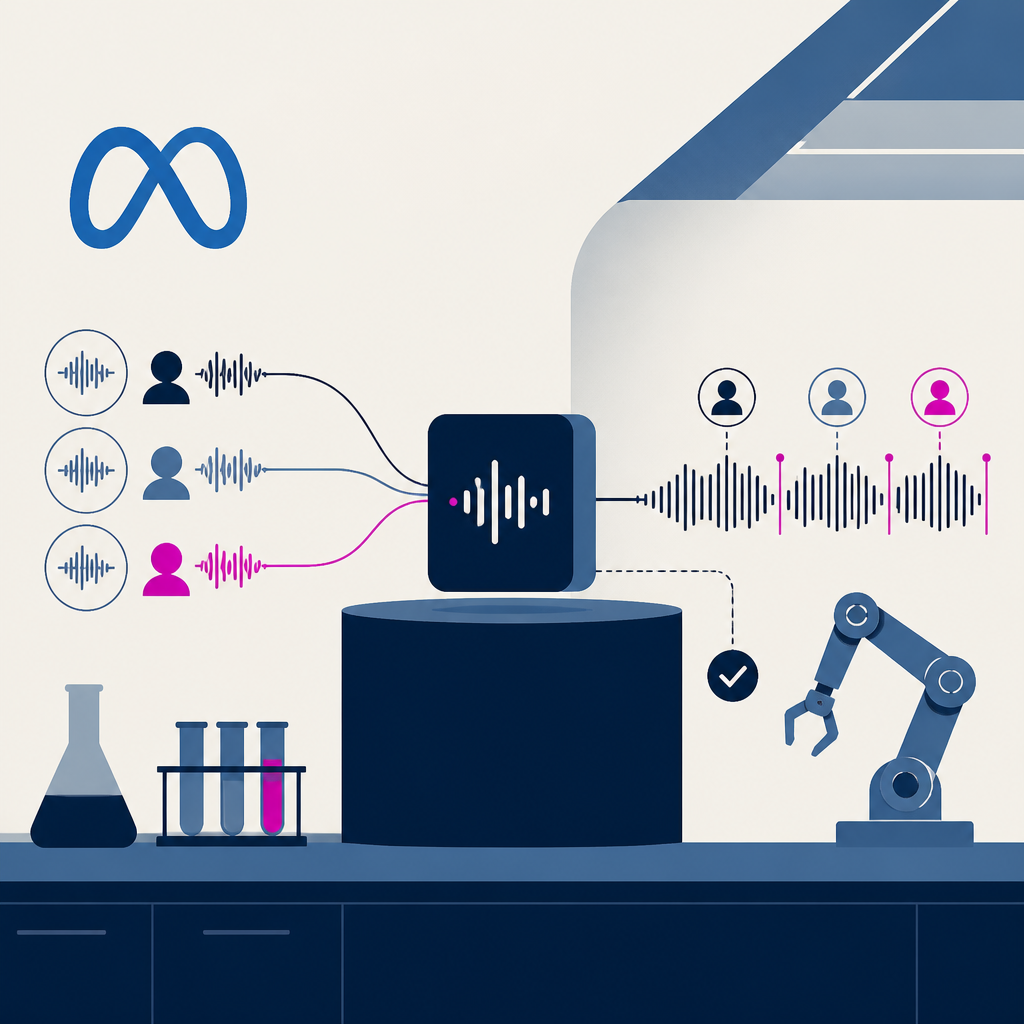
Meta rolled one voice model that can transcribe, tag speakers, and spot when people stop talking. It’s live as a hosted API, and Meta says it beats older stacks on speed, accuracy, and price.
Based on reporting by MarkTechPost, Michal Sutter — read the original for the full story.
Summary, retelling and take written by AI under human oversight; images are AI-generated illustrations. How we work · Report an error
Meta Superintelligence Labs has put out Muse Voice Transcribe, a single model built to do what production voice systems usually split into three jobs. It handles streaming speech-to-text, speaker diarization, and endpointing in one pass, which means fewer hand-offs and fewer places for latency to creep in. Meta says it is its first real-time audio perception model.
The model is live now, but only through Meta’s hosted API. It appears there as muse-voice-transcribe-1.0 and costs $3.00 per 1,000 audio minutes, or $0.18 per hour. Meta says the model already powers dictation in Meta AI for Mac and Muse Code. There are no released weights, so self-hosting is off the table for now.
Under the hood, Muse Voice Transcribe is an autoregressive multimodal model from the Muse Spark family. Audio comes in 80ms chunks at 12.5 Hz. For each chunk, the model either asks for the next chunk or emits text. That design keeps listening and writing inside the same decoder loop, with no separate alignment stage to drift. When the stream ends, it flushes the remaining text instead of waiting for more audio.
Meta also trained the model to choose its own delay. Longer delay gives the system more audio context and usually better accuracy, but it also adds latency. Reinforcement learning pushes on both word error rate and delay, so the model can vary that trade-off word by word. Meta says that puts it on the Pareto front for speed versus accuracy, ahead of the previous frontier it formed from Soniox, Cartesia, and ElevenLabs systems.
The diarization and endpointing pieces are folded into the same token stream too. Special tokens mark speaker switches, identify speakers, and flag speech onset and speech endpoint. Meta says the model was trained on 70+ languages, with 25 extensively verified at launch, and that it can handle code-switching inside a sentence or between sentences. It also natively supports audio longer than one hour and 20+ speakers, again without post-processing.
On Meta’s charts, the numbers are solid. As of September 1, 2026, Meta says the model ranks first on Artificial Analysis for streaming speech-to-text and on public diarization benchmarks. It posts 3.1% final-transcript WER at 0.16 seconds after end of speech, and 17.5% average diarization error rate across AMI-IHM, AMI-SDM, and VoxConverse. The pricing is part of the pitch too: Meta says it undercuts Cartesia Ink-2 at $4.00, and is less than half the $6.50 charged by ElevenLabs Scribe v2 Realtime and Deepgram Flux.
My take — AI-written commentary, not fact-checked reporting
This is the right kind of “one model” story: fewer moving parts, fewer excuses, and a price that undercuts the usual premium voice crowd. The awkward part is the usual Meta ending — neat demo, hosted API only, no weights, so everyone else gets to applaud from the curb. Open models still do the work; closed ones just invoice it.
Read more about this at: MarkTechPost
Related stories
 Meta’s Play for Coding Data, Google Robotics Multi-Embodiment, MiniMax’s Open Video Model (With an Asterisk)
The Batch ·
39
Meta’s Play for Coding Data, Google Robotics Multi-Embodiment, MiniMax’s Open Video Model (With an Asterisk)
The Batch ·
39