
Liquid AI Releases LFM3: 6 Open-Weight 2B-Class Multimodal Models
MarkTechPost Asif Razzaq ● Covered by 3 sources
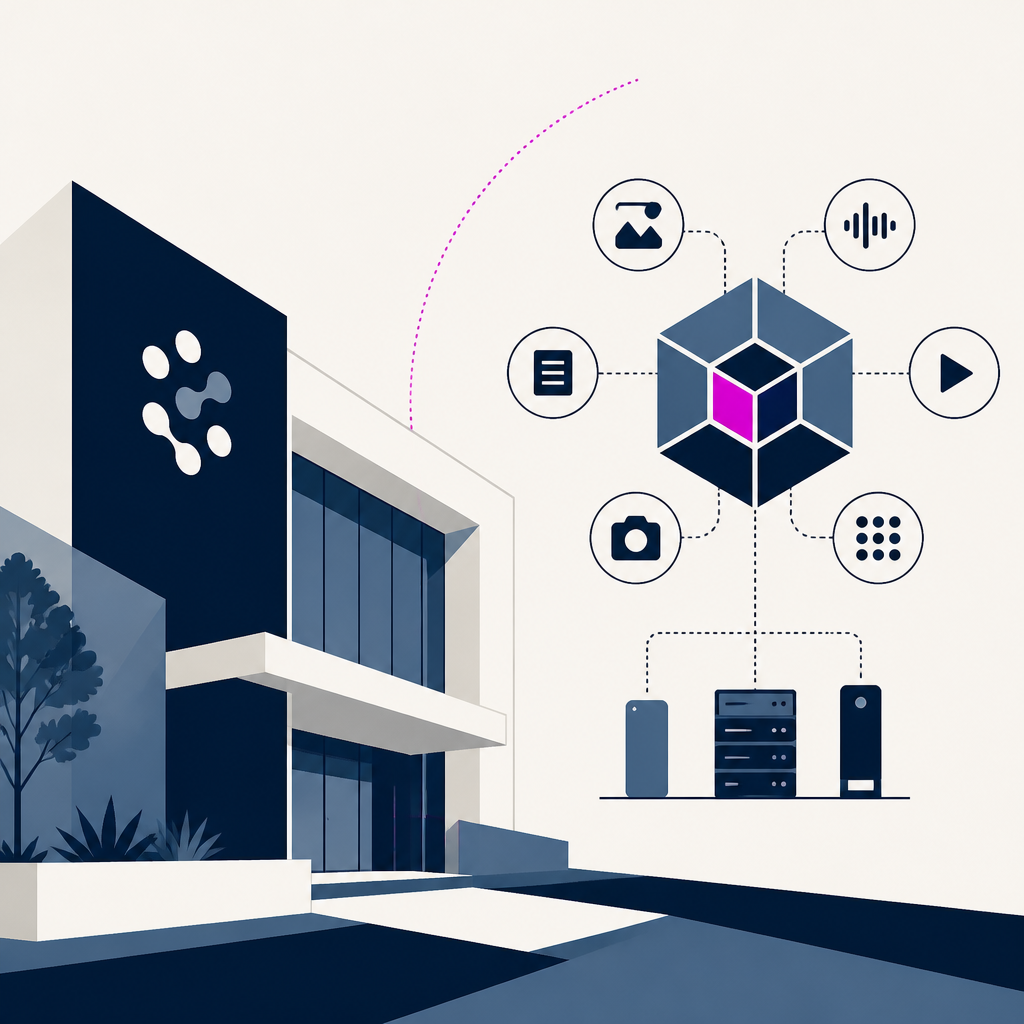
Liquid AI released LFM3, a 6-model open-weight family built on one backbone. It’s small enough for phones and still reaches 256K context.
Based on reporting by MarkTechPost, Asif Razzaq — read the original for the full story.
Summary, retelling and take written by AI under human oversight; images are AI-generated illustrations. How we work · Report an error
Liquid AI has rolled out LFM3, a new family of six open-weight models built on a single backbone. The lineup spans text, vision, audio, omni and decision tasks, and the company says each model can be fine-tuned on one GPU before being pushed to phones, laptops, private servers or the cloud.
The headline number is the size. LFM3-1.7B has 1.73 billion parameters and a 256K context window. LFM3-VL-2B comes in at 1.92 billion parameters with 128K context, while LFM3-Omni-2B reaches 2.2 billion. Liquid AI says the family can run in about 1 GB of memory at 4-bit quantization, which is the kind of footprint that makes on-device use more than marketing copy.
The architecture is the interesting part. Liquid AI says the backbone mixes 13 gated short convolutions, five sliding-window attention layers and six global attention layers across 24 layers. The company found that mix through hardware-in-the-loop architecture search, and it tuned LFM3 across 14 device and backend combinations, including a Raspberry Pi 5 and Qualcomm’s Hexagon NPU. The base model saw 22T tokens, with the last 3.5T tokens used in agent-heavy mid-training that also extended context to 256K.
Post-training came in four stages: supervised fine-tuning on 1.75T tokens, mixed reinforcement learning, distillation from six specialist teachers into one model, and then agentic RL. Liquid AI says that setup helps LFM3-1.7B average 49.37 across 29 benchmarks, ahead of Qwen3.5-9B’s 47.24 in its own evaluation. The model does especially well on agent-style tests such as WebArena-Verified and BFCL V4, but it still trails bigger rivals on knowledge-heavy work and agentic coding.
The rest of the family fills in the gaps. LFM3-VL-2B handles video input sampled at 2 fps, LFM3-Audio-2B covers speech in and out across 18 languages with tool calling, and LFM3-Omni-2B can answer in text or speech. Liquid AI also says d1-2B and d1-Omni-2B answer many questions in one forward pass, and that d1-2B improves Decision Bench while using a third fewer parameters than d1-3B. The weights ship through Hugging Face, the Liquid AI Playground and the company’s API, with GGUF, MLX, ONNX, FP8 and NVFP4 checkpoints in the mix.
My take — AI-written commentary, not fact-checked reporting
This is the part of AI that actually matters: smaller models that fit on real hardware and still do useful work. The industry loves giant demos; users love things that run without renting a datacenter. Liquid AI is betting on efficiency over swagger, and that’s the saner bet by far.
Read more about this at: MarkTechPost
Related stories
 Liquid AI Releases LFM2.5-2.6B: An On-Device Agentic Model With 128K Context, Tool Calling, And Open Weights
MarkTechPost · 2 months ago ·
50
 Liquid AI Releases LFM2.5-24B-A2B: A 2B-Active MoE for On-Device Agents
MarkTechPost · 2 weeks ago ·
35
 Liquid AI Releases LFM2.5-VL-3B: A 3B Vision-Language Model That Reads Screens, Grounds Objects, and Calls Tools On-Device
MarkTechPost · 2 months ago ·
26