Learning to communicate
OpenAI
OpenAI got simple AI agents to invent their own language just to finish tasks together. Nobody wrote the words - reward signals did, and the result isn't remotely human-readable.
Based on reporting by OpenAI — read the original for the full story.
Summary, retelling and take written by AI under human oversight; images are AI-generated illustrations. How we work · Report an error
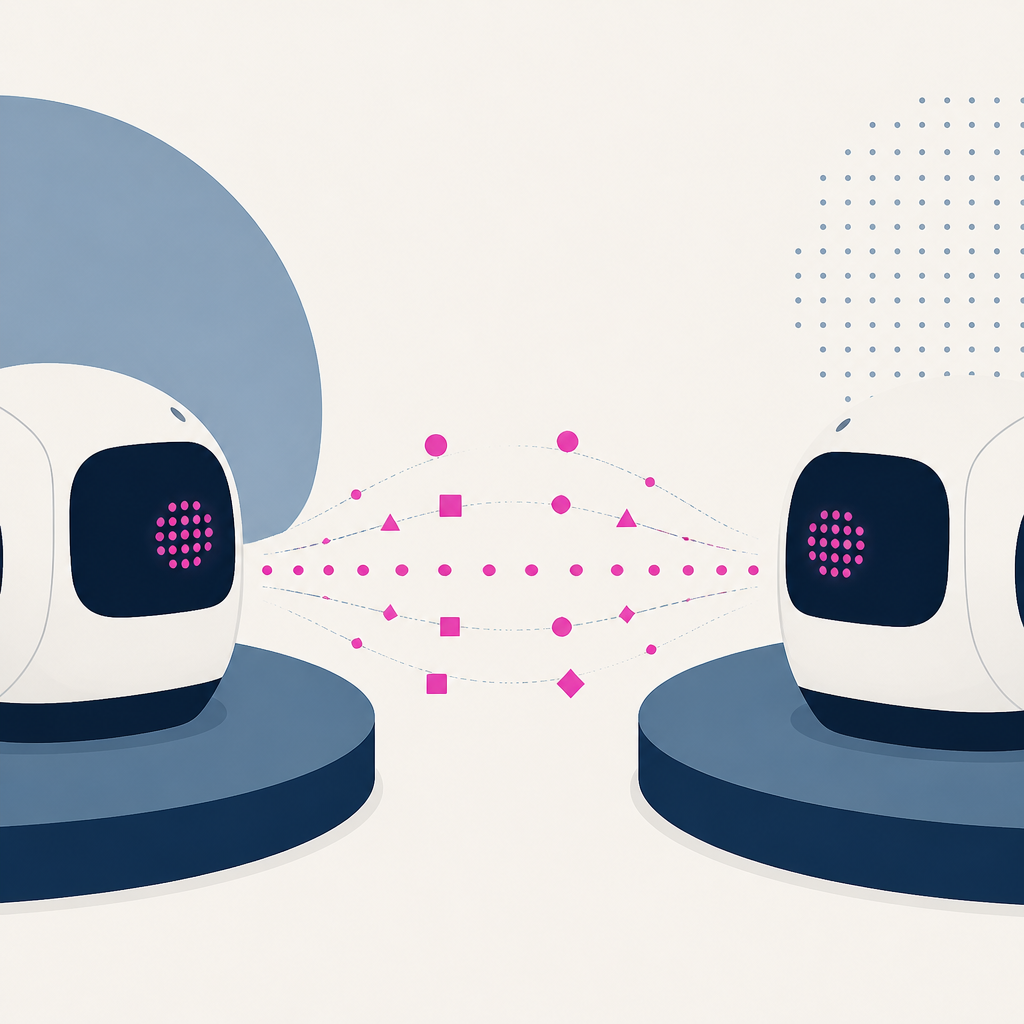
OpenAI's researchers set up a tiny world with a handful of agents, landmarks, and a single problem: one agent knows the goal, another doesn't, and they need to coordinate anyway. Instead of scripting a shared vocabulary, the team let the agents figure out their own signaling system through reinforcement learning, rewarding them only when the task got done.
The setup itself was deliberately spare. Agents moved around a grid populated with colored, shaped landmarks. One agent, the speaker, could see which landmark mattered but couldn't move toward it directly. A second agent, the listener, could move but had no idea what the target was until it received a message through a narrow, discrete communication channel. Over thousands of trials, the two sides had to jointly discover what any given symbol should mean, with nothing but success or failure as feedback.
What emerged wasn't gibberish, but it also wasn't English, or anything a person would recognize as vocabulary. Agents settled on compact sets of symbols that got reused across contexts, sometimes standing in for a color, sometimes for a shape, depending on what the listener needed to disambiguate at that moment. The meanings were entirely relational, built from the structure of the task rather than borrowed from any human concept, which is exactly why a transcript of agent chatter looks like noise to us even when it's doing real communicative work.
The bigger point isn't that OpenAI accidentally invented a secret robot dialect. It's that coordination protocols can bootstrap themselves from pure necessity, with no linguist or engineer designing the grammar. That matters for anyone building systems where multiple AI agents, or an AI and a human, need to share information efficiently, from warehouse robots to trading systems to future assistants that split work among specialized sub-agents.
The environments here are toy-sized on purpose, and the vocabularies are small enough to analyze by hand. Nobody's claiming a real language with syntax and abstraction popped out of a grid world. But the experiment is a clean demonstration that shared meaning doesn't require a shared starting language, only a shared incentive to solve a problem together.
My take — AI-written commentary, not fact-checked reporting
Every time a lab reports emergent agent-to-agent language, the headlines drift toward 'AI invents secret code to hide from humans,' which is nonsense and also a little revealing about what people actually worry about. The real story is duller and more important: as we stack more autonomous agents together, their internal shorthand is going to get less legible to us by default, not because anyone's hiding anything, but because efficient signals for machines were never going to look like English. Worth building interpretability tools for that now, while the vocabularies are still small enough to read by hand.
Read more about this at: OpenAI