
Instant LLM Updates with Doc-to-LoRA and Text-to-LoRA
Sakana AI ● Covered by 2 sources
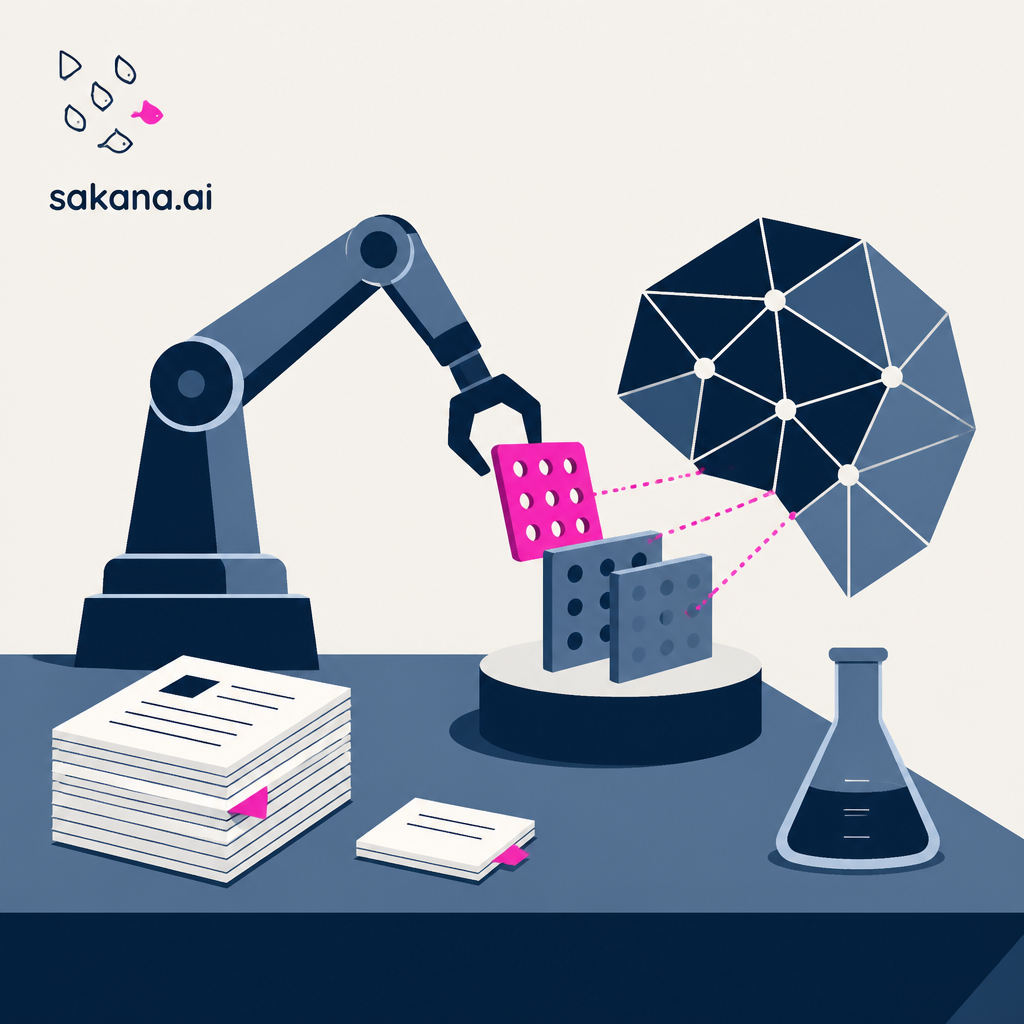
Sakana AI built a system that generates custom AI model tweaks instantly instead of retraining from scratch. It turns hours of fine-tuning into a single quick step, no expensive setup needed.
Based on reporting by Sakana AI — read the original for the full story.
Summary, retelling and take written by AI under human oversight; images are AI-generated illustrations. How we work · Report an error
Sakana AI just dropped two research projects, Text-to-LoRA and Doc-to-LoRA, that attack a problem anyone who's fine-tuned a model knows well: customizing an LLM is slow and expensive. Normally you need labeled data, GPU time, and a training run to get a model to specialize in a task or absorb a new document. Sakana's pitch is that you can skip almost all of that.
The trick is a hypernetwork, a smaller model whose only job is to spit out LoRA adapters, the lightweight weight patches used to steer big models without retraining them fully. Train this hypernetwork once, expensively, and afterward it can generate a task-specific or document-specific LoRA in a single forward pass. Sakana calls this cost amortization, and it's a fair description. Pay once upfront, then get customization essentially for free.
Text-to-LoRA handles the task side. Feed it a plain-English description of what you want the model to do, and it produces an adapter tuned for that job, even for tasks the hypernetwork never saw during training. Doc-to-LoRA pushes further, letting a model swallow entire documents and treat them like internalized memory rather than something crammed into a context window. In needle-in-a-haystack tests, Doc-to-LoRA held near-perfect recall on documents five times longer than what the base model could normally handle. Oddly, it also managed to transfer visual understanding from a vision-language model into a text-only model, so the text model could classify images despite never seeing pixels directly.
What stands out is speed. Both systems run in under a second, which is the difference between an experiment you can iterate on all afternoon and one you run twice and give up on. Sakana frames this as lowering the barrier to model customization, letting regular users specialize a foundation model with a sentence instead of a training pipeline. Code and papers are already public, so outside labs can poke at the claims themselves rather than take Sakana's word for it.
My take — AI-written commentary, not fact-checked reporting
I'll believe the sub-second, near-perfect-accuracy claims once independent labs replicate them outside Sakana's own benchmarks, because hypernetwork papers have a long history of looking magical in the demo and mediocre in the wild. That said, if this holds up even partially, it's a genuinely useful direction — cheap customization matters more for open, self-hosted models than for anything locked behind an API, and Europe's open-model scene in particular could use more tools like this instead of another closed leaderboard flex.
Read more about this at: Sakana AI