
How Boston Dynamics is turning robots into a real business
Fortune Sheryl Estrada
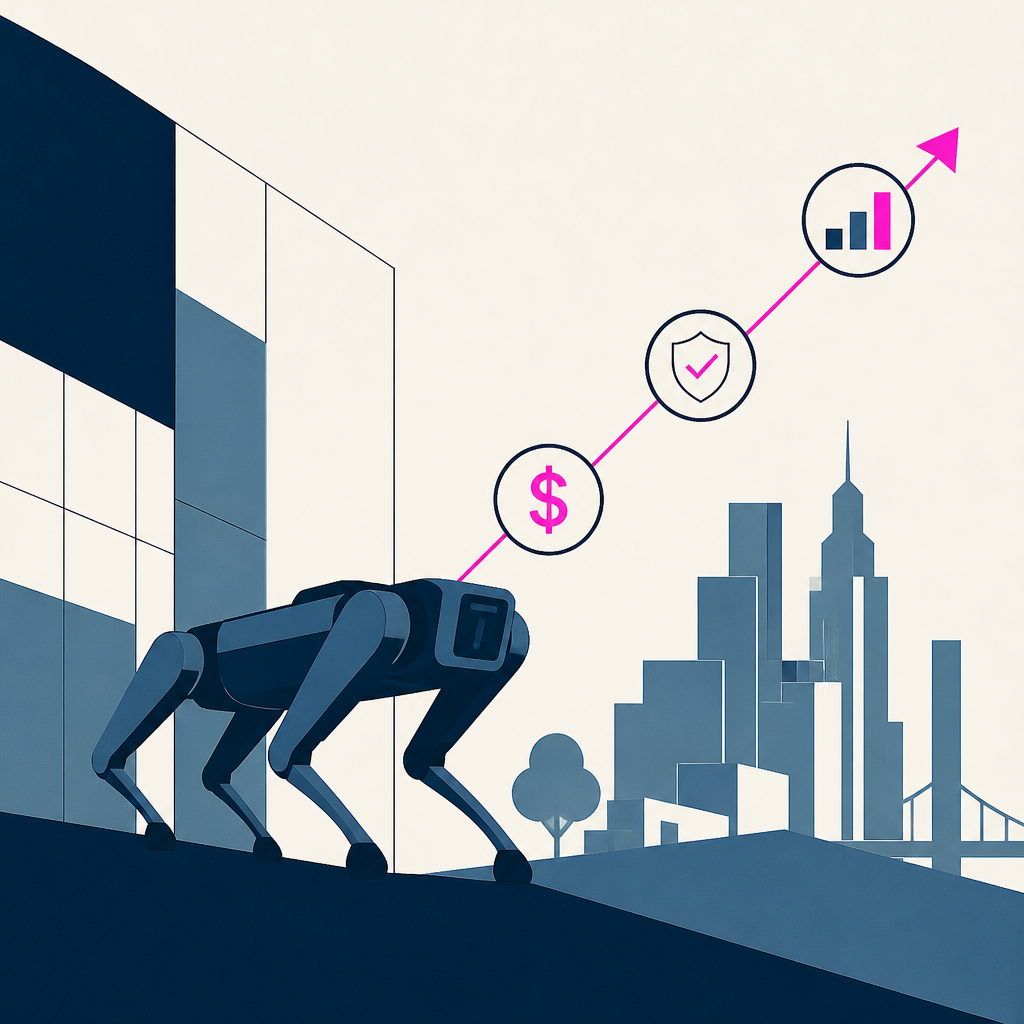
Boston Dynamics is trying to sell robots as a real business, not just a demo. Its bet is that Spot and Atlas can work at scale without blowing up costs.
Based on reporting by Fortune, Sheryl Estrada — read the original for the full story.
Summary, retelling and take written by AI under human oversight; images are AI-generated illustrations. How we work · Report an error
Boston Dynamics has spent years showing off what robots can do. Now it has to prove they can make money. That was the core message from Amanda McMaster, who spent six years as the company’s CFO and then served as interim CEO from February until Rohit Prasad took over on Oct. 7. Her point was blunt: early interest is not enough. A company like this needs a sales motion, tight cost control and robots that keep working in the field.
McMaster helped build those pieces as Boston Dynamics pushed deeper into commercial sales. Spot, the four-legged robot, sells for about $100,000 at the base level and can reach $300,000 depending on the payloads attached to it. It is already being used for inspections and equipment readings in places like semiconductor factories, food and beverage plants and public safety operations. Intel is one of the biggest Spot customers. Through the Orbit software platform, customers can move through facilities almost like they’re using Google Street View.
The company’s pitch is not that robots will wipe out jobs. McMaster said they take on the “dull, dirty, dangerous work” and leave people to do the rest. She even said workers are naming the robots, which is about as good a sign as any that the machines are becoming part of the routine rather than a stunt.
Atlas is the harder test. Boston Dynamics is trying to build a humanoid robot that can be manufactured and deployed at scale while the price comes down. McMaster said about 70% of Atlas’s bill of materials is actuators, and Hyundai Mobis will make them at cost. Hyundai has also committed to roughly 50,000 robot deployments across Hyundai Motor and Kia facilities, giving the company what she called planning certainty and cost target certainty. That matters because this is the moment where robotics stops being a spectacle and starts being a business model.
As interim CEO, McMaster also had to clean house fast. About two weeks into the role, she reorganized the entire company. Her phrasing was as direct as the move: “Rip the Band-Aid off.” She said the CFO job was her dream role, but the temporary CEO stint showed her what she could handle. Prasad inherits a company with deep robotics talent, an industrial parent and a growing commercial base. The next step is making those machines reliable enough in the real world to matter at scale.
My take — AI-written commentary, not fact-checked reporting
Boston Dynamics is finally doing the dull part of the robot business: sales, service and cost control. That’s less glamorous than parkour videos, but it’s the only part that pays the bills. The industry loves a demo; the market rewards boring machines that keep showing up and working.
Read more about this at: Fortune
Related stories
 The Boston Dynamics spinout building robots you’ll actually want to hug
Fortune ·
41
Agility Robotics: Inside the First US Humanoid Company to Go Public
Tanayu2019s Newsletter · 3 weeks ago ·
43
Physical AI’s bottleneck shifts from what robots can do to whether factories trust them
SiliconANGLE · 2 weeks ago ·
44