How Anthropic’s Dynamic Workflows Coordinate Claude Agents
Latent Space Richard MacManus
Anthropic unveiled “flows,” a new way for Claude to run many agents at once. It’s meant for bigger jobs, but it also hands Claude more control over the whole setup.
Based on reporting by Latent Space, Richard MacManus — read the original for the full story.
Summary, retelling and take written by AI under human oversight; images are AI-generated illustrations. How we work · Report an error
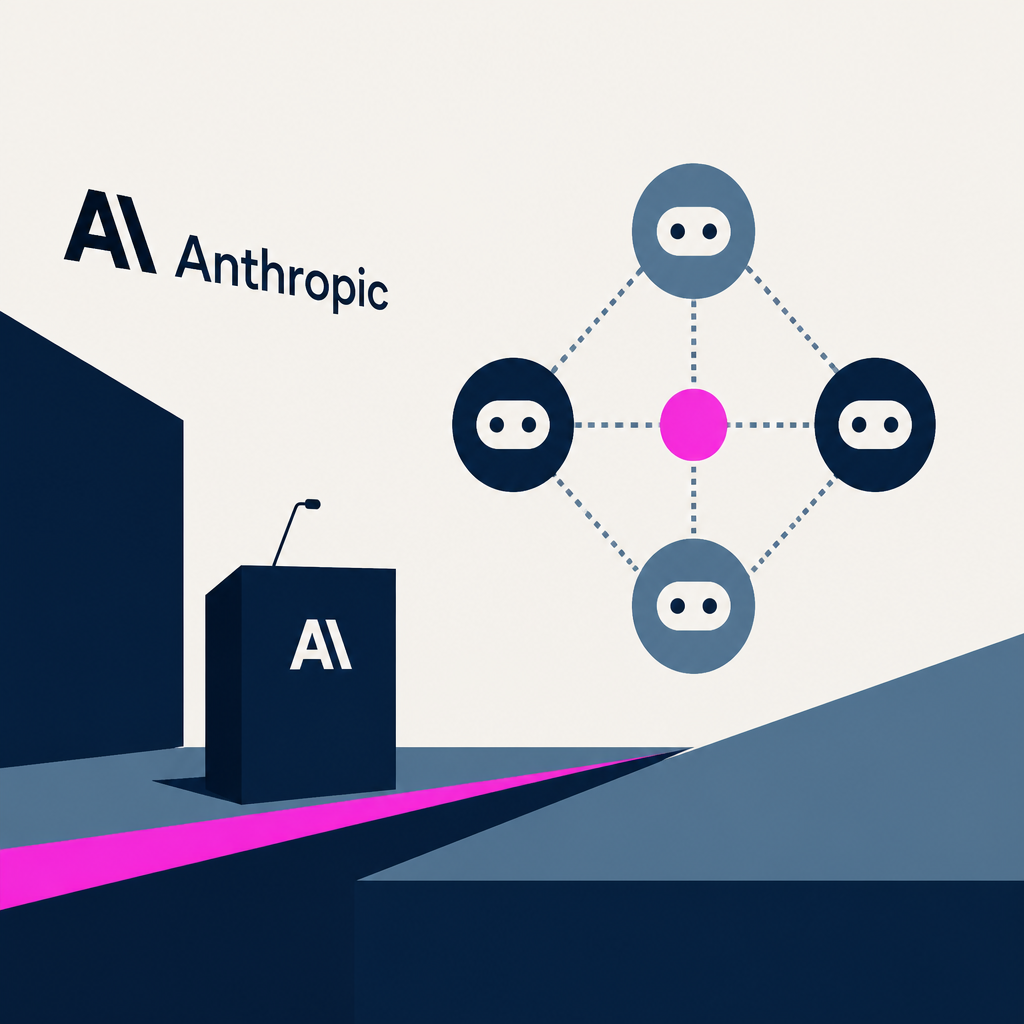
Anthropic used the opening of AI Engineer New York 2026 to show off a new feature for Claude Managed Agents: dynamic workflows, or “flows,” as the company kept calling them. The pitch is simple enough. Instead of making developers stitch together a coordinator and a roster of subagents by hand, Claude now decides how to organize the work itself.
CJ Avilla and Harrison Stall, both Members of Technical Staff at Anthropic, framed the idea in old-school operating system terms. They pointed to Unix, then Linux, as examples of systems that grew by layering trust and structure. Their argument was that agents need the same kind of discipline if they’re going to handle the “ambitious workloads” Anthropic has in mind.
The mechanics are more than marketing gloss. Claude first makes a plan, then writes an orchestration program that launches agents, gathers results, and moves information around. Anthropic says this lets Claude break work into discrete, verifiable chunks without developers having to manage every connection between agents. Developers can still pass in preconfigured specialist subagents if they want, but the default is that Claude handles the topology.
To make the idea less abstract, the presenters showed a stock watchlist scanner. One phase spread tickers across agents with isolated contexts, then a later review phase pulled the findings together into a report. It was a modest example, but it made the pattern clear: flows are built for jobs that run longer and broader than a single agent, or even a fixed roster of them.
The audience questions quickly turned to the messy parts. How many agents should a task get? Stall said the answer comes down to evals and lower defaults, with ambitious work needing explicit encouragement for more parallelism. How does a model stay inside budget? It doesn’t know the budget while it’s running, though developers can set a session budget. And if repeated flows need to get cheaper, Avilla pointed to “dreaming,” a research preview feature that rewrites memory stores by merging duplicates, replacing stale or contradicted entries, and surfacing new insights.
Anthropic was also candid that flows cost “much more” than a single-agent approach. The upside, in its telling, is that they’re also “much more effective” at finding details. The bigger bet is that this kind of orchestration could eventually help with far larger tasks, even scientific work, by throwing test-time compute at hard problems and making that capability available through an API.
My take — AI-written commentary, not fact-checked reporting
This is classic AI platform behavior: take a messy human problem, add orchestration, then call the coordination layer the product. Sometimes that’s real progress, and sometimes it’s just a fancier way to spend more tokens with better branding. The telling line is that Anthropic still needs budgets, defaults, and graph views just to keep the whole thing from wandering off like an overcaffeinated intern.
Read more about this at: Latent Space