
Harvard’s $699 startup bootcamp has professors who never sleep–but that’s because they’re AI clones
Fortune Mia Osmonbekov ● Covered by 2 sources
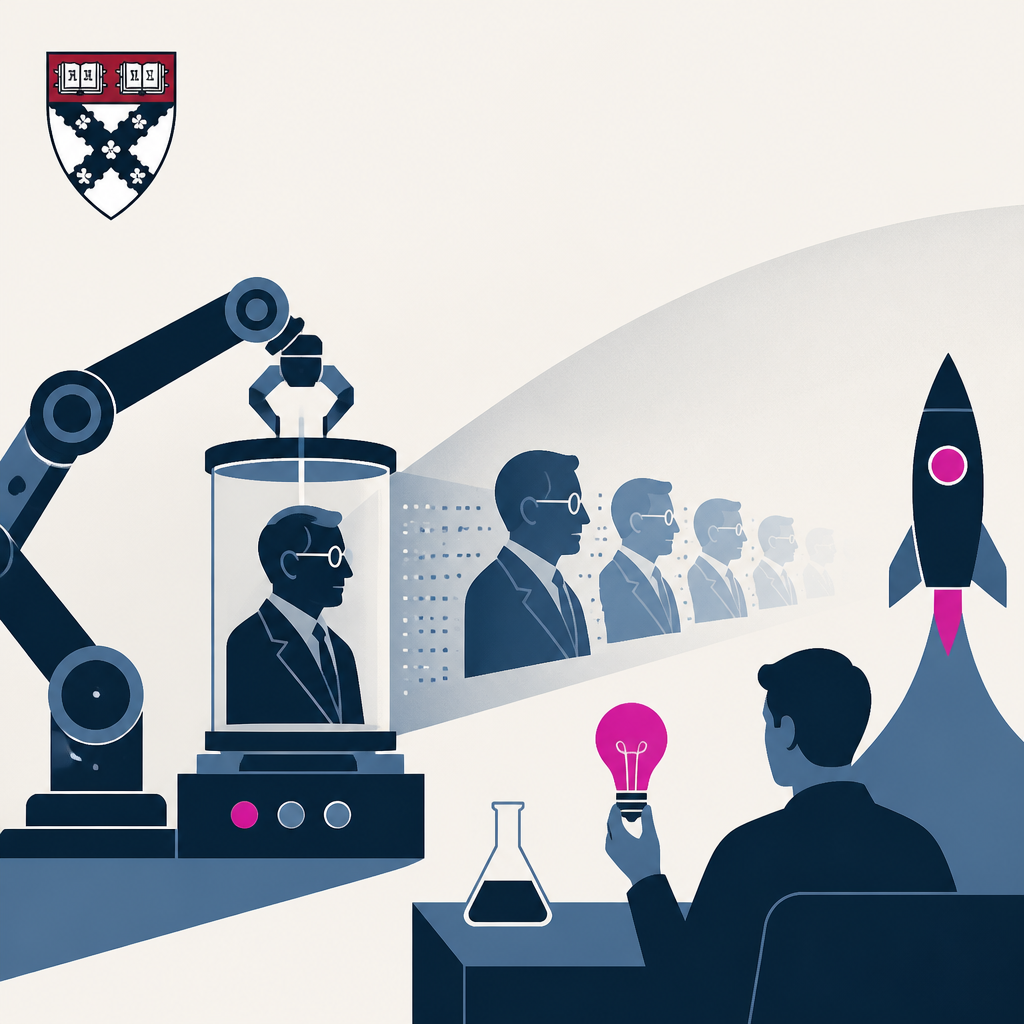
Harvard’s startup bootcamp now uses AI clones of its professors. Founders can rehearse pitches again and again before facing real investors.
Based on reporting by Fortune, Mia Osmonbekov — read the original for the full story.
Summary, retelling and take written by AI under human oversight; images are AI-generated illustrations. How we work · Report an error
Harvard Business School has turned part of its startup training into software. In a $699 online bootcamp, founders can practice investor pitches, sales calls, and board meetings with AI versions of HBS instructors who never get tired and can hear the same idea over and over again.
The eight-week program sits inside HBS Foundry, which Harvard calls an “AI-native digital workspace” for entrepreneurs. It mixes live sessions with experts and personalized AI mentoring based on Harvard Business School faculty, and it ends with a chance to pitch for $100,000. A Harvard spokesperson said 760 founders have taken part so far.
The AI setup came from a simple founder complaint: they wanted a way to get pushed and rehearse before they walked into real meetings with mentors and investors. Kat Rings, Foundry’s director, said the point was to make those later conversations more useful. The AI versions cover seven HBS professors and senior lecturers with experience in venture capital, business-model design, board dynamics, and startup strategy.
Harvard says the professors joined voluntarily and went through interviews, recording sessions, testing, and ongoing feedback. Shikhar Ghosh, one of the faculty members cloned into AI, said the goal is not to replace him but to free up live time for the questions that really need human judgment. The program is not a degree and does not offer academic credit; Harvard pitches it as a way to reach founders who may never study there or have access to a major innovation network.
That puts Harvard in the middle of a bigger split on campus. Professors complain about students using AI to cheat, while some universities are using it to stretch scarce faculty time into something that can scale. Georgia Tech and Imperial Business School have already experimented with digital versions of teachers, and Georgia Tech’s David Joyner has even built an avatar of himself for an online generative AI course. The basic bargain is getting clearer: AI can help more people practice, but it still can’t do the human part that makes a real professor matter.
My take — AI-written commentary, not fact-checked reporting
This is the sane use of AI in education: let the bot handle repetition and keep the humans for judgment. Universities love pretending every shiny tool is about access, but the real test is whether the student still gets the awkward, messy, useful part that only a person can do. If the avatar is built with the faculty member in the room, fine; if not, it’s just academic cosplay with better branding.
Read more about this at: Fortune
Related stories
 'We believe in college': inside Andreessen Horowitz's $42m unaccredited academy that will charge Harvard prices without degrees
Fortune ·
18
Andreessen Horowitz is launching an ‘academy’ with no homework and partnerships with Palantir, Google, and Meta
The Verge · 3 weeks ago ·
32
AI is making startup pitches increasingly uniform, and investors say this is costing founders funding
Tech Funding News · 1 month ago ·
2
'We believe in college': inside Andreessen Horowitz's $42m unaccredited academy that will charge Harvard prices without degrees
Fortune ·
18
Andreessen Horowitz is launching an ‘academy’ with no homework and partnerships with Palantir, Google, and Meta
The Verge · 3 weeks ago ·
32
AI is making startup pitches increasingly uniform, and investors say this is costing founders funding
Tech Funding News · 1 month ago ·
2