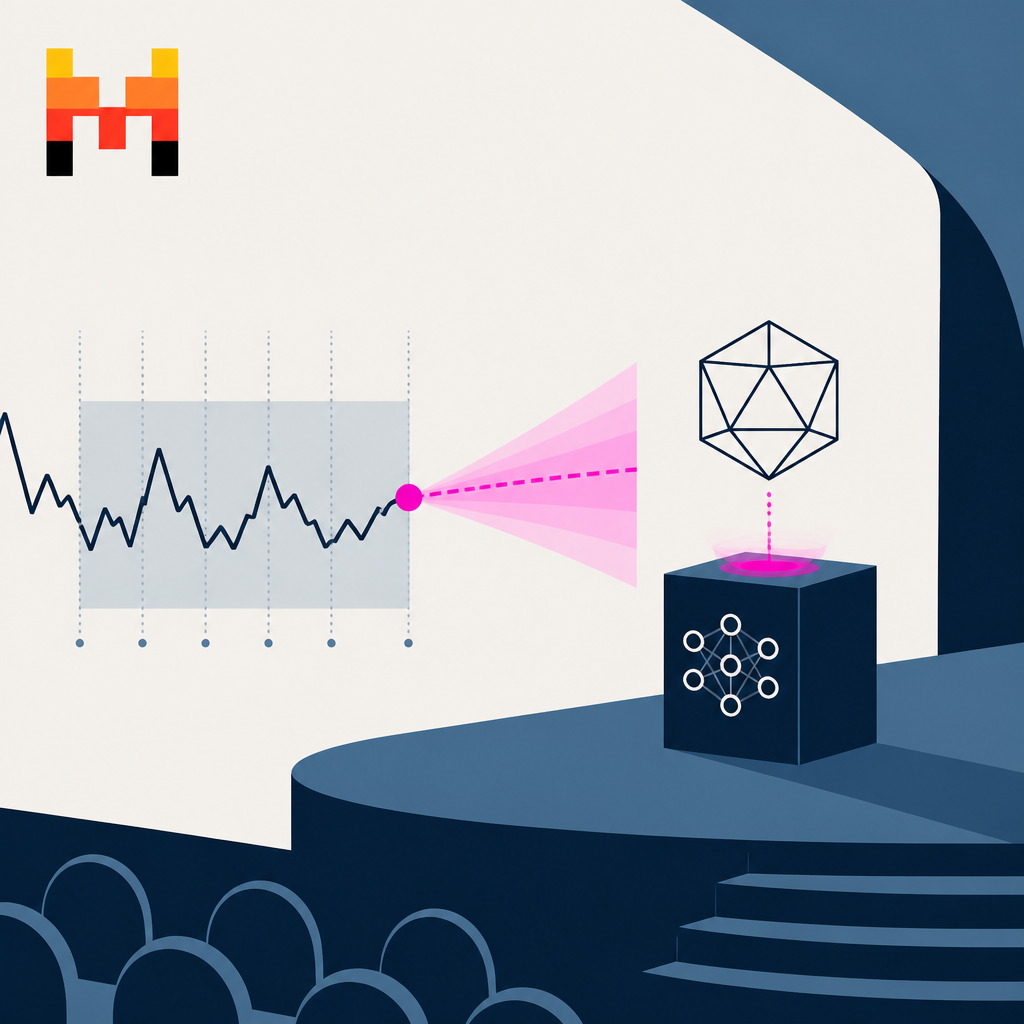
Google AI Releases TimesFM-3: A 330M Parameter Zero-Shot Foundation Model For Multivariate Time Series Forecasting
MarkTechPost Michal Sutter ● Covered by 3 sources
Google’s new TimesFM-3 can forecast multiple linked time series at once. It’s strong on benchmarks, but the weights are non-commercial, so you can test it, not ship it.
Based on reporting by MarkTechPost, Michal Sutter — read the original for the full story.
Summary, retelling and take written by AI under human oversight; images are AI-generated illustrations. How we work · Report an error
Google Research has released TimesFM-3, a 330 million parameter foundation model for time series forecasting that finally treats related series as related. Earlier TimesFM checkpoints through 2.5 worked one series at a time. This version is trained natively for multivariate forecasting and can handle multiple targets, past covariates, and past-future covariates without task-specific fine-tuning.
That shift matters because many real forecasting problems are messy bundles of signals. Google’s own example is ice cream sales, where foot traffic, weather, promotions, and holidays all tug on the outcome together. TimesFM-3 is pretrained on more than 1 trillion time points drawn from real and synthetic series, and it uses that scale to make zero-shot forecasts across linked inputs.
The model’s architecture stays decoder-only, but the mechanics are built for multivariate work. Inputs are grouped into 32-step patches and normalized per series so one large series does not overwhelm the rest. Target and past-covariate tokens share a patch representation, while past-future covariates use a lookahead setup that lets the model see scheduled future events like a promotion calendar.
Inside the model, two attention patterns alternate. Causal temporal attention moves across time within a series and stays strictly causal. Full variate attention moves vertically across series at the same time step, which is how the model learns cross-series correlations. Google says this setup avoids leakage while still letting the model combine signals that belong together.
TimesFM-3 also changes how forecasts are produced. Instead of decoding patch by patch, it uses Contiguous Patch Masking so the whole horizon is filled in one forward pass. That cuts down latency and the compounding errors you get when each step depends on the last one. Each target gets nine quantiles, from the 10th through the 90th percentile, at every horizon step.
On GIFT-Eval, fev-bench, and the TIME leaderboard, Google says TimesFM-3 takes the top average rank among pretrained foundation models, on both point and probabilistic metrics. The release notes also call out rank #1 overall on fev-bench across 100 real-world tasks, rank #1 overall on TIME across 50 domain datasets and 98 evaluation tasks, and rank #1 among foundation models on GIFT-Eval.
There is a catch, and it is a big one for anyone hoping to build a product on top of it. The repository code is Apache-2.0, but the TimesFM 3.0 weights are under timesfm-non-commercial-license-v1.0 and are limited to non-commercial, non-production use. You can benchmark it today. You cannot put it behind a production forecast API.
My take — AI-written commentary, not fact-checked reporting
This is the familiar modern AI bargain: the flashy part is free to inspect, and the part you’d actually ship is fenced off. Google gets a benchmark win and the ecosystem gets another demo, while anyone with a real forecasting product is told to keep moving. Open code with closed weights is becoming the industry’s favorite way to say “look, but don’t touch.”
Read more about this at: MarkTechPost