From Brain Waves to Words: Brain2Qwerty Offers a New Path to Communication Without Surgery
Meta AI
Meta built an AI that reads brain waves into text without surgery, and it's now way more accurate than before. Word accuracy jumped to 61% (78% for the best subject), closing in on invasive brain-implant methods.
Based on reporting by Meta AI — read the original for the full story.
Summary, retelling and take written by AI under human oversight; images are AI-generated illustrations. How we work · Report an error
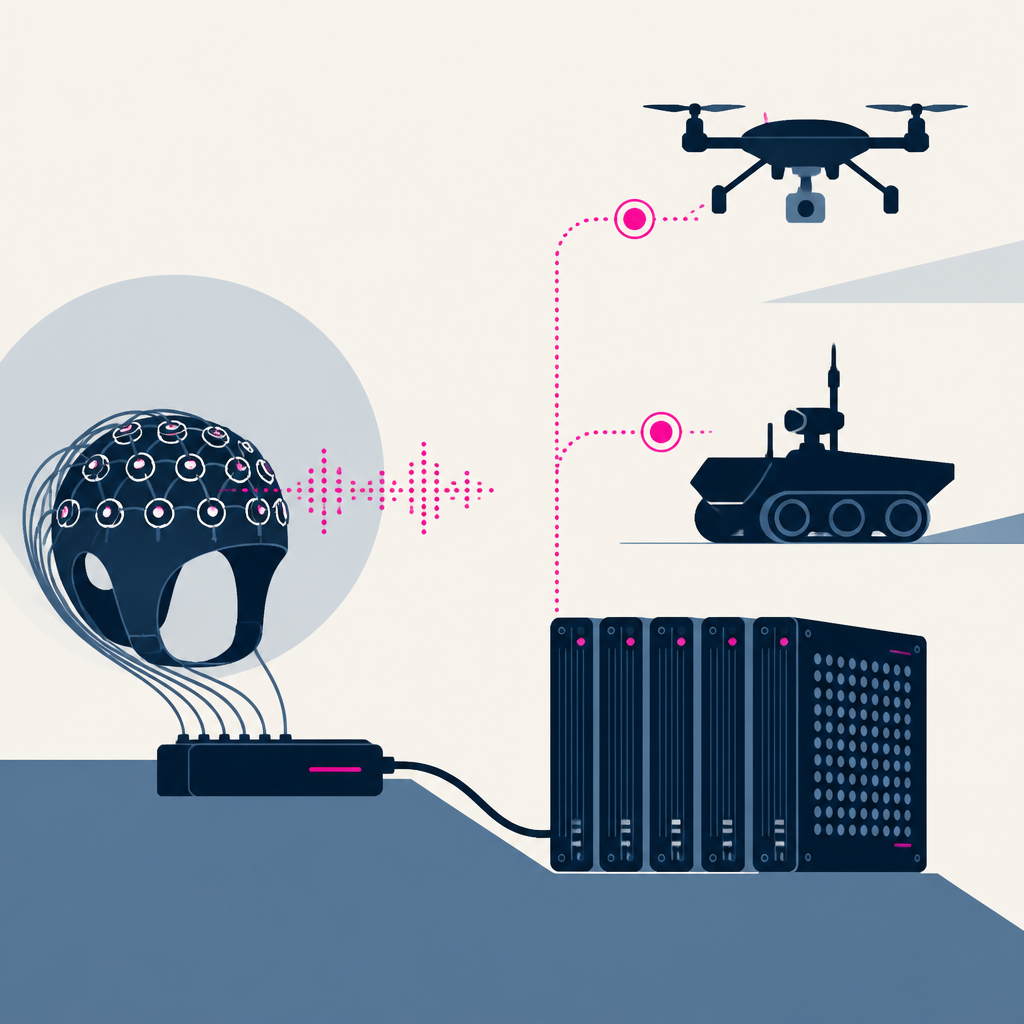
Meta just dropped the sequel to a research project it started last year, and the upgrade is bigger than a typical version bump. Brain2Qwerty v2 takes brain activity recorded through a non-invasive helmet and turns it into typed sentences in real time, no electrodes implanted in anyone's skull required. That distinction matters more than it might sound: the invasive route, using techniques like stereotactic electroencephalography or electrocorticography, has already proven that AI can turn brain signals into communication for people who've lost the ability to speak or type. But surgery doesn't scale. You can't offer a brain implant to millions of people who need it.
So Meta's team trained this new version on roughly 22,000 sentences gathered from nine volunteers, each of whom sat through 10 hours of recording while wearing a magnetoencephalography device and actually typing. Rather than building a hand-tuned pipeline that hunts for specific neural signatures, the researchers went end-to-end: raw brain signals in, deep learning model figures out the rest. They also fine-tuned large language models on the neural data itself, which lets the system lean on semantic context to fill in gaps when the brain signal is noisy and ambiguous. Engineers even used AI agents to help hunt for pipeline optimizations, though humans still picked the final training setup by hand.
The numbers are the real headline here. Word accuracy hit 61%, a sharp jump from the 8% seen in other non-invasive approaches. For the best-performing participant, accuracy climbed to 78%, meaning more than half their sentences came out with a single word error or none at all. That's a meaningful leap toward the kind of performance previously reserved for surgical methods, and it comes without anyone going under the knife.
What might matter even more long-term is a pattern Meta noticed: decoding accuracy scales log-linearly with the amount of data fed into the system. In plain terms, more recordings from more people could keep closing the gap with invasive techniques, no fundamental breakthrough required, just more data. That's a much easier problem to throw resources at than solving new neuroscience from scratch.
Meta is releasing the full training code for both v1 and v2, and its research partner, the Basque Center on Cognition, Brain, and Language, is putting out the v1 dataset alongside it. The work sits under Meta's broader push toward open brain-foundation models, including tools like Tribev2 for perception encoding and NeuralSet for processing brain data at scale, backed by a $5 million fund meant to encourage more open datasets in this space. The stated goal is straightforward: build this stuff in public so neuroscience moves faster than it would if everyone worked behind closed doors.
My take — AI-written commentary, not fact-checked reporting
Releasing the code and a full dataset instead of just publishing a flashy paper is the part worth applauding here, because brain-decoding research has a nasty habit of staying locked inside single labs with proprietary data nobody else can touch. The log-linear scaling finding is the sleeper detail: if accuracy keeps climbing just by collecting more sessions, this becomes an engineering and outreach problem rather than a moonshot science problem, and that's a far more solvable kind of hard. Getting from 78% best-case to something clinically reliable for everyday communication is still a real gap, but betting on non-invasive tech for people who can't get surgery is the right call, not the flashy one.
Read more about this at: Meta AI