Fortune Tech: A pivotal shift
Fortune Andrew Nusca
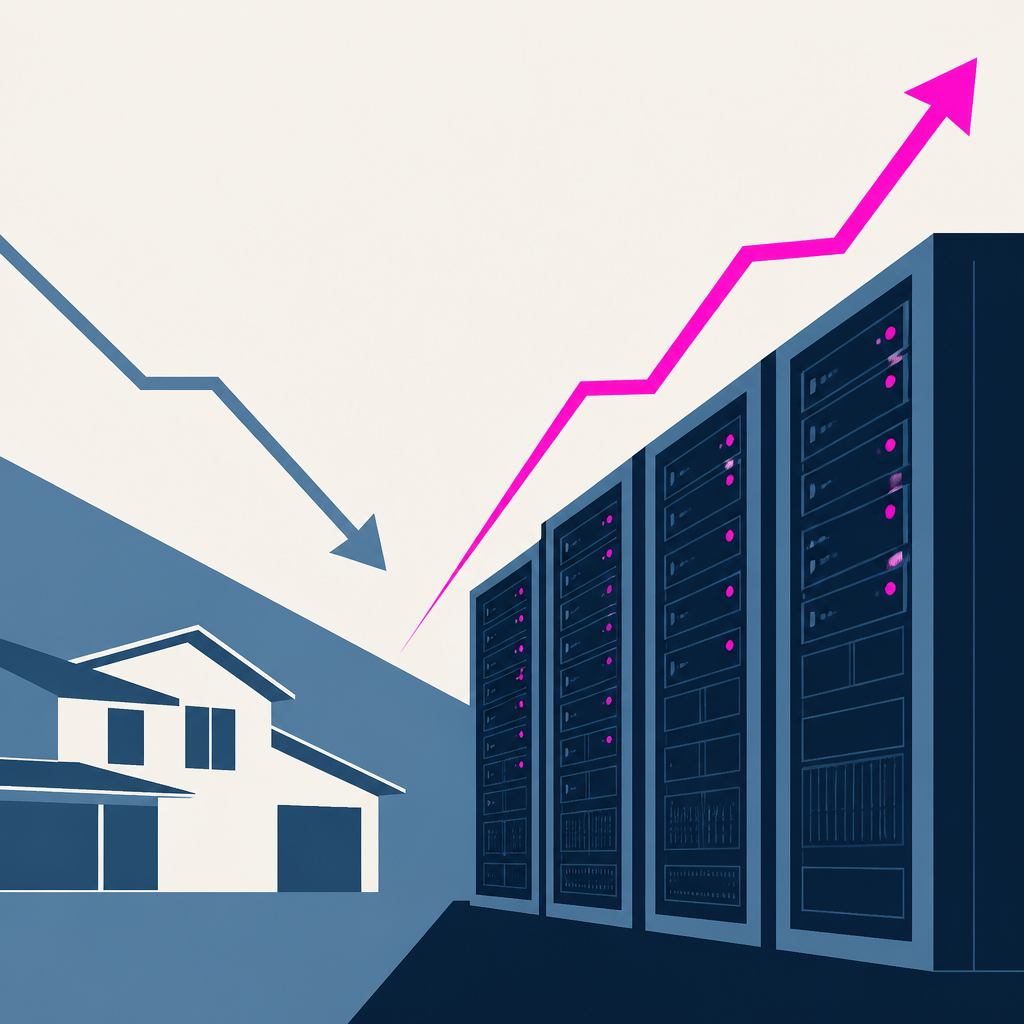
Data centers and IT spending just passed housing in the U.S. AI buildout is now driving more growth than homes, and it’s still ramping up.
Based on reporting by Fortune, Andrew Nusca — read the original for the full story.
Summary, retelling and take written by AI under human oversight; images are AI-generated illustrations. How we work · Report an error
The U.S. economy has hit a strange new milestone: spending on data centers and IT now tops spending on housing. That’s not a metaphor. It’s the actual shift showing up in the numbers, and it says a lot about where money is flowing while the old housing boom sits mostly frozen.
Adam Shapiro, a vice president at the San Francisco Fed, said residential investment is losing ground to computers. On LinkedIn, he pointed to inflation-adjusted spending on information processing equipment — the category that includes data centers and computer hardware — as now higher than residential investment. The Bureau of Economic Analysis backs that up. In the second quarter, real private residential fixed investment was $748 billion, down 18% from its early 2021 peak.
At the same time, spending on information processing equipment climbed to $752 billion, up 51% over the same stretch. That’s the AI era in a single comparison: less money chasing houses, more money pouring into compute, cooling, cables, chips, and the rest of the machine needed to keep these systems running.
And the spending isn’t slowing. S&P Global said last month that capital expenditures from Alphabet, Amazon, Microsoft, Meta, Oracle, and SpaceX will exceed $1.3 trillion in 2027. It projected $870 billion in 2026 and $470 billion in 2025. The firm also warned that capex is growing faster than revenue, which raises the ugly possibility of overcapacity if demand does not catch up.
S&P sees 2028 as the turning point, when revenue growth starts to outrun capex and cash flow improves. Until then, it expects the six hyperscalers’ operating cash flow to be negative in both 2026 and 2027. That’s the real tension here: the buildout is huge, but the bill lands long before the payoff.
My take — AI-written commentary, not fact-checked reporting
This is what happens when every giant tech company decides the answer to uncertainty is more concrete and more debt. The AI boom is starting to look less like a revolution and more like a very expensive race to avoid being the one holding the empty warehouse.
Read more about this at: Fortune