
FAIRChem v2 UMA for Multidomain Atomistic Simulation across Molecules, Catalysts, Materials, Vibrations, and Molecular Dynamics
MarkTechPost Sana Hassan
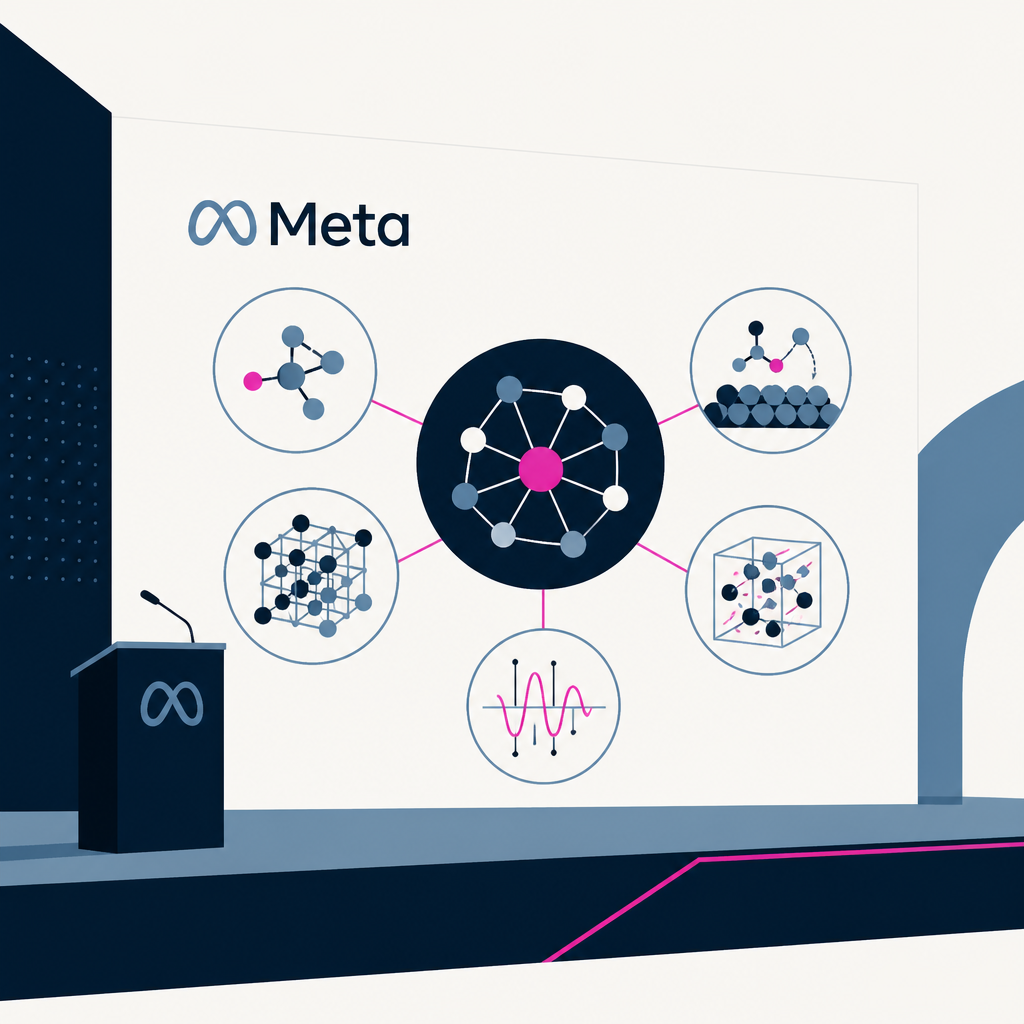
A new tutorial shows FAIRChem v2's UMA model running one potential across molecules, catalysts, and materials. No separate model needed per task—same weights handle water, metal surfaces, and iron crystals alike.
Based on reporting by MarkTechPost, Sana Hassan — read the original for the full story.
Summary, retelling and take written by AI under human oversight; images are AI-generated illustrations. How we work · Report an error
There's a quiet shift happening in computational chemistry, and this FAIRChem v2 tutorial captures it well. Instead of training a fresh machine-learning potential for every flavor of atomistic problem, the workflow leans on a single pretrained model, UMA (uma-s-1p2), and just swaps the task name depending on what kind of system is being simulated. Molecules get the omol calculator, catalytic surfaces get oc20, and bulk materials get omat. Same underlying weights, three different lenses.
The walkthrough starts small and builds up. A water molecule gets its energy and forces computed, then a deliberately distorted version gets relaxed back toward its equilibrium bond length and angle using LBFGS. From there it gets more interesting: the tutorial checks whether UMA understands electron spin by comparing singlet and triplet methylene, then estimates the reaction energy of methane combustion by relaxing methane, oxygen, carbon dioxide, and water separately and combining their energies. A vibrational analysis of water follows, pulling out normal-mode frequencies and zero-point energy through finite differences.
Things shift into materials science once carbon monoxide gets placed on a copper (100) surface. The lower slab layers are frozen in place with constraints, the adsorbate-surface system gets relaxed with the OC20 calculator, and a clean slab plus gas-phase CO are optimized separately as references to build a naive adsorption-energy cycle. The tutorial is upfront that OC20 has its own DFT reference convention, so mixing energies across tasks casually isn't something to do for anything resembling a real result.
Bulk iron gets the full materials treatment: cell relaxation with a Frechet cell filter, a scan across compressed and expanded volumes, and a Birch-Murnaghan equation-of-state fit to pull out equilibrium volume and bulk modulus. Then the same UMA predictor runs a half-picosecond Langevin molecular dynamics simulation of water at 300 K, tracking temperature, potential energy, and bond length over the trajectory. The tutorial closes with a potential-energy-surface scan that stretches one O-H bond in water from 0.7 to 2.5 angstroms, tracing out a dissociation curve.
What ties all of it together isn't any single result — it's that none of these tasks required swapping out the underlying model. The tutorial suggests trying uma-m-1p1 for higher accuracy, or extending into MOF and molecular-crystal domains, and mentions multi-GPU inference support for bigger MD runs. Everything from a stretched water molecule to a relaxed iron lattice went through the same learned potential.
My take — AI-written commentary, not fact-checked reporting
Having one interatomic potential handle molecules, catalysis, and crystals is the kind of consolidation that quietly changes how research groups work, since nobody has to babysit a separate model per domain anymore. The adsorption-energy caveat about mixing task-specific DFT references is the part people will most likely ignore and then get burned by later. Convenience like this is exactly how sloppy benchmarking creeps into a field.
Read more about this at: MarkTechPost