
Evaluating Multimodal Vision Models with Moonshot PerceptionBench Using Robust Data Loading and Automated Judging
MarkTechPost Sana Hassan
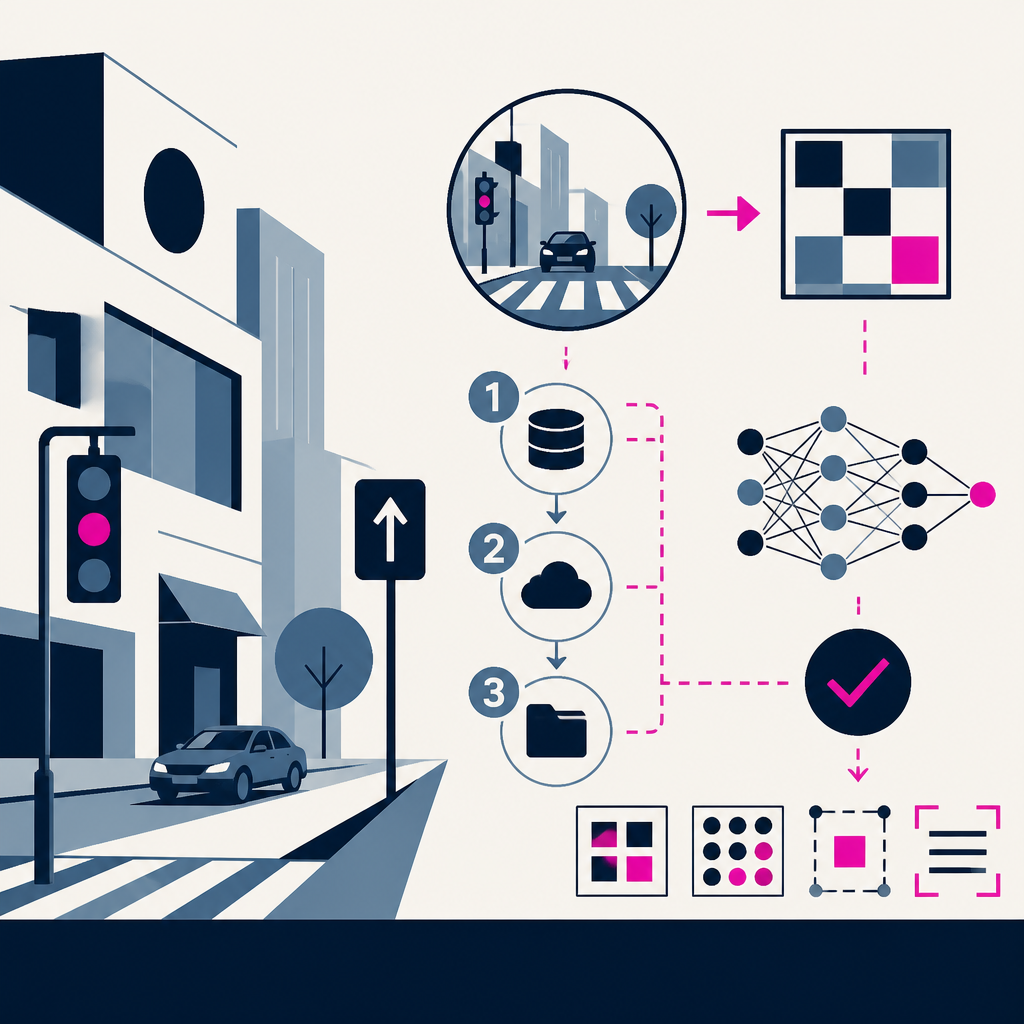
Someone built a full tutorial for testing vision AI models on Moonshot's PerceptionBench, a tricky benchmark that checks things like counting, OCR, and depth perception. It's basically a DIY grading kit so anyone can see if a model can actually 'see' or is just guessing well.
Based on reporting by MarkTechPost, Sana Hassan — read the original for the full story.
Summary, retelling and take written by AI under human oversight; images are AI-generated illustrations. How we work · Report an error
MarkTechPost has published a hands-on walkthrough for evaluating multimodal AI systems against PerceptionBench, a Moonshot AI benchmark built to stress-test how well vision-language models handle fine-grained visual tasks. We're talking OCR, counting objects, spatial localization, depth judgments, comparisons between images, and — maybe most interesting — hallucination detection, where a model has to admit an image doesn't show something rather than confidently making it up.
The tutorial itself reads less like a demo and more like a small research pipeline. It starts with a surprisingly defensive data-loading strategy: try streaming Parquet shards first, fall back to streaming raw files if that fails, and only download the full 1.63GB dataset as a last resort. That kind of layered fallback logic isn't glamorous, but anyone who's fought with Hugging Face's `datasets` library at 2am will recognize why it's there. From the roughly 3,000 examples in the full PerceptionBench card, the code pulls a balanced subset — 12 questions per capability category — so the final accuracy number isn't secretly dominated by whichever task happened to load first.
What follows is a genuinely thorough decoding and normalization step: images arrive as base64 data URIs, raw bytes, file paths, or PIL objects, and the code handles all of them, then resizes anything over 1024 pixels to keep vision-API token costs sane — a real concern when some questions bundle up to eight images. Once normalized, the dataset gets profiled by answer type (integers, yes/no, single letters, phrases), image count, and source benchmark, revealing that a chunk of PerceptionBench questions were authored fresh rather than recycled from older benchmarks, roughly a 40/60 split per Moonshot's own documentation.
The harness then supports three ways to generate predictions: a deliberately dumb 'blind-prior' baseline that ignores the images entirely (useful as a sanity floor), any OpenAI-compatible multimodal API like GPT-4o-mini, or a local Hugging Face vision-language model such as SmolVLM2. Judging can run on simple rule-based string matching or hand off to an LLM for messier free-text answers, and the pipeline finishes by computing bootstrap confidence intervals and slicing performance by difficulty and capability — the kind of rigor that turns a leaderboard screenshot into something you can actually trust.
My take — AI-written commentary, not fact-checked reporting
This is exactly the kind of unglamorous infrastructure work that gets ignored while everyone argues about whether GPT-5 or Gemini 3 is smarter, and it deserves more attention than a new model drop does. Benchmarks are only as good as the loading, balancing, and judging code around them, and most 'we tested X on Y benchmark' tweets skip all of that. If you're not stratifying by capability and running a blind-prior baseline, your accuracy number is basically vibes with a decimal point.
Read more about this at: MarkTechPost