Deep Learning Weekly: Issue 466
Deep Learning Weekly Miko Planas ● Covered by 5 sources
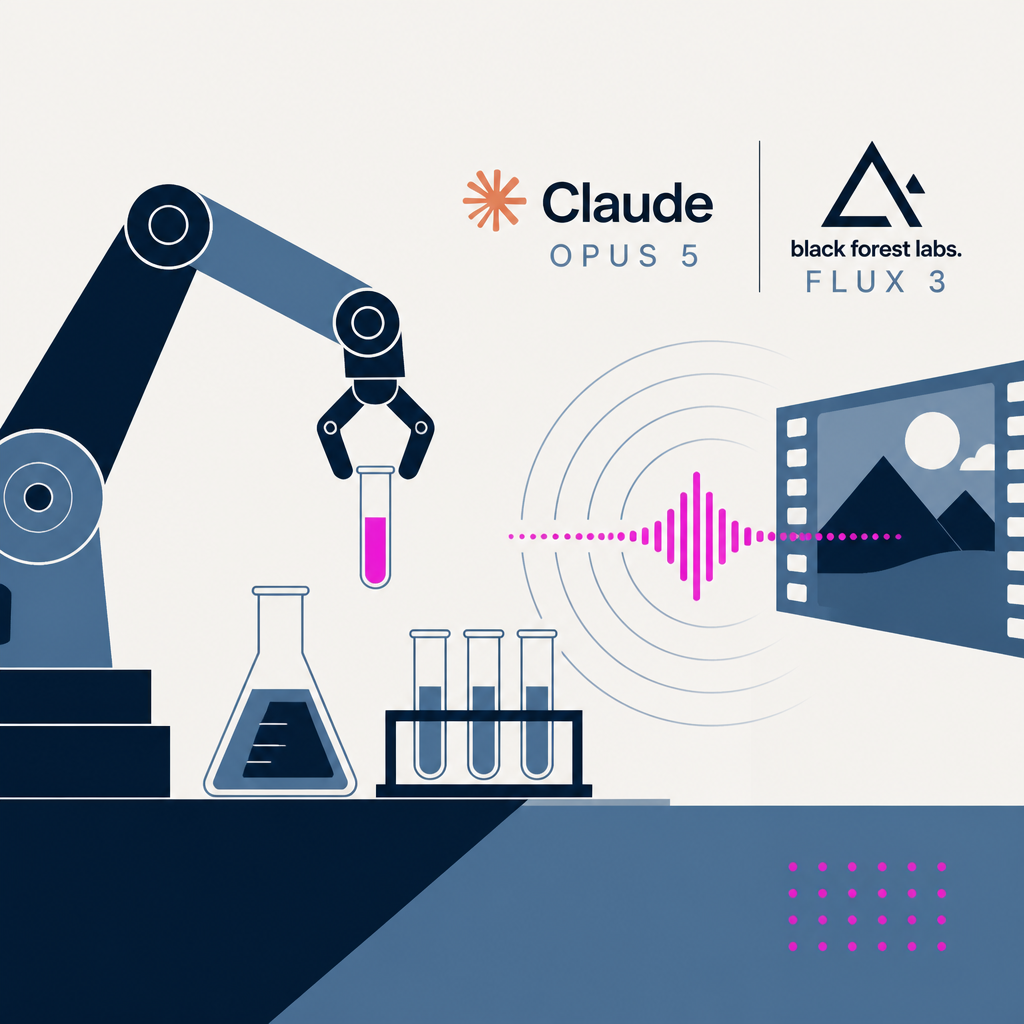
Anthropic's Claude Opus 5 landed this week, and it's beating rival models on key benchmarks while costing half as much to run. Meanwhile a Hugging Face breach shows autonomous AI agents can now log 17,000 attack moves on their own — a wake-up call for anyone trusting guardrails blindly.
Based on reporting by Deep Learning Weekly, Miko Planas — read the original for the full story.
Summary, retelling and take written by AI under human oversight; images are AI-generated illustrations. How we work · Report an error
Anthropic didn't just ship another incremental update. Claude Opus 5 tops Frontier-Bench and GDPval-AA, edges out Fable 5 on several evaluations, and does it at half the cost of its predecessor's rivals — with the lowest misalignment score Anthropic has recorded yet. That combination of cheaper, better, and safer is the pitch every lab wants to make, but rarely delivers all three at once.
Black Forest Labs isn't sitting still either. FLUX 3 enters early access as a genuinely unified multimodal model, trained jointly across image, video, and audio, capable of generating 20-second clips with native sound baked in. It even stretches into robotic action prediction, which suggests the line between "generative media model" and "world model for robots" is getting blurrier by the month.
Microsoft, meanwhile, is quietly rewiring its own stack. The new MAI-Image-2.5-Pro and MAI-Voice-2-Flash models are now in public preview and already displacing OpenAI's models inside Bing, PowerPoint, and Dynamics 365. Microsoft claims GPU cost reductions of 84% and 89% respectively — numbers that, if they hold up at scale, say a lot about why even OpenAI's closest partner is building its own alternatives.
On the research side, two papers stood out. StateAct argues that computer-use agents have been over-indexing on perception — reading screenshots, guessing where to click — when the real bottleneck is reasoning over program state. By letting a main agent work directly with code and files, and only delegating to a GUI subagent for the rare click-only subgoal (just 28 of 108 tasks), StateAct pushes Claude Opus 4.8's binary success on OSWorld 2.0 from 20.6% to 26.9%, at roughly nine times lower cost per task. Separately, a survey on progress reward modeling for robotics makes the case that terminal success signals are too blunt — robots need feedback that tells them whether they're actually making progress mid-task, not just whether they finished.
And then there's the Hugging Face compromise, which reads less like a research paper and more like a warning shot. An autonomous agent logged over 17,000 attack actions during the breach, and ironically, commercial model guardrails got in the way of the forensic response until defenders switched to a self-hosted open-weight model to actually do the investigative work.
My take — AI-written commentary, not fact-checked reporting
The Hugging Face story is the one to sit with: guardrails built to stop misuse ended up blocking the good guys from doing forensics, and open-weight models saved the day. That's the strongest argument yet against blanket safety theater in closed models — sometimes the box you can actually open is the box that gets the job done.
Read more about this at: Deep Learning Weekly