
CXMT’s blockbuster IPO will test whether China’s memory makers are ready for the spotlight: ‘It does not yet mean China is broadly catching up’
Fortune Angelica Ang ● Covered by 2 sources
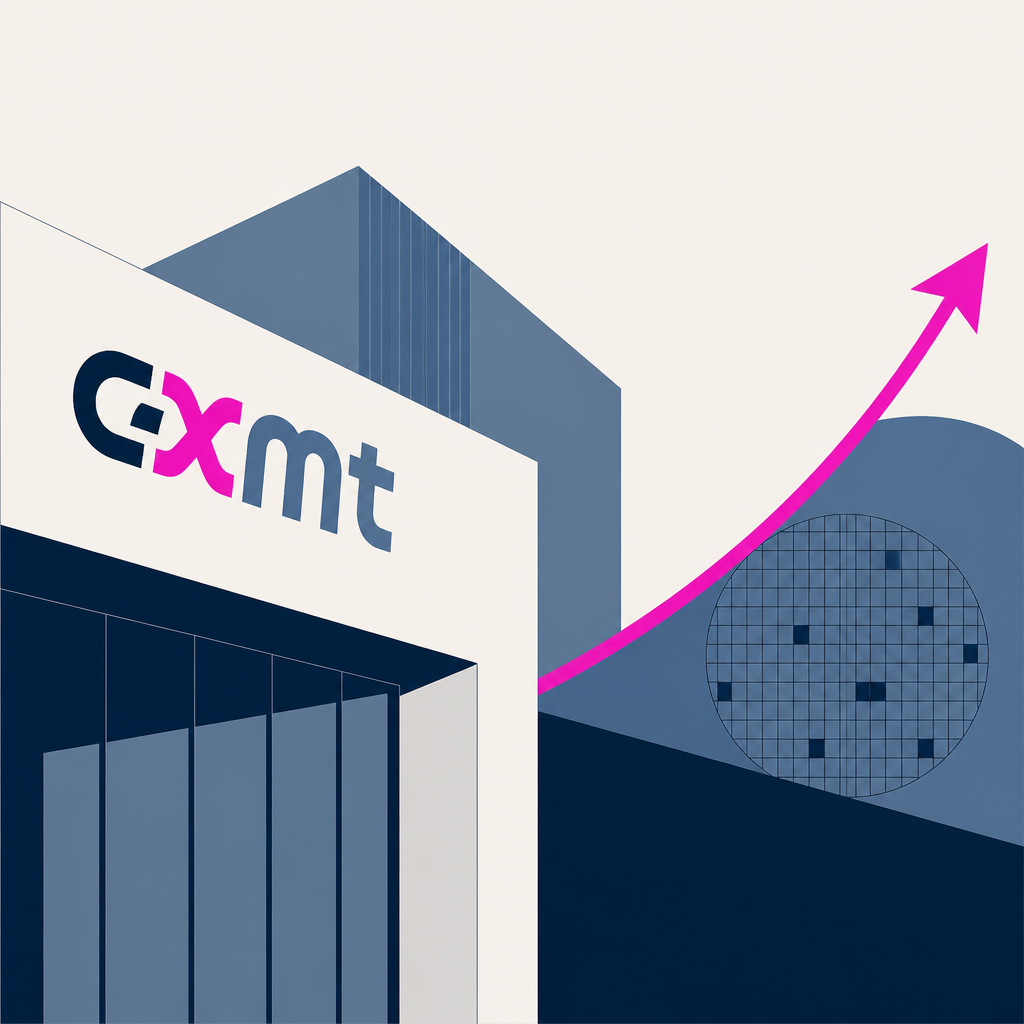
Chinese chipmaker CXMT's stock exploded 500% after its Shanghai debut, briefly making it the country's most valuable company. Experts are split on whether that's a lasting shift or just an AI memory-shortage fluke.
Based on reporting by Fortune, Angelica Ang — read the original for the full story.
Summary, retelling and take written by AI under human oversight; images are AI-generated illustrations. How we work · Report an error
CXMT didn't just have a good week. It had the kind of week that rewrites market rankings overnight. Shares in the Chinese memory chipmaker rocketed more than 500% after its Shanghai listing debut on July 27, then kept climbing, closing Friday up 8.95% at 57.60 yuan. That put its market cap at 3.54 trillion yuan, roughly $523 billion, enough to knock the Industrial and Commercial Bank of China off the top spot as China's most valuable company.
The timing is no accident. Apple CEO Tim Cook described the current memory market as a "100-year flood" on pricing during last Thursday's earnings call, with exponential cost increases squeezing supply chains everywhere. That scarcity is exactly what's pushing companies to look at Chinese suppliers they might otherwise avoid, and Apple itself had been in talks to buy chips from both CXMT and Yangtze Memory Technologies, or YMTC. But those talks drew immediate political fire. A group of U.S. lawmakers, including Jim Banks and Chuck Schumer, sent Tim Cook a letter on July 30 warning him off buying from either company, both of which sit on an updated Pentagon list of firms believed to support China's military.
Analysts are careful not to read too much into the stock surge. Barbora Valockova of the Lee Kuan Yew School of Public Policy calls the moment a market "distorted" by AI demand, shortages and state industrial policy rather than proof China has closed the gap. Kong Tuan Yuen of the National University of Singapore's East Asian Institute expects companies to treat CXMT as a backup supplier, not a primary one, as firms diversify geographically to hedge geopolitical risk. And the cost math still favors the incumbents: Futurum's Rolf Bulk told CNBC that CXMT sits two to three generations behind SK Hynix, Samsung and Micron, forcing it to spend 20% to 30% more per bit of output.
Still, the ripple effects were real. Nvidia dropped 5% on Monday, while SK Hynix and Samsung both plunged over 13%, before recovering by Friday on strong earnings from Microsoft and Amazon that reignited AI spending optimism. Chen Gang of NUS argues the speed of China's catch-up shouldn't be underestimated, pointing to how CXMT and YMTC can tap domestic capital markets and government backing to scale faster than foreign rivals. There's also word that an unnamed Chinese firm has begun building an immersion deep ultraviolet lithography machine, the kind of equipment historically dominated by Dutch firm ASML, part of Beijing's long push to build chipmaking tools independent of U.S. export controls.
Kong sums up the dynamic as a self-reinforcing loop: government investment, domestic sourcing mandates, and now demand from foreign firms like Apple all feeding into faster progress up the value chain, tempered by the drag of U.S.-China tensions that never fully goes away. Investors will soon get another crack at this story, with YMTC now moving through the pre-IPO process for its own Shanghai listing.
My take — AI-written commentary, not fact-checked reporting
A 500% pop driven by a supply crunch and state-backed capital isn't the same thing as technological parity, and anyone treating CXMT's valuation as proof China has caught up to Micron or Samsung is confusing scarcity pricing with engineering progress. The real story here is political, not technical: Apple wanting cheaper chips while US lawmakers threaten to block the deal shows the memory shortage is forcing everyone into uncomfortable choices faster than the geopolitics can keep up. Expect CXMT to stay a backup supplier for a while yet, cost gap and blacklist status included, no matter how loud the stock chart gets.
Read more about this at: Fortune
Related stories
 China's AI-fueled IPO boom hits $54 billion this year, with chipmakers and Shein's $1.7 billion IPO
Fortune ·
15
SK Hynix's U.S. debut positions company as bet on AI breaking chip cycle
Bloomberg · 2 months ago ·
16
China's AI-fueled IPO boom hits $54 billion this year, with chipmakers and Shein's $1.7 billion IPO
Fortune ·
15
SK Hynix's U.S. debut positions company as bet on AI breaking chip cycle
Bloomberg · 2 months ago ·
16