
Cisco Foundation AI Releases Antares: 350M and 1B Open-Weight Models That Localize Known Vulnerabilities Inside Real Codebases
MarkTechPost Michal Sutter
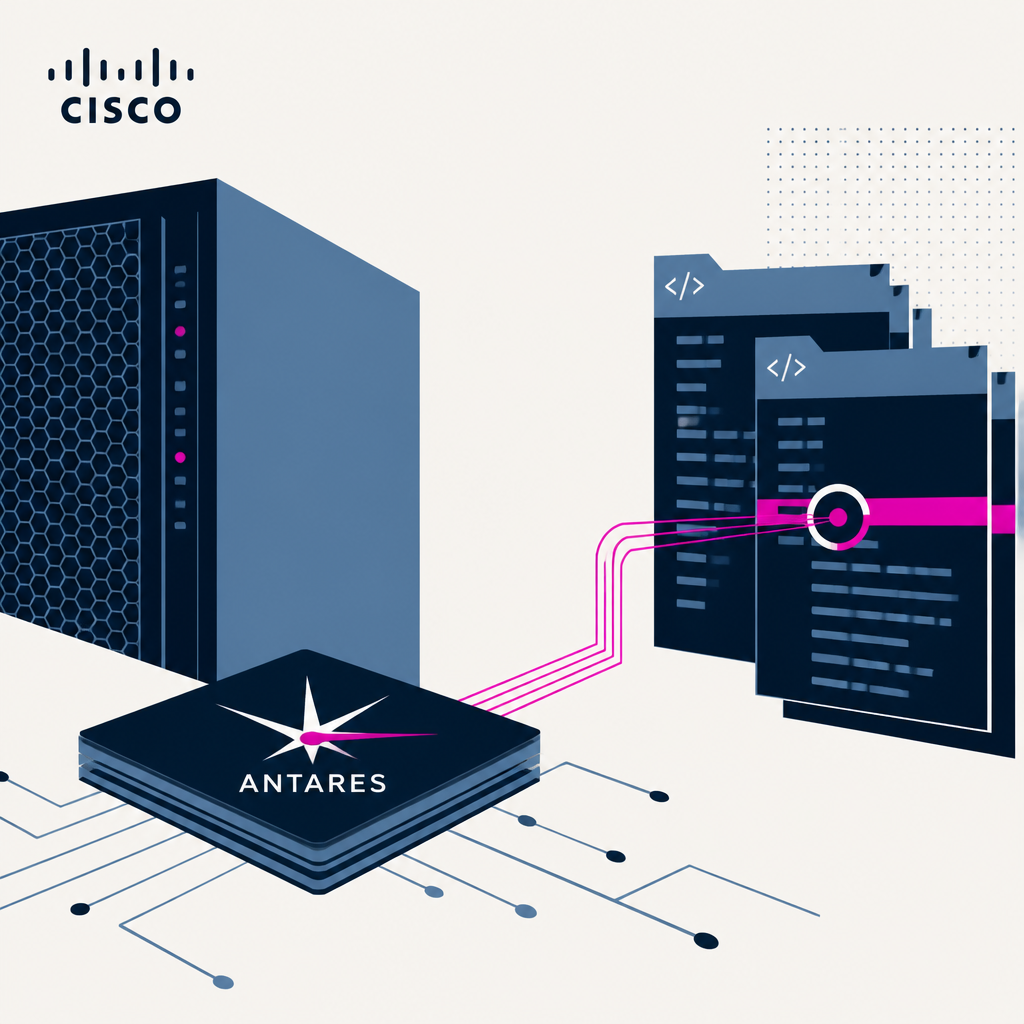
Cisco just open-sourced tiny AI models built for one job: finding which files in your codebase have a known security bug. A 1B model comes close to GPT-5.5 on this narrow task, beating a 753B open model.
Based on reporting by MarkTechPost, Michal Sutter — read the original for the full story.
Summary, retelling and take written by AI under human oversight; images are AI-generated illustrations. How we work · Report an error
Cisco's Foundation AI team has a habit of picking one unglamorous problem and building something small and sharp for it. This time the target is vulnerability localization: given a description of a known flaw and a real repository, figure out which files actually contain it. That sounds trivial until you've spent an afternoon grepping through someone else's dependency-heavy codebase trying to match a CWE advisory to actual source lines. Cisco calls this the expensive triage step that eats developer time before any real remediation work starts, and it built a family of models called Antares specifically to shrink it.
Two of the three models are out now on Hugging Face under Apache 2.0: Antares-350M and Antares-1B, both built on IBM's Granite 4.0 checkpoints with the usual modern plumbing — grouped-query attention, SwiGLU, RoPE, RMSNorm. A 3B version exists but hasn't been released. Cisco also published VLoc Bench, a 500-task benchmark pulled from 290 real GitHub repositories across npm, pip, Maven, Go, Rust, and Composer, covering 147 CWE categories with 78% of entries tied to actual CVEs. Ground truth comes straight from the files touched in the real security patch, which is a clean way to avoid hand-labeled guesswork.
What makes the release interesting isn't a leaderboard-topping score — it's the gap between model size and performance. Antares-1B, at roughly 1.6 billion parameters, hits a File F1 of 0.209 running inside a sandboxed agent loop with 15 read-only terminal commands and no advisory text, just a bare CWE description. GPT-5.5 scores 0.229 on the same task. A 753B-parameter open-weight model only manages 0.186. That's a two-order-of-magnitude size difference producing a result within striking distance of, and in one case behind, a model 500 times larger.
The evaluation setup itself deserves a mention because it's stricter than most benchmark theater. The model works inside a networkless Docker sandbox, output per command is capped at 2,000 characters, and it has to actively decide to submit a ranked list of files or declare no vulnerability at all. VLoc Bench even runs a second phase on the patched version of the same repo to check whether the model cries wolf on code that's already been fixed. Cisco is upfront that Antares isn't a replacement for dependency scanners, secret detection, or dynamic testing — it's meant to sit ahead of that stack, doing the unglamorous job of pointing a human or another tool at the right files faster.
My take — AI-written commentary, not fact-checked reporting
This is the correct instinct in an industry obsessed with parameter counts: pick a task narrow enough that a model under two billion parameters can specialize its way past something 500 times its size. I'd rather see ten more of these boring, scoped security tools shipped open-weight than another giant general model claiming it can do everything a little better. Security tooling especially benefits from small, auditable, self-hostable models — nobody wants to pipe their unpatched CVE details through a third-party API.
Read more about this at: MarkTechPost
Related stories
 Sakana AI Releases Fugu-Cyber: An Orchestration Model Reporting 86.9% on CyberGym and 72.1% on CTI-REALM
MarkTechPost · 1 month ago ·
24
When vendor-supplied support matters: How AI is changing the open source security equation
The New Stack · 1 month ago ·
6
Sakana AI Releases Fugu-Cyber: An Orchestration Model Reporting 86.9% on CyberGym and 72.1% on CTI-REALM
MarkTechPost · 1 month ago ·
24
When vendor-supplied support matters: How AI is changing the open source security equation
The New Stack · 1 month ago ·
6
 Microsoft AI Releases MAI-Cyber-1-Flash: A 5B-Active-Parameter Cyber Model That Pushes MDASH to 95.95% on CyberGym
MarkTechPost · 1 month ago ·
42
Microsoft AI Releases MAI-Cyber-1-Flash: A 5B-Active-Parameter Cyber Model That Pushes MDASH to 95.95% on CyberGym
MarkTechPost · 1 month ago ·
42