
Apple to Skip High-End M6 Mac Chips in Favor of AI-Focused M7 Line
Bloomberg
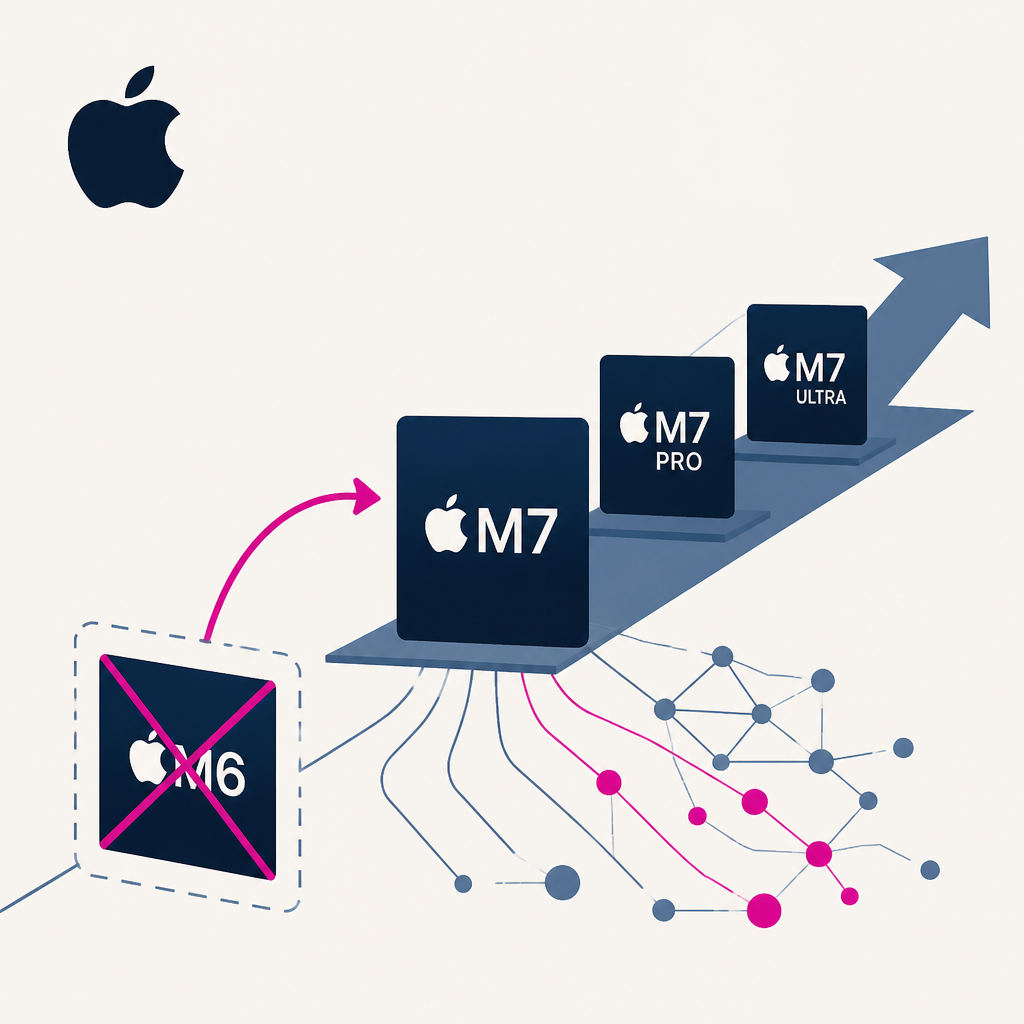
Apple's reportedly skipping the high-end M6 Mac chips entirely, jumping straight to M7. Pro and Max versions could land by late 2027, Ultra by 2028 — all built around AI.
Based on reporting by Bloomberg — read the original for the full story.
Summary, retelling and take written by AI under human oversight; images are AI-generated illustrations. How we work · Report an error
Apple's chip roadmap just got a reshuffle, and it tells you a lot about where the company thinks the next few years of computing are headed. According to the latest reporting, the M7 Pro and M7 Max could arrive as early as the end of 2027, with the beefier M7 Ultra following in 2028. The twist: there's no high-end M6 in between. Apple appears to be skipping that tier entirely to get to M7 faster.
That's a notable break from the usual cadence. Apple has spent years marching through M1, M2, M3, M4, and M5 variants at a fairly predictable pace, with Pro, Max, and Ultra chips trickling out roughly a year after their base siblings. Jumping straight past a high-end M6 suggests Apple isn't just chasing incremental clock-speed and core-count bumps anymore. It's optimizing for something specific, and the pattern points squarely at AI workloads — bigger neural engines, more memory bandwidth, and architecture built to handle on-device model inference rather than just faster video exports.
The timing lines up with the broader industry scramble. Every major chipmaker, from Qualcomm to Intel to Nvidia, is racing to bake AI acceleration deeper into silicon, and Apple's Neural Engine has already been the quiet backbone of features like on-device Siri improvements and image processing. If M7 is genuinely engineered around AI from the ground up rather than retrofitted, that's a meaningful shift in priorities, not just a marketing label slapped on a spec sheet.
There's also a practical angle here: skipping a chip generation at the high end saves Apple engineering cycles and lets it consolidate R&D toward architecture that actually matters for the next several years, rather than spending a cycle on a stopgap. It's a bet that AI capability, not raw performance-per-watt bragging rights, is what will differentiate the Mac lineup going forward. Whether consumers actually notice or care by 2027 is the real open question.
My take — AI-written commentary, not fact-checked reporting
Honestly, skipping a whole chip tier to chase AI is the most Apple move possible — cautious, deliberate, and years out from when anyone will actually judge whether it paid off. I'd bet this is less about a genius AI breakthrough and more about Apple realizing its on-device AI story has been underwhelming and needing real silicon headroom to catch up to what Qualcomm and Nvidia are already shipping.
Read more about this at: Bloomberg