Apple refreshes Mac mini, Mac Studio lineups with new chips
SiliconANGLE Maria Deutscher ● Covered by 7 sources
Apple just refreshed the Mac mini and Mac Studio with new chips. The surprise: its top Mac mini chip is the first 2-nanometer Apple silicon.
Based on reporting by SiliconANGLE, Maria Deutscher — read the original for the full story.
Summary, retelling and take written by AI under human oversight; images are AI-generated illustrations. How we work · Report an error
Apple has rolled out four new custom chips and used them to refresh both the Mac mini and Mac Studio. The Mac mini now comes in two versions, each with its own processor. So does the Mac Studio. Apple is leaning hard on its own silicon again, and this time the pitch is not just speed, but more on-device AI muscle and newer manufacturing tech.
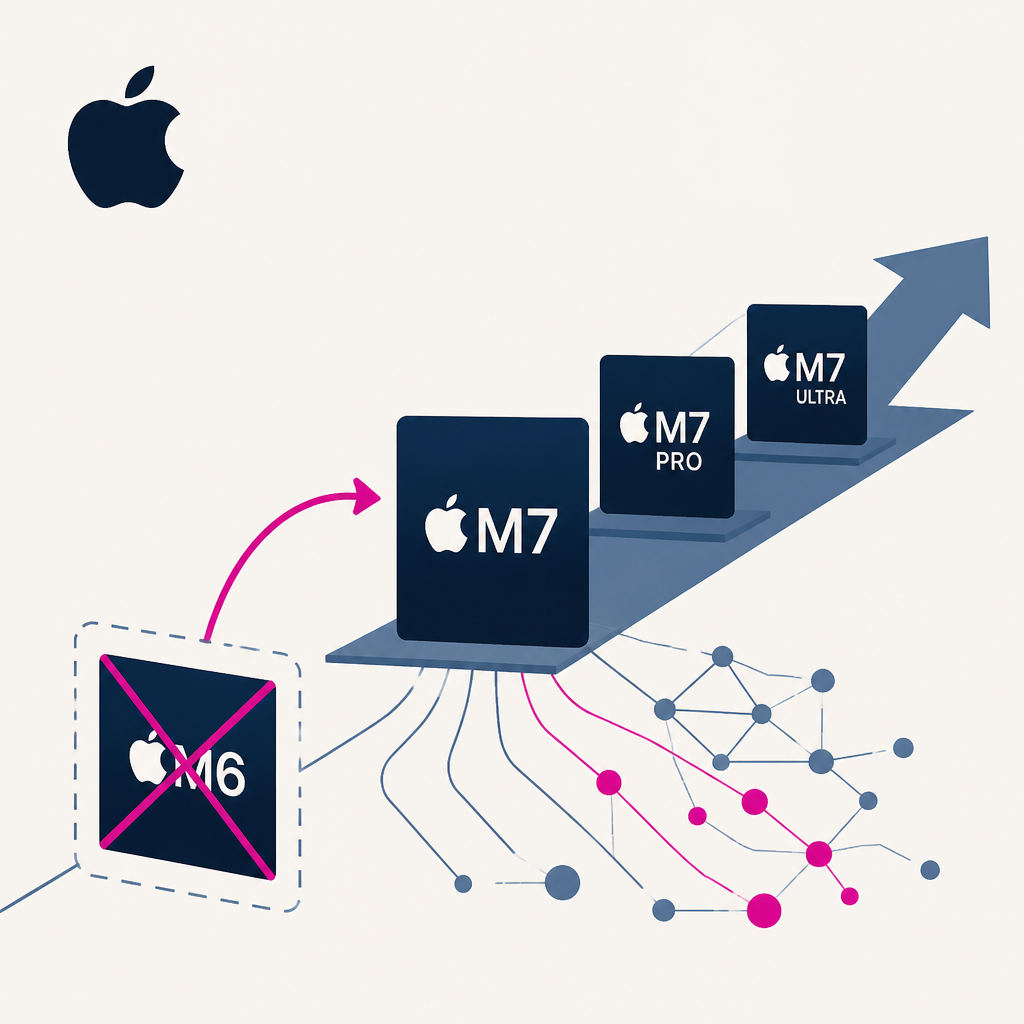
The headline chip is the M6, which ships in one Mac mini edition. It’s Apple’s first chip made on Taiwan Semiconductor Manufacturing Co.’s latest two-nanometer process. Apple says the chip uses SHPMIM capacitors to help with power delivery, soaking up extra energy or filling in gaps when the chip’s needs jump too quickly. The M6 also bumps both CPU and GPU core counts to 12, with two performance cores, six efficiency cores and four midrange cores on the CPU side. The GPU cores include AI-focused circuitry, and the chip has a 16-core Neural Engine.
The other Mac mini option is the M5 Pro. It doesn’t use TSMC’s newest node, but Apple says its CPU and GPU have six and eight more cores, respectively, than the M6’s corresponding blocks. It also carries a 16-core AI accelerator. Apple says it can run on-device large language model prompts up to four times faster than the M4 Pro. The M6 is said to be 4.8 times faster than the M4, and Apple says the new chip can also speed up work like Excel calculations. The M6 Mac mini starts at $899 with 16 gigabytes of memory and 256 gigabytes of storage. The M5 Pro model starts at $1,699 with 25 gigabytes of memory and a 512-gigabyte flash drive.
Mac Studio gets its own pair of upgrades. The entry model uses the M5 Max, with an 18-core CPU, a GPU with up to 40 cores and a 16-core Neural Engine. The pricier version uses the M5 Ultra, which is built from two M5 Max chips linked by a custom interconnect. Apple also built in its N1 chip for Wi-Fi 7 and Bluetooth 6, plus separate video codec circuits. Pricing starts at $2,499 for the M5 Max Mac Studio, and $5,499 for the M5 Ultra.
My take — AI-written commentary, not fact-checked reporting
Apple is doing what Apple does best: making the chip story the product story. But the real tell is how much of this pitch is about keeping work inside the machine, from large language models to video codecs. That’s not just faster Macs; that’s Apple quietly betting users will pay a premium to avoid the cloud circus.
Read more about this at: SiliconANGLE