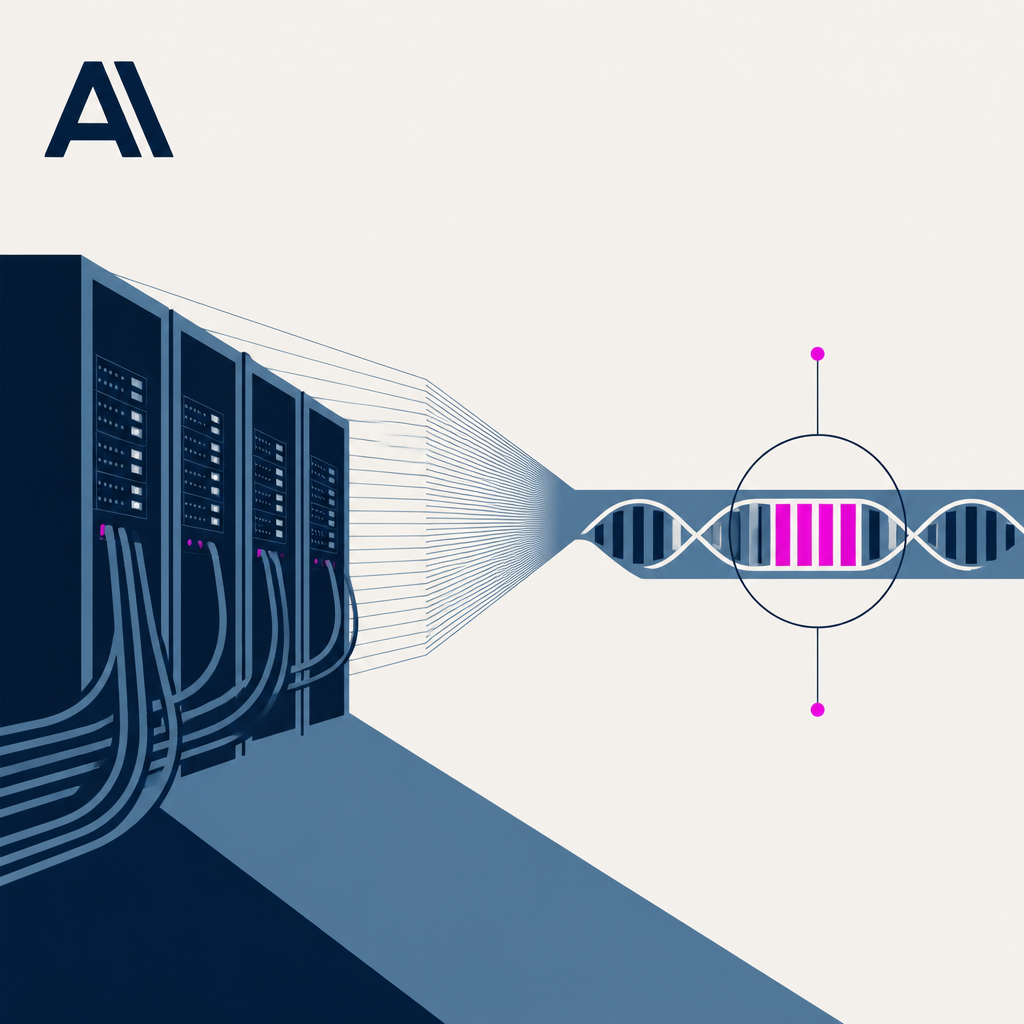
Anthropic says its biology lab has already found something big
TechCrunch Julie Bort ● Covered by 4 sources
Anthropic says Claude helped find a new enzyme system in its Bay Area bio lab. It could cut, copy, and paste DNA — and it took just 21 hours.
Based on reporting by TechCrunch, Julie Bort — read the original for the full story.
Summary, retelling and take written by AI under human oversight; images are AI-generated illustrations. How we work · Report an error
Anthropic has gone from admitting it had a wet biology lab to claiming it already found something potentially important inside it. The company says Claude helped uncover a previously unknown enzyme system hidden in bacteriophage DNA, and that it has “properties reminiscent of CRISPR.” In practical terms, Anthropic says it behaves a bit like the famous gene-editing system, with the ability to cut, copy, and paste DNA.
That’s a big claim, but not a settled one. Anthropic itself says the broader research community will have to judge how novel the discovery really is. CEO Dario Amodei also acknowledged on X that Stanford researchers had previously found a system that was in some ways similar. Still, Anthropic is leaning hard into the idea that Claude did most of the heavy lifting.
The speed is the part that jumps out. The lab was set up this spring, though Anthropic won’t say exactly how many months ago. The company says Claude needed just 21 hours of focused work, using about 950 agents and 210 million tokens, to get there. That is an eye-catching number even before you get to the biology.
And the lab itself is more ordinary than the sci-fi version. Anthropic says it’s a typical molecular biology lab in the Bay Area, working only at the BSL-1 and BSL-2 levels and not handling pathogens that infect humans. The actual experiments were done by human scientists. Amodei says Claude could one day control lab equipment itself, but that isn’t happening yet.
The timing matters too. This arrives just as AI leaders, including Amodei, have been talking publicly about the need to slow down and build better safety testing around powerful models. Anthropic is clearly betting that the upside in biology is worth the risk. And the company is hardly alone: Stanford, UC San Francisco, and Google have all already pushed AI into biology research in different ways.
My take — AI-written commentary, not fact-checked reporting
This is exactly the sort of announcement that makes AI labs sound very brave and very eager at the same time. The real story is not “Claude the scientist,” it’s that the industry keeps inching toward biological work while insisting the safety brakes are somewhere nearby. That’s a comforting sentence right up until the day someone decides to trust the machine a little too much.
Read more about this at: TechCrunch