AI took three quarters of UK venture funding this year. Its margin problem is still unsolved.
Tech Funding News Gavin Lester ● Covered by 6 sources
UK AI startups grabbed $12.6bn in H1 2026, nearly 75% of all British VC money. Problem: their profit margins still lag way behind normal software.
Based on reporting by Tech Funding News, Gavin Lester — read the original for the full story.
Summary, retelling and take written by AI under human oversight; images are AI-generated illustrations. How we work · Report an error
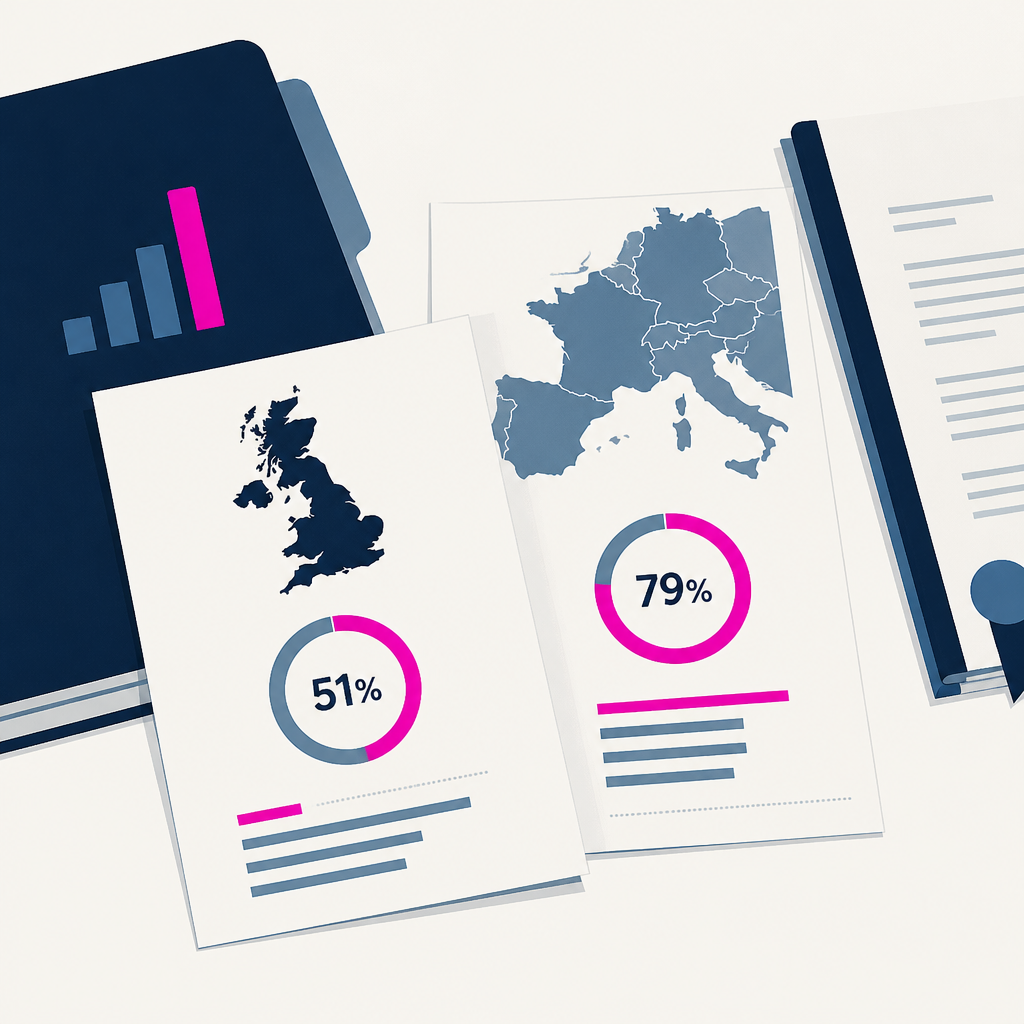
British AI firms just had a blockbuster half-year. HSBC Innovation Banking and Dealroom put UK AI funding at $12.6bn for the first half of 2026, over four times the same period last year, and close to three-quarters of all venture capital raised in the country. Total UK venture funding hit $17bn, its strongest opening to a year since 2022, with Britain capturing 39% of all European venture capital. That is a genuinely striking run of numbers.
But the money is flowing into businesses whose economics look nothing like the software companies investors are used to backing. ICONIQ's State of AI survey, drawing on roughly 300 executives, found AI product gross margins averaging around 52% in 2026, up from 41% in 2024 and 45% in 2025. Progress, sure. Still 25 to 30 points below the 75% to 85% margins traditional software has delivered for two decades. And the gap isn't evenly spread: Bessemer's research found the fastest-scaling companies, those hitting $100m in annual recurring revenue in around eighteen months, running at roughly 25% gross margins, while a more capital-efficient group averaged around 60%.
The part that should worry anyone valuing these companies on old assumptions is the direction of travel. ICONIQ's data shows model inference climbing from 20% to 23% of total spend as products mature, while talent costs fall from 32% to 26%. Software margins used to expand with scale because cost of goods sold was basically fixed. Here, the dominant cost is per-query and grows with usage. A company losing money at a hundred customers doesn't get saved by reaching a thousand.
That changes how boards should think about where compute runs. For most companies, renting via API is still correct, especially with spiky usage or a product that's still changing every fortnight. The question only bites once a company runs its own models on its own GPUs at sustained, predictable utilisation. Even then, there's no universal break-even number, despite the internet being full of confident ones; the only reliable calculation is on your own bill. One real documented case, 37signals, spent $3,201,564 on cloud in 2022, bought roughly $700,000 of Dell hardware to leave, recouped that outlay during 2023, and co-founder David Heinemeier Hansson projected savings well over $10m across five years. But that's a stable SaaS workload, not AI inference, and doesn't transfer automatically.
Britain adds a wrinkle the American version of this debate doesn't have: capacity is rationed. The demand-connection queue for the transmission network reached 125GW against national peak demand of around 45GW, prompting the National Energy System Operator's largest ever connection reforms in December 2025. Transformers carry two-to-four-year lead times, and data centre vacancy has fallen from 27% in 2016 to 8% in early 2026. Meanwhile inference costs keep dropping, and ICONIQ's own margin improvement is partly that effect, so some of this may solve itself without any infrastructure decision. Still, in a year when AI absorbed three-quarters of UK venture funding, the founders and investors who actually understand their compute line are working from a far better map than the ones still running a 2021 software playbook.
My take — AI-written commentary, not fact-checked reporting
The funding numbers are the fun part to talk about, but the margin data is the part that actually decides who's still standing in three years. A sector where compute costs grow as a share of spend while it scales is not a sector that gets fixed by growth alone, and anyone still pricing AI startups off a Rule of 40 built for fixed-cost software is going to get an unpleasant surprise. Britain's power-grid queue makes this worse, not better: even founders who do the maths and decide to build their own infrastructure are stuck behind a multi-year wait to get the capacity to act on it.
Read more about this at: Tech Funding News