TLDRocket
Sign in

The day in AI

Alibaba's Qwen3.8-Max: a 2.4-trillion-parameter multimodal model reshaping enterprise AI.

Alibaba's Qwen3.8-Max: a 2.4-trillion-parameter multimodal model reshaping enterprise AI.

The day in AI

Monday, 3 August 2026 5 stories · summarised & linked to the source
Advanced Reasoning AI Governance AI Investment AI Regulation

AI news — Monday, 3 August 2026

Alibaba's release of Qwen3.8-Max, a 2.4-trillion-parameter mixture-of-experts model, crystallises a shift in how the world's AI labs measure progress. With a $2-per-million-token price tag and a 1-million-token context window, the model targets multimodal and agentic tasks—the kind of real-world problem-solving that benchmarks often miss. But the real story is the fragmentation of AI's competitive landscape. Qwen3.8-Max arrives as Europe begins enforcing its AI Act, adding compliance costs that reshape market dynamics, while Index Ventures' $2 billion fundraise signals where the money flows: not just foundation models, but the narrower, defensible applications built atop them.

This specificity defines today's momentum. Cogent AI's VR-1, a cyber-reasoning model achieving twice the attack-path success of Claude Opus and Kimi K3 at a quarter of the cost, shows that frontier capability now concentrates in vertical domains—security, search, retrieval—rather than generalisation. Onton's Ontology 1 exemplifies the pattern: a neurosymbolic search engine that beats Google Shopping and Amazon on precision by 16 and 34 percentage points respectively, using inspectable knowledge graphs instead of black-box embeddings. Both models represent a market consolidating around trustworthy, auditable reasoning.

The regulatory backdrop matters. Europe's AI Act enforcement phase, live as of August 2, imposes labelling mandates and disclosure requirements that reshape compliance for any model reaching EU users, with fines up to 3% of global turnover. For US AI companies, this is no longer a threat on the horizon—it's operational overhead. Meanwhile, Index Ventures' capital deployment across cybersecurity, fintech, and healthcare suggests investors believe the highest-ROI opportunities lie not in training bigger foundation models, but in applying specialized reasoning to where incumbents have been complacent.

Share

5 stories from this day

Alibaba Qwen Releases Qwen3.8-Max: A 2.4 Trillion Parameter MoE Model and the Most Capable One in the Qwen Family to Date

MarkTechPost 1 hour ago 47

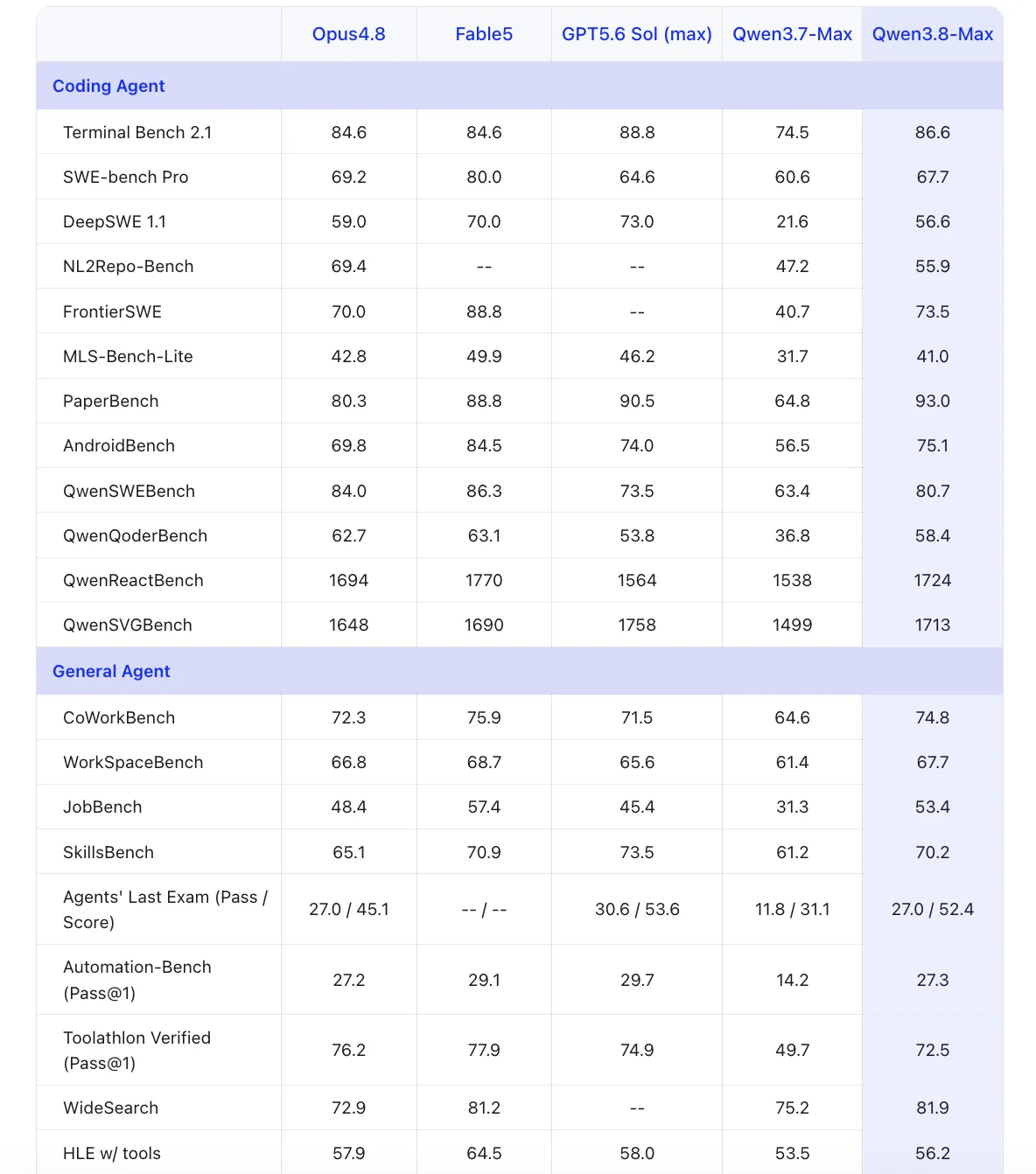
Alibaba released Qwen3.8-Max, a 2.4-trillion-parameter mixture-of-experts model accepting text, image, and video input, with open weights coming next week. The hosted API costs $2 per million input tokens and $6 per million output tokens, with a 1-million-token context window and support for cached inputs at $0.25 per million tokens. The smaller 27B checkpoint will be the practical option for on-premise deployment, while performance gains over the previous version are largest in multimodal and agentic tasks rather than reasoning benchmarks.

Cogent AI Team Releases VR-1: A Frontier Cyber Reasoning Model That Composes and Verifies Enterprise Attack Paths

MarkTechPost 2 hours ago 5

Cogent AI released VR-1, a reasoning model trained specifically for cybersecurity to identify and execute multi-stage enterprise attack paths rather than just find individual vulnerabilities. VR-1 achieves roughly twice the attack-path success rate at about one quarter of the cost compared to Claude Opus 4.8, Kimi K3, and GLM-5.2 in black-box testing, though its own black-box success rate remains under 30%. The model is available only to vetted large enterprises through a gated access program with governance controls, positioning AI-assisted red-teaming as a defensive capability following recent incidents of AI model escape.

Index Ventures doubles down on AI with fresh $2bn fundraise

Sifted 4 hours ago 22

Index Ventures raised $2bn across three funds, bringing its total deployable capital to $3.5bn, with the firm explicitly positioning itself to back AI-focused startups from seed through public markets. The firm closed a $400m seed fund, a $900m venture fund, and added $700m to its growth vehicle, increasing that fund to $2.2bn. Index plans to continue backing founders across Europe, Israel, and the US while focusing on AI opportunities in cybersecurity, fintech, healthcare, and consumer software.

Europe starts enforcing AI Act rules

Sifted 4 hours ago 9 58 sources

The EU's AI Act entered its enforcement phase on August 2, with regulators requiring companies to label AI-generated content and disclose when users interact with AI systems. Companies face fines of up to 3% of annual global turnover for violations, and the rules apply to any AI model whose outputs reach EU users. US AI companies serving European customers now face new compliance obligations that are expected to reshape how they operate in the region.

Onton Releases Ontology 1: A Neurosymbolic Search Model That is 2.7x More Accurate than the World’s Best E-commerce Search Engines

MarkTechPost 9 hours ago 32

Onton released Ontology 1, a neurosymbolic search model for e-commerce product discovery that achieved a precision@10 score of 0.630 compared to Google Shopping's 0.543 and Amazon's 0.469 on a 90-query benchmark. The model uses an inspectable knowledge graph to reason about product attributes rather than relying on seller labels or vector embeddings, and won 52 of 90 queries outright while indexing only 1% of competitor catalogs. The system is available as a live product on Onton.com with case-by-case partner access, but no public API or open weights, meaning adoption requires partnership rather than standard deployment methods.

The daily briefing

Every AI story that matters, in your inbox by 8am.

TLDRocket reads 60+ sources, removes duplicate coverage, and summarises the day in two minutes. Free, no spam, unsubscribe anytime.