AWS Machine Learning
·
1 week ago
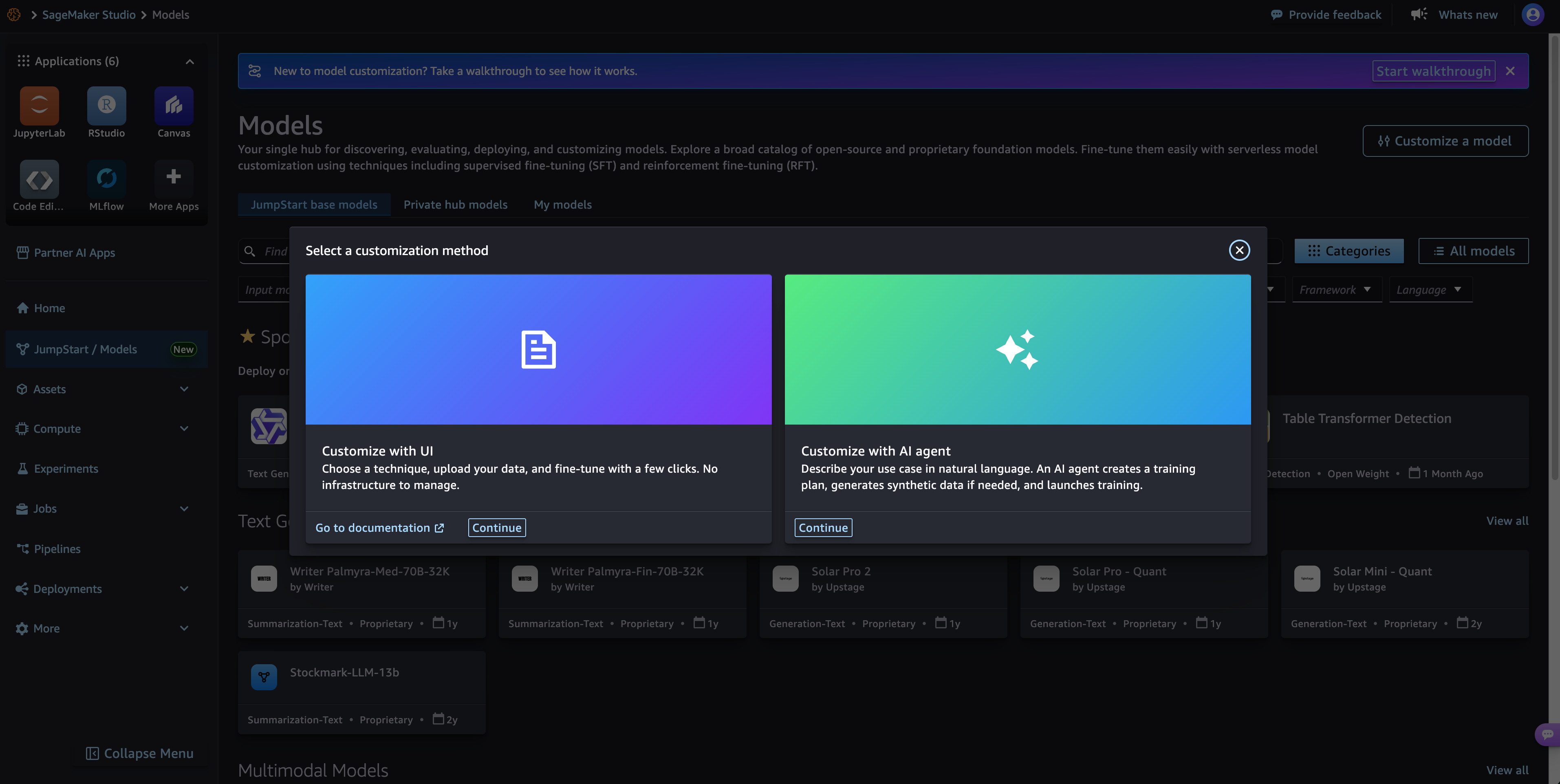
Amazon SageMaker AI now supports serverless fine-tuning for NVIDIA Nemotron 3 models, including Nemotron 3 Nano (30B parameters with 3B active) and Nemotron 3 Super (120B parameters with 12B active). The service offers three fine-tuning techniques—Supervised Fine-Tuning, Reinforcement Learning with Verifiable Rewards, and Reinforcement Learning from AI Feedback—allowing organizations to customize open-weight models without managing infrastructure. Users can access the customization workflow through SageMaker Studio console or Python SDK, with automatic compute provisioning and metric tracking via MLflow.
AWS Machine Learning
·
1 week ago
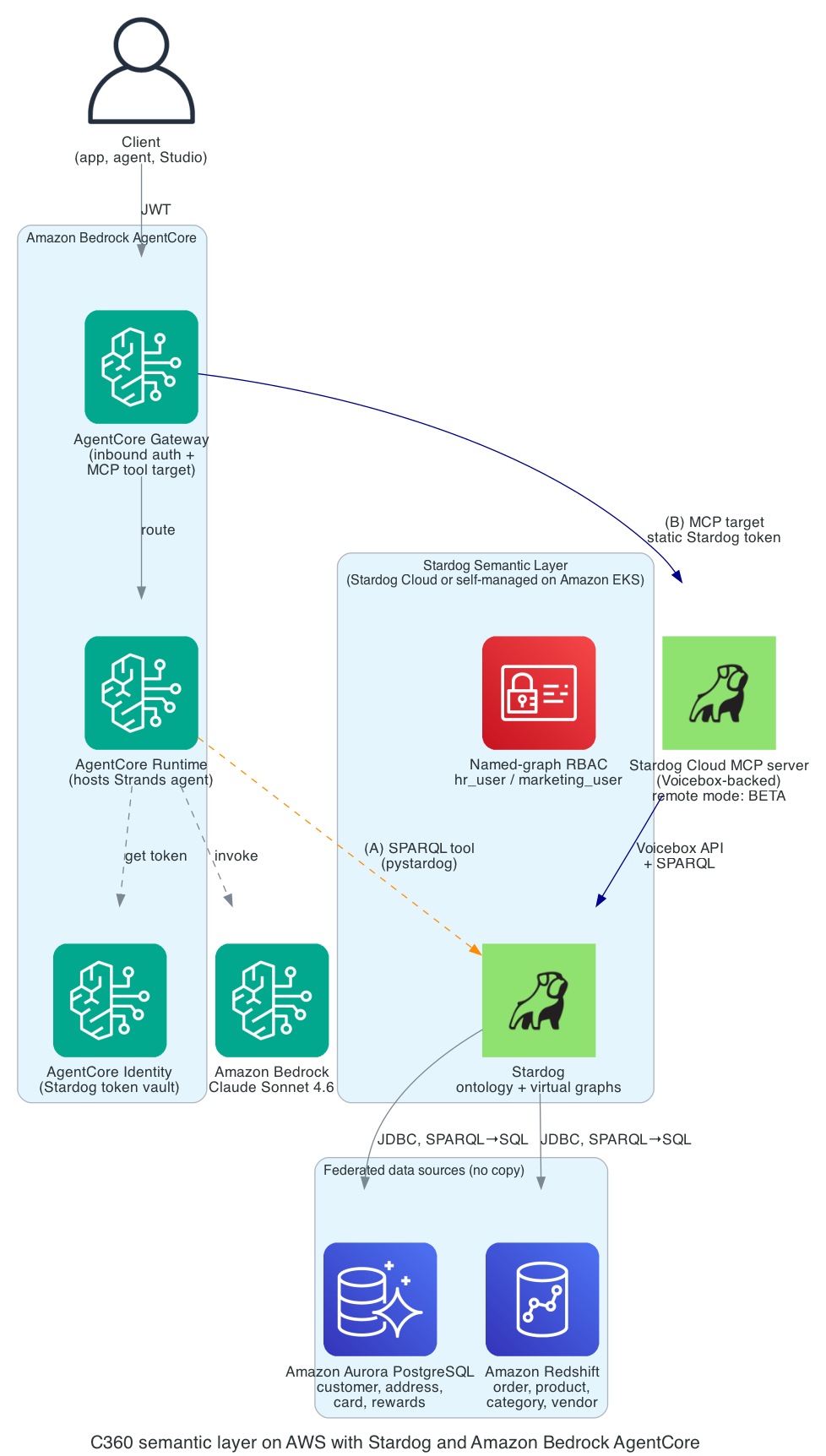
AWS and Stardog demonstrated building a semantic layer for agentic AI by connecting Amazon Aurora and Amazon Redshift through a federated knowledge graph that enables agents running on Amazon Bedrock AgentCore to answer cross-database questions without ETL pipelines. The solution uses an ontology-driven knowledge graph with virtual graphs mapping to live data sources, allowing the foundation model to compose answers across fragmented enterprise data while maintaining business logic rules and access controls. By separating the model layer, meaning layer, and agent runtime layer, organizations can enable AI agents to reason over enterprise data with the same fluency as senior analysts without duplicating business definitions across multiple systems.
AWS Machine Learning
·
1 week ago
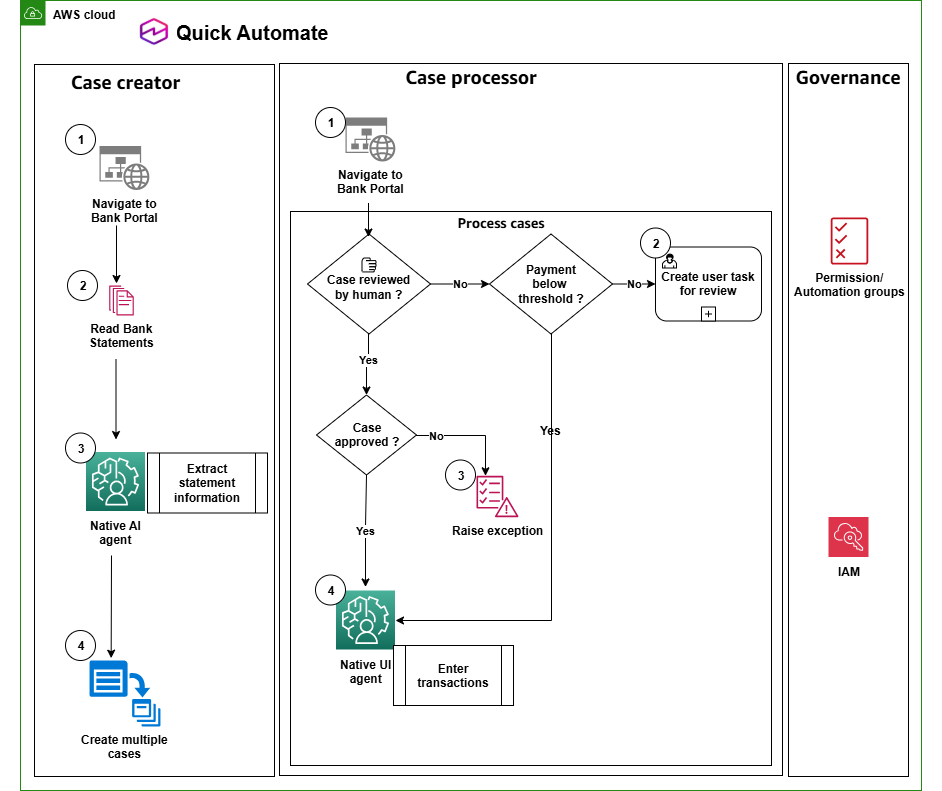
Amazon Quick Automate adds native case management to help enterprises run AI agents at scale, tracking work items through defined lifecycle stages while handling human oversight and parallel processing. The service enables organizations to process thousands of work items in production by providing visibility into workflow state, exception handling, and human-in-the-loop capabilities with built-in audit logging. Case management allows enterprises to automate complex business processes reliably by separating data ingestion from processing, enabling multiple parallel processors to handle concurrent work items and meet service level agreements.
AWS Machine Learning
·
1 week ago
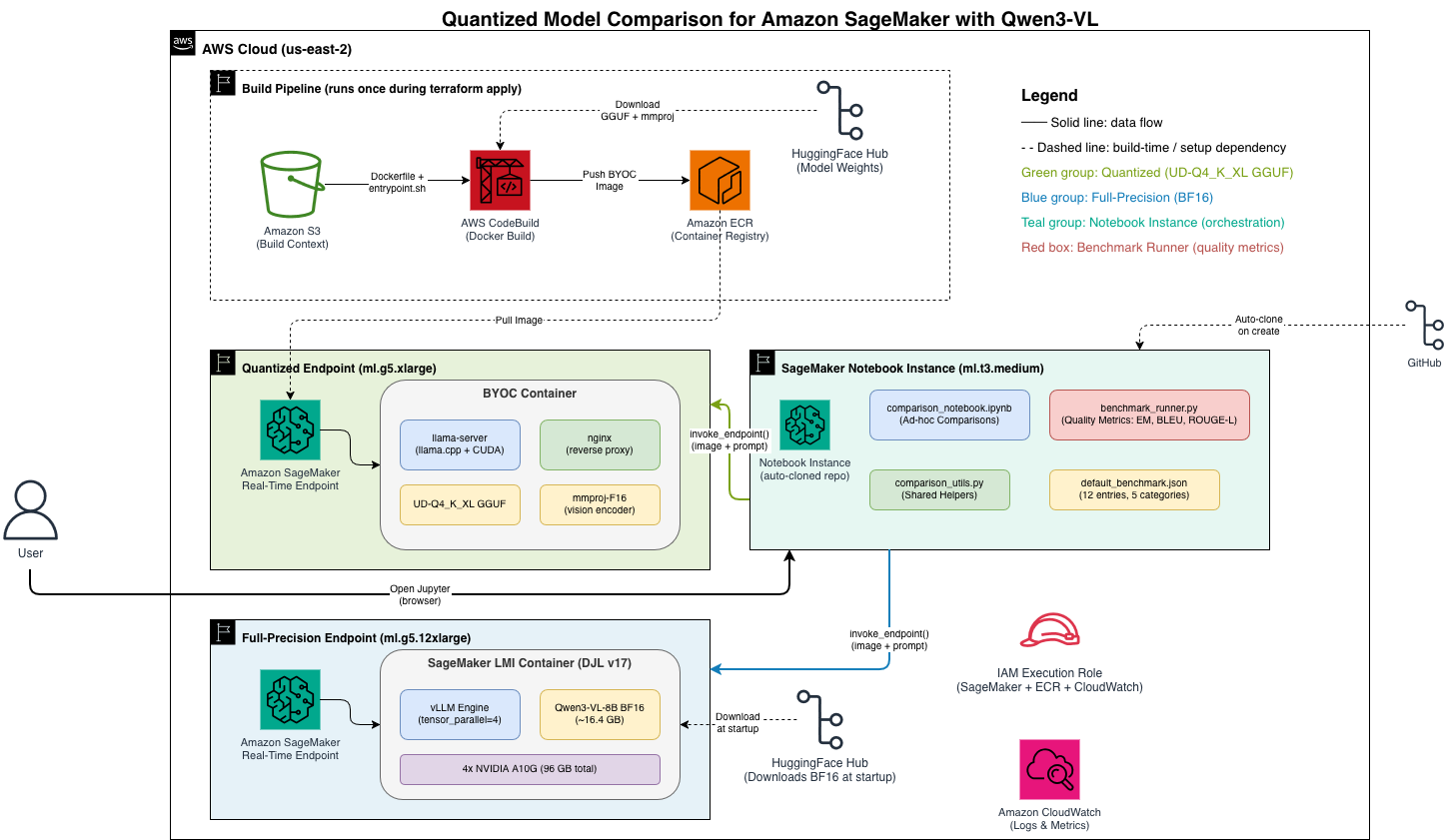
Amazon and Unsloth published guidance on deploying quantized large language models on AWS infrastructure using Unsloth's dynamic quantization technique, which reduces model precision selectively by layer rather than uniformly. A 1.5TB model quantized to 4-bit can be reduced to 217GB with only 14% accuracy degradation instead of 86%, as demonstrated with an 8-billion parameter model shrinking from 16GB to 5GB. The post provides four deployment patterns using EC2, SageMaker inference endpoints, EKS, and ECS, with examples including a Qwen model on ml.g5.xlarge at $1.41/hour versus $7.09/hour for full-precision serving.

TLDR Dev
·
1 week ago
Traycer is an open-source AI orchestration app that enables users to connect their existing AI agents and run multiple agents in parallel while maintaining shared context across different models and providers. The platform supports agents including Claude, Codex, Cursor, and OpenCode, with features for agent-to-agent communication, real-time team collaboration, and cross-device synchronization. Users can orchestrate complex workflows without vendor lock-in, switching between models instantly within the same conversation and structuring work through regular or Epic modes for multi-step tasks.

TLDR Dev
·
1 week ago
A software engineer who previously failed building a product with AI-generated code (70,000 lines of Roadtrip Ninja) built a new startup (Reclaim) that reached 900,000 lines almost entirely written by Claude Code, succeeding where the first attempt failed. The key difference was architectural ownership—the engineer designed the architecture first, then had Claude implement within those constraints, rather than letting Claude make architectural decisions autonomously. Model improvements from Claude Opus 4.5 (released one month after the first article) addressed specific complaints about context loss and instruction-following, but the author attributes success equally to better tooling, disciplined workflows, and maintaining human ownership of the product.

TLDR Dev
·
1 week ago
Progressive disclosure is an interaction design technique that presents essential features prominently while deferring specialized options to secondary layers, supported by 40 years of evidence showing novices learn faster and experts need only one additional click. Research from 1984 demonstrated that hiding advanced functions reduces beginner errors by approximately 25% and speeds learning, while modern applications of the pattern achieve an 80/20 split where most tasks complete at level 1. The pattern becomes increasingly important for AI agents and long-running processes, requiring careful data-driven decisions about what goes where, honest labeling, and strict adherence to two levels maximum to maintain usability and discoverability.
TLDR Dev
·
1 week ago
● 5 sources
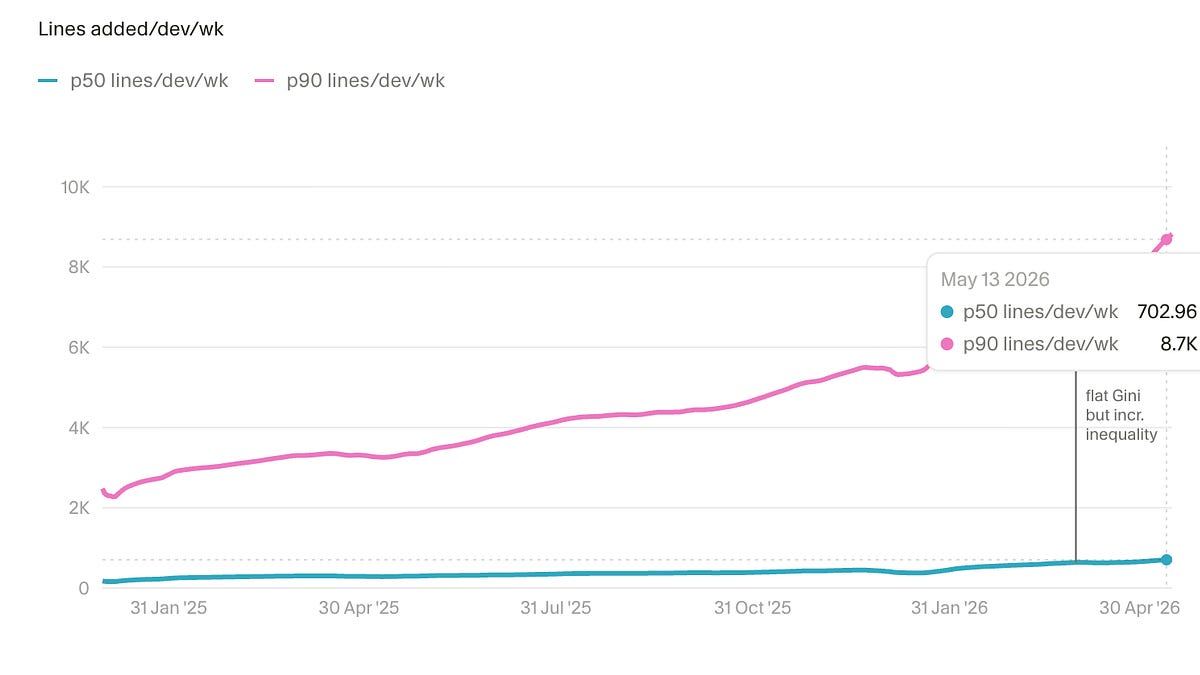
Cursor released a report on two years of aggregated usage data showing that median developers generate 700 lines of code per week with the tool, while top 1% users generate 30,000-40,000 lines weekly. Input tokens account for 90% of token usage and 70% of costs, with Cursor's Composer model being approximately 10x cheaper per request than Anthropic's Opus 4.7, though similar in cost-per-line-accepted. Developer behavior shifted dramatically in one month from 10% to 40% of users allowing AI agents to commit code without manual review, correlating with the release of more capable models like Opus 4.7 and GPT-5.5.

TLDR
·
1 week ago
PostHog engineers are removing themselves from code review bottlenecks by delegating reviews to multiple AI agents with different instructions rather than trying to review faster themselves. In one quarter, their StampHog agent automatically approved roughly one in three pull requests merged to their main repository, reducing 1.6K Slack interruptions for engineers. Teams can now focus human review only on genuinely risky changes by using deterministic checks for routing and having agents decompose large changes into small, independently observable pull requests.

Hugging Face Blog
·
1 week ago
PyTorch's profiler documentation on attention mechanisms was extended to show how different implementations of the attention operation appear in performance traces. The naive in-place attention implementation launches five GPU kernels and takes 1.955 ms, while the math backend of scaled dot product attention launches twenty kernels and takes 7.239 ms due to upcasting to FP32 and materializing intermediate matrices. Different SDPA backends optimize attention by fusing multiple operations into single kernels while maintaining numerical safety, with trade-offs between speed and precision visible in profiler traces.
