Latent Space
·
1 week ago
● 3 sources
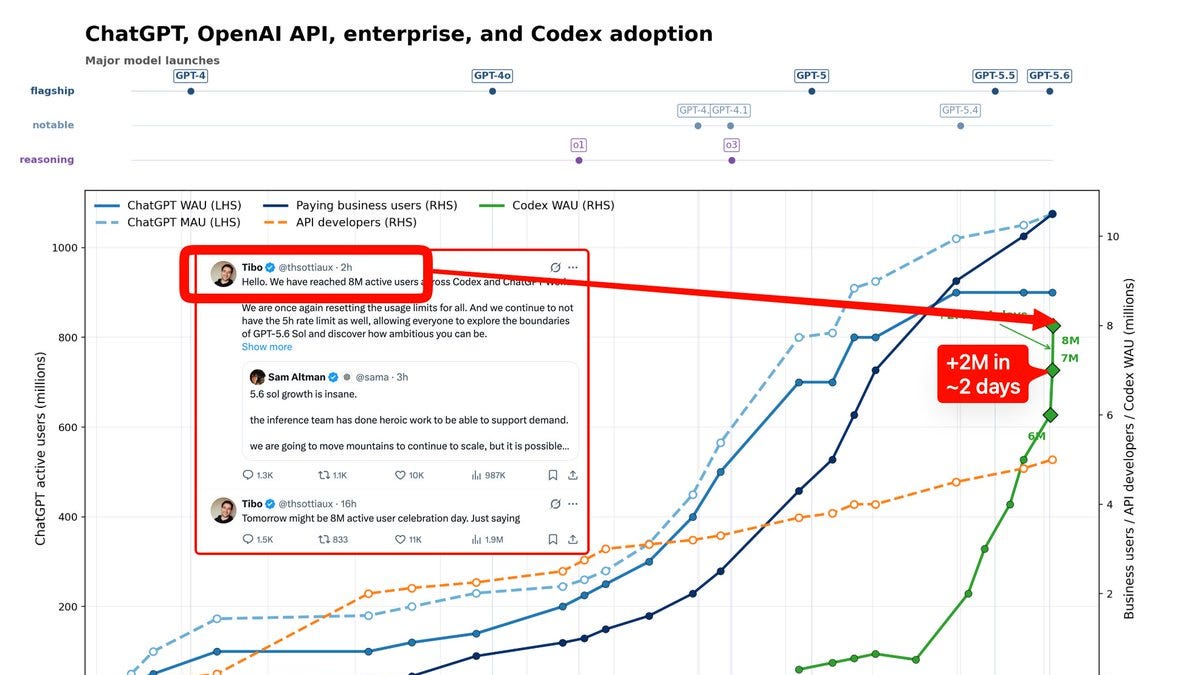
Superapp usage grew by 1 million users since the previous report, while OpenAI's Codex and ChatGPT Work products saw usage jump 2.5x in a week. PrismML released Bonsai 27B, a compressed model that runs on consumer devices at 3.9 GB and 1.125 effective bits while supporting multimodal and agentic workflows. The shift toward local inference and compressed models is making edge deployment viable for serious agent applications, while industry focus is moving from raw model quality to harness quality and observability as primary differentiators.
MarkTechPost
·
1 week ago
PrismML released Bonsai 27B, a quantized version of Qwen3.6-27B using 1-bit and ternary weight compression. The ternary variant achieves 5.9GB model size while retaining 94.6% of FP16 baseline performance, and the 1-bit variant reaches 3.9GB with 89.5% retention. These models enable running 27B-class quality inference on laptops and phones with practical memory constraints and improved throughput on resource-limited devices.

TLDR Dev
·
1 week ago
Anthropic analyzed 309,815 Claude conversations across three models and 20 languages to measure how Claude's expressed values vary, identifying four key axes: Deference vs. Caution, Warmth vs. Rigor, Depth vs. Brevity, and Candor vs. Execution. Sonnet 4.6 leans toward warmth and deference while Opus 4.7 emphasizes caution, rigor, and depth, with Claude also expressing notably different values across languages, particularly on the Warmth vs. Rigor axis where Arabic and Hindi lean toward warmth while English and Russian emphasize rigor. This research provides a framework to empirically track which values Claude expresses in different contexts and potentially connect those variations to specific training decisions and cultural contexts.

TLDR Dev
·
1 week ago
● 2 sources
OpenAI released GPT-5.6-Sol, Terra, and Luna models, with Sol priced at $5/$30 per input/output million tokens compared to Fable at $10/$50. Sol demonstrated capabilities including proving the 50-year-old Cycle Double Cover Conjecture using 64 subagents in under one hour and outperforming physician-written responses in healthcare evaluations. The models are positioned for practical task execution and coding work, with Sol serving as a cost-effective alternative to Fable despite trailing it on raw capability benchmarks.

Wired AI
·
1 week ago
● 2 sources
Researchers recovered the original source code for ELIZA, the 1960s chatbot, revealing multiple program versions and challenging popular misconceptions about how it worked and why people formed emotional attachments to it. ELIZA's design deliberately concealed its lack of understanding through scripted responses, yet Weizenbaum observed that users attributed intelligence and empathy to the system anyway—a phenomenon now called the ELIZA effect. Modern large language models like ChatGPT retain ELIZA's deceptive chatbot interface while obscuring their underlying machinery, raising concerns about how such obfuscation can lead to exploitation, privacy violations, and discrimination when systems are removed from meaningful social context.
Apple ML Research
·
1 week ago
Researchers introduced Pare, a framework that simulates active users to evaluate proactive AI agents in digital environments by modeling apps as finite state machines rather than flat APIs. The framework includes Pare-Bench, a benchmark with 143 tasks across communication, productivity, scheduling, and lifestyle applications that test context observation, goal inference, intervention timing, and multi-app coordination. This approach addresses limitations in existing proactive agent evaluation methods that fail to capture the stateful nature of real digital interactions.
