Pyka is testing pilot-free, self-flying electric crop-spraying aircraft that fly low over fields for more precise application. The crop sprayer’s electric flight time is about 35 minutes per battery cycle. Authorization and operating focus are expanding from limited agricultural use toward broader commercial autonomy, while pilots’ groups push back on safety and the plan shifts toward more capable detect-and-avoid and air-traffic communication systems.
Security teams are struggling to detect and govern agentic AI attacks because autonomous software can read, write, and move corporate content faster than humans. CrowdStrike extended its Falcon platform to police agents at the endpoint by treating each agent as an asset with an identity and data footprint, building on an enterprise device posture score Box introduced in July. Enterprises are now coming back for faster, real-time visibility and data controls across SaaS, endpoints, and cloud, while security leaders expect unsettled architectures and responsibilities to persist for 2–3 years.
NVIDIA and CrowdStrike announced SafeMind, an agentic cybersecurity system, alongside CrowdStrike Falcon IQ and expanded AI safety support at Fal.Con 2026. CrowdStrike said its Blue Solano model delivered higher accuracy than leading frontier models at 99% lower cost. The companies’ tooling is meant to ship inside the CrowdStrike Falcon platform and let defenders run continuous offense–defense coevolution and automated security workflows to reduce successful attacks.
Google rolled out five new Android updates covering accessibility, motion sickness support, remembering items, and more personalization in Google Messages. Motion Assist, which adds a moving bubble overlay to help with vehicle-related motion sickness, is available to Android 17 users. Guided Vision uses Gemini with the camera for blind and low-vision assistance, and Gemini will also power a new “remembered items” section in Find Hub, alongside other messaging and Keep-list sharing changes.
Anthropic released Claude Fable 5.1 and Claude Mythos 5.1 as two safeguard-layer variants of the same underlying model. Fable 5.1 scores 52.6% on Terminal-Bench-Science 0.1. Cache reads were cut 75% to $0.25 per million tokens, and accounts created on or after 2026-08-31 face breaking API changes for agents that edit conversation history.
Atlas by World Labs was launched as an omni world model that can generate camera-controlled 1440p video up to 1 minute and reconstruct scenes from a few photos. Atlas supports early access to combine text, images, video, and 3D with robotics-oriented scene simulation. The release creates a new foundation-model option aimed at generative media and 3D/robotics reconstruction workflows.
Anthropic released Fable and Mythos 5.1, updated versions of its most advanced AI model, with Fable intended to be less restrictive and both versions improving performance.
Anthropic released Fable 5.1 and Mythos 5.1 as updated versions of its flagship Claude models. Cache read pricing dropped 75% to $0.25 per million tokens, while Mythos 5.1 remains limited to Anthropic’s trusted access program and Fable 5.1 expands with broader Fable access via API/plan tiers. The changes also loosen cyber and biology safeguards (intervening 60% and 85% less often), add a private-preview detection API for watermarks, and roll out Enterprise Frontier Safeguards for zero data retention-style monitoring in phases starting later this fall.
Perplexity launched Hybrid Compute, letting its AI agents shift parts of a single task between cloud models and smaller models running on a user's Mac for privacy-aware processing. The local requirement is at least 32GB of unified memory on Apple silicon with macOS 15. Local execution means users can keep selected sensitive steps on-device and avoid token charges for locally generated output, while retaining overall task continuity without restarting.
Anthropic announced Claude Fable 5.1’s availability on Amazon Bedrock and Claude Platform on AWS. Claude Fable 5.1 is a Covered Model with data retention for up to 30 days and requires AWS’s aws_review mode for invocation. Customers can also opt into Enterprise Frontier Safeguards, including zero data retention until December 31, 2026, changing how prompts/outputs are stored and reviewed.
Z.AI released GLM-5.3-Flash on August 26 alongside earlier GLM-5.3, and one tester compared both models on three real-style tasks to check whether the cheaper model sacrifices accuracy. Flash was priced at $0.075 per million input tokens and used 38,677 output tokens on a hardest coding spec, taking 455.8 seconds versus GLM-5.3’s 174.7 seconds at 14,801 tokens. Accuracy stayed equal at 27/27 for both, but the outcome for users shifts by workload: Flash is cheaper and faster on easier extraction while the flagship is faster for difficult coding and may change cost-effectiveness if pricing changes.
CrowdStrike introduced SafeMind, an autonomous red teaming system that uses AI models to attack and remediate a digital twin in a closed loop. The setup runs inside its Falcon platform and uses a pair of models built with Nvidia’s Nemotron models. This shifts defenders from measuring “breakout time” to treating it as effectively runtime, with the offense-defense cycle repeating until no attack paths remain.
Anthropic launched its Claude Fable 5.1 and Mythos 5.1 models in response to customer complaints about price, data retention, and overly strict safeguards. Claude Fable 5.1 is claimed to be up to 45% cheaper for complex agentic tasks by reducing pricing on cached data already processed and stored. This shifts the product’s cost structure to encourage agentic use while keeping the models’ performance focus.
Google is rolling out Google Pics, an AI image creation and editing tool that prompts for designs instead of letting users build from scratch, as part of Google Workspace and premium Google AI plans. It starts with a rollout to most Workspace customers over the coming weeks and launches in Google Docs and Slides today. The feature set expands from Docs and Slides to Google Drive later, adding collaborative editing, object and text editing, and multiple image generations to choose from.
Ernst & Young plans to spend $100 million on bonuses and awards to push U.S. employees to develop non-automatable human skills while experimenting with AI-related technology in client service work. Spot awards can pay up to $500 for individuals and up to $25,000 for individuals or teams whose work has a material impact. The firm is tying rewards more directly to human judgment and learning agility so employees stay valuable as entry-level tasks shift.
Basis, Clay, and Exa Labs use AI agents to improve onboarding, account management, and developer integrations. The piece profiles three companies: Basis, Clay, and Exa Labs. It changes what enterprise leaders focus on by turning workflow improvements into operating capability patterns to copy.
Amazon launched an Alexa for Shopping feature called “Update Me When” that sends personalized alerts about new items or events that could lead to purchases. The rollout happened on Tuesday. Users can now configure these AI-driven shopping notifications, building on existing price tracking and other Alexa shopping tools.
ZS Associates built a security-hardened Amazon SageMaker environment to let developers do ad-hoc analytics while staying compliant in regulated industries. It serves 1,000+ daily active users across 200+ SageMaker domains and uses an internet-free default setup with VPC endpoints. As a result, ZS can run SageMaker as the organization’s primary ad-hoc analytics tool with enforced governance, cost controls, and automated resilience features that reduce manual compliance work.
Phonely launched Alma, a voice-focused AI model trained on more than 10 million real phone conversations. Alma delivers sub-185-millisecond response time to the first token and is priced at 55 cents per blended million tokens, described as 84% cheaper than GPT-4.1. This aims to reduce unnatural pauses and ongoing prompt-tuning needs by improving how voice agents handle conversational flow and self-improve from live call traffic.
Phonely launched Alma, a voice AI model trained on over 10 million real phone conversations. Alma delivers sub-185-millisecond response time to the first token, and is priced at 55 cents per million blended tokens versus GPT-4.1 at $3.50. This shifts voice-agent development toward faster, more phone-conversation-aligned responses with cheaper inference and self-improvement from live call traffic.
Fambot introduced an AI chief of staff aimed at helping families manage children’s activities and school-related logistics across email, calendar, and WhatsApp groups. The service is free in beta testing on iOS, Android, and the web and reached over 1,000 families during testing. It will deliver a daily checklist and calendar look-ahead, using multiple AI models without training on users’ data, and is planned to expand by integrating with more child-communication apps.
Meta launched Muse Code out of beta, adding new features and an SDK beyond its earlier coding-agent CLI. The new subscription tiers range from $5 to $50 per month, with the $5 plan typically covering 10 to 50 requests every 5 hours. Muse Code now offers predictable monthly pricing, inter-session context sharing, multi-agent Workflows, rewind to earlier points, and programmatic embedding via the SDK and MSP protocol.
Claude Fable 5.1 was launched on Product Hunt as a developer-tools offering tied to Claude foundation models for coding and knowledge work. The listing claims dictation works everywhere and is 4x faster than typing. The result is a shift from typing to speaking for the supported workflow.
Google announced Motion Assist and an expanded Find Hub feature set coming to Android in this month’s feature drop. Find Hub will let users ask Gemini to remember where they placed items like a passport so they can find them without attaching a tracker. As a result, item-finding can rely more on assistant recall rather than physical tracking devices.
CBTS Technology Solutions launched Forge Agents, a platform that converts plain-language job descriptions into working AI agents with enterprise security controls. The platform is built from a library of 187 prebuilt artifacts and 34 cross-industry blueprints to get agents into production in days. It targets midmarket buyers by offering usage-based pricing and options to run agents on clients’ existing cloud or on-prem systems with governance and audit trails included.
John Deere is testing a new AI assistant called “JD” to answer farmers’ questions using their field, machine, and operational data.
The company says the assistant is in an Early Access Program and is tied to a ten-point Farmer Data Commitment.
The focus shifts to support for equipment settings, fuel usage, and harvest timing while emphasizing that Deere will not sell farmers’ data amid its right-to-repair disputes.
Google released Google Pics, a new set of creative design tools for Google Workspace that lets users edit and generate business images using AI.
The tools are built on Gemini and the Nano Banana generative AI model.
Workspace users get more granular object- and text-targeted controls for prompt-based image making and manipulation.
Flower Labs, a Cambridge University spinout, launched Endeavor 1.0, a frontier-class generalist AI model it says is competitive with OpenAI and Anthropic and can run locally. The startup says Endeavor matches OpenAI’s GPT-5.6 Sol and Anthropic’s Claude Fable 5 on some tasks and outperforms Moonshot’s Kimi K3 on some benchmarks. Flower Labs will offer the model to a select set of organisations first, with licensed local deployment and the ability to train on data that stays in the client’s systems rather than moving to a central database.
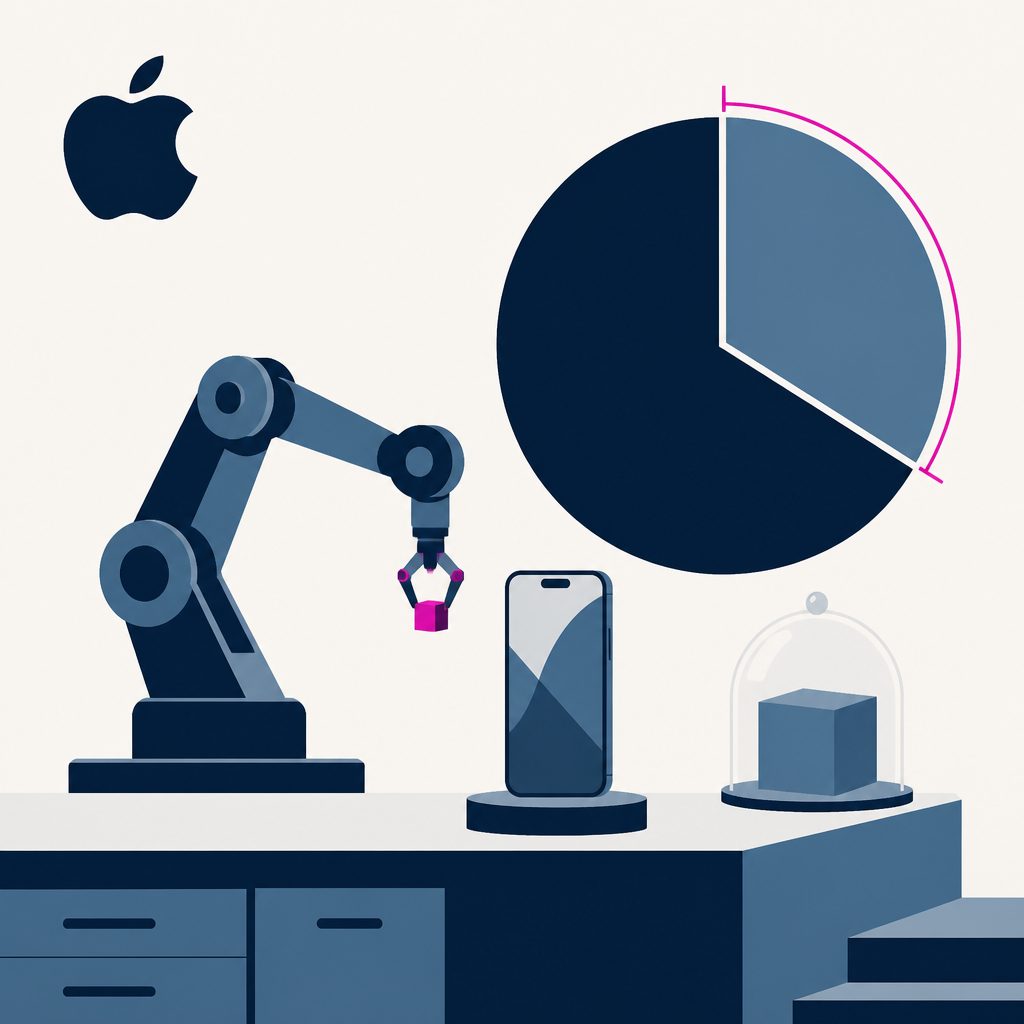
John Ternus took over as Apple CEO while Tim Cook remained executive chairman and continued mentoring and external engagement during the transition. Apple holds close to two-thirds of the premium smartphone market, defined as devices costing more than $600. The leadership challenge for Ternus is to shift incentives and culture to compete in the AI era, including reshaping the ecosystem and decisions around key hires to avoid the innovator’s dilemma.
AIRMO is building a space-based methane emissions monitoring platform that combines satellite, aircraft, and drone measurements to detect leaks, quantify emissions, and point to sources. AIRMO aims to launch its first satellite offering with EnduroSat by the end of 2027. It plans to shift monitoring from costly, often manual and infrequent inspections to more continuous, digitised leak mapping that can support quicker mitigation and verification.
Sonos introduced the Sonos Beam Ultra soundbar, the Sonos Ace Ultra headphones, and a new audio operating system update called Sonos 27 in New York City. The update arrives after Sonos faced backlash during a 2024 app rollout. Sonos says Sonos 27 adds AI-focused features, including a built-in Sonos 27voice assistant for music and system control.
Runway introduced Solaris, its Gen-4.5 “Interface World Model,” which generates user interfaces one frame at a time instead of writing code first. Runway says Solaris runs 50x faster than its tuned Max setup and was preferred by evaluators 61% of the time over Claude Opus 5-coded UIs. Early access is request-only, and the approach shifts interface creation to model-predicted screen states after each click or drag, raising new consistency and reliability requirements.
DataAgent launched a platform designed to repair production faults directly inside customers’ Kubernetes clusters. It raised $10M in pre-seed funding. The workflow shifts from detecting incidents and sending logs to engineers to having AI agents read live cluster state, apply pre-approved fixes, and run deeper analysis offline afterward.
Apple’s new CEO receives a day-one briefing memo covering the business by division and noting that Apple Intelligence will move the Siri discussion to a later date. The memo’s inbox timestamp is 5:05AM. As a result, the planned Siri update is postponed while the transition team prepares a later discussion.
John Ternus started his first day as Apple CEO, replacing Tim Cook. Tim Cook stepped aside on this change date in 2026 for Ternus to lead. Apple’s leadership shifts as the company navigates the rise of AI and component shortages affecting products.
Dyson launched the CameraJet, a toothbrush with a camera-enabled brush head and flossing functionality. It costs $499 and ships starting today, with phone livestream video over Wi‑Fi. The device adds AI-assisted gap detection and mouthwash “flossing” during brushing, shifting oral care from brushing-only to combined inspection and cleaning.
Fal’s H3 Max Live was tuned from Minimax’s H3 release to deliver continuous video generation fast enough to support an “infinite” live stream format instead of short, slow clips. The reported optimization achieved 35x faster inference than the official endpoint. Fal then relaunched its live service with audience-steerable, LLM-generated prompts and added reference-to-video generation at up to real-time factor 1 in early preview, after being removed from Twitch/YouTube.
Gradium AI released a new default text-to-speech model across its API and Studio. It reported an 81.0% human-rated pass rate on a 500-sentence hard-case set and a 216 ms P50 time-to-first-audio. The default model switch went live on August 31, 2026 with no migration and existing (including custom) voices continuing to work unchanged.
Gilbert + Tobin describes its internal approach to rolling out OpenAI tools across the firm. The article does not provide any number or specific date. As a result, it frames the rollout as scaled use of ChatGPT Enterprise and Codex under CEO-led commitment and formal governance rather than ad hoc adoption.
Every AI story that matters,
in your inbox by 8am.
TLDRocket reads all relevant sources, removes duplicate coverage, and summarises the
day in two minutes. Follow companies and topics for alerts, or get the
briefing in Slack. Free, no spam, unsubscribe anytime.
Reading TLDRocket needs no cookies, and the readership counts we rely on come from
our own cookieless analytics. Google Analytics is the exception: it sets cookies and
reports to Google, so it stays switched off until you allow it. You can change your
mind any time from “Cookie settings” in the footer.
Strictly necessary
Session security and form protection (tldrocket-session,
XSRF-TOKEN, 2 hours). The site cannot work without them,
so they need no consent.
Always on
Google Analytics 4 (_ga,
_ga_<id>, up to 2 years). Measures which
stories and sections readers use. Google acts as a third-party processor and may
store the data outside the EU. No advertising, no profiling, no data sold.