Every AI story that matters — and the intelligence behind it.
TLDRocket reads all relevant sources, removes duplicate coverage, and publishes a short neutral
summary of every story, linking back to the original. Free, no spam, unsubscribe anytime.
Google claimed its AI agents built an operating system for $916 using Gemini 3.5 Flash and Antigravity 2.0, but the company's disclosure was misleading about key details including that the "single prompt" was thousands of lines long and the system used specialized scaffolding with subagents and anti-cheating measures. The cost reported was $916.92 with a total token budget of 2.6 billion tokens, but Google did not release the lengthy prompt, agent logs, or code, making independent verification impossible. The experiment demonstrates that AI agents can work autonomously on long-horizon tasks but highlights the need for rigorous methodological standards in open-world evaluations rather than relying on vendor-conducted press releases.
Mistral released Mistral Medium 3.5, a 128-billion-parameter model that powers remote coding agents capable of running asynchronously in the cloud while developers work on other tasks. The model scores 77.6% on SWE-Bench Verified for coding performance and costs $1.5 per million input tokens and $7.5 per million output tokens via API. Developers can now launch multi-step coding and productivity tasks from Mistral Vibe's CLI or Le Chat that execute remotely in parallel, with results delivered as pull requests or completed work rather than requiring oversight of each step.
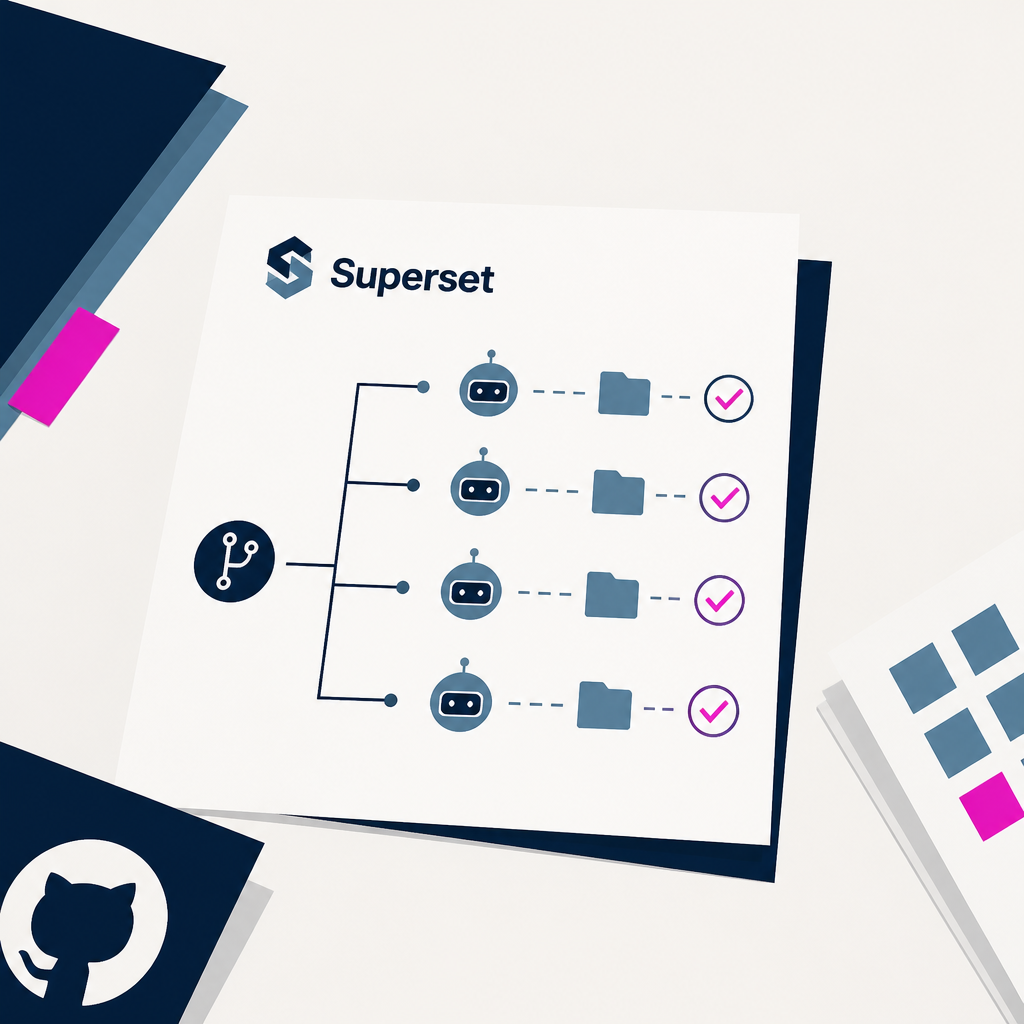
Superset is an open-source IDE that manages multiple coding agents running in parallel across isolated git worktrees, allowing developers to coordinate agent work on tasks like bug triage and feature development simultaneously. The tool includes task tracking to move work from issues through agent execution to pull requests, and beta Remote Workspaces let agents run on separate machines while controlled from a desktop app. This addresses the workflow coordination problem that emerges when running five or more agents concurrently, shifting the bottleneck from agent execution to human review and context management.
Mistral released Connectors in Studio, enabling developers to access built-in connectors and custom Model Context Protocol (MCP) integrations via API/SDK for use with all model and agent calls. Connectors are now centrally registered and reusable across Mistral apps including LeChat and AI Studio, with programmatic access for creating, modifying, listing, and deleting connectors. Developers can now implement human-in-the-loop approval flows, direct tool calling, and eliminate duplicated integration work across teams by building enterprise AI agents with secure, governed access to systems like CRMs and knowledge bases.
Google introduced AI agents that summarize web content directly in email and YouTube, intensifying tensions between publishers and platforms over content aggregation. The feature appears to be part of Google's broader AI integration strategy announced at I/O 2026. Publishers face increased pressure as AI summarization tools reduce traffic incentives for users to visit original sources.
Virgin Atlantic used Codex to complete its mobile app redesign and meet a fixed holiday travel deadline. The app achieved near-total unit test coverage and shipped with zero severity-1 defects. The airline was able to accelerate development cycles while maintaining quality standards during a time-sensitive project.
OpenAI has been designated a leader in Gartner's 2026 Magic Quadrant for enterprise AI coding agents, with its Codex model recognized for both innovation capabilities and ability to deploy at enterprise scale. The evaluation places OpenAI among a select group of vendors assessed across criteria including technical performance, market presence, and suitability for large organizations. Companies evaluating coding agent solutions can now reference this quadrant positioning when making procurement decisions for their development teams.
Every AI story that matters,
in your inbox by 8am.
TLDRocket reads all relevant sources, removes duplicate coverage, and summarises the
day in two minutes. Follow companies and topics for alerts, or get the
briefing in Slack. Free, no spam, unsubscribe anytime.
Reading TLDRocket needs no cookies, and the readership counts we rely on come from
our own cookieless analytics. Google Analytics is the exception: it sets cookies and
reports to Google, so it stays switched off until you allow it. You can change your
mind any time from “Cookie settings” in the footer.
Strictly necessary
Session security and form protection (tldrocket-session,
XSRF-TOKEN, 2 hours). The site cannot work without them,
so they need no consent.
Always on
Google Analytics 4 (_ga,
_ga_<id>, up to 2 years). Measures which
stories and sections readers use. Google acts as a third-party processor and may
store the data outside the EU. No advertising, no profiling, no data sold.