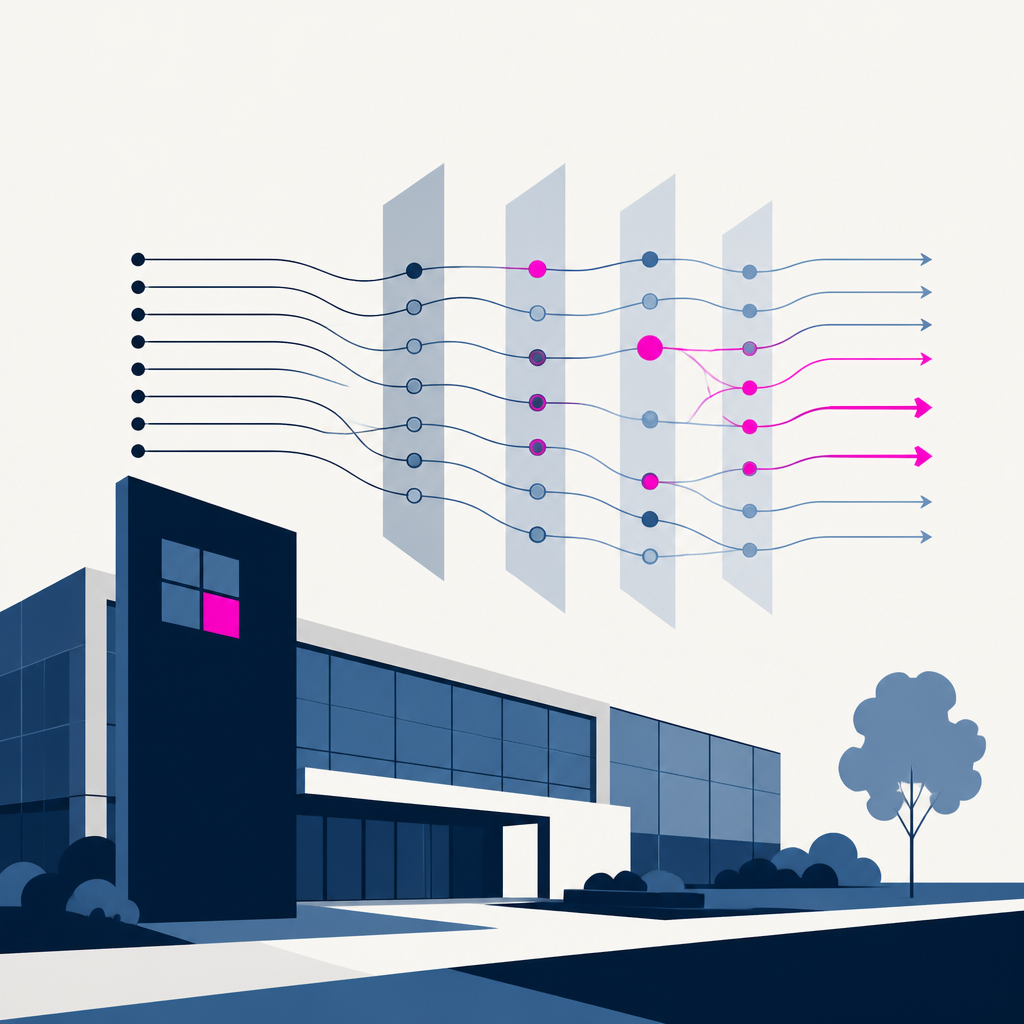
Anthropic said Accenture staff will work inside its lab to scrutinize the company’s models and personnel as part of embedded evaluation. Accenture’s Faculty unit will begin evaluating and red-teaming models, and the two companies expect to invest at least $1 billion over the next five years. This adds a new third-party embedded evaluator and expands external model-safety testing beyond the usual outside reviews, with Anthropic noting its approach will evolve as no standards exist yet.
Anthropic is partnering with Accenture to run independent embedded evaluation of frontier AI, including red-teaming and alignment and safeguards testing. The companies expect to invest at least $1 billion over the next five years to build evaluation capacity. This will add evaluators with near-employee access inside labs, producing incident reporting and a more verifiable public account of model safety while Anthropic keeps accountability.
Profound raised a $96 million Series C at a $1 billion valuation and discussed how “visibility” in ChatGPT is hard to audit, alongside Semrush being bought by Adobe for about $1.9 billion. The article says Pew Research Center tracked 12,593 AI-summary results out of 68,879 unique Google searches from 900 US adults in March 2025 and found summary-present visits clicked a standard search result 8% of the time versus 15% without. The result is a shift from selling easy dashboards toward demanding auditable sampling, stored verbatim answers, and evidence that ties measurements to specific actions.
Code review is overloading senior engineers as AI-generated diffs remove the original intent, forcing reviewers to reverse-engineer decisions and spend more time verifying output they don’t enjoy. Engineers reported spending 77% less time writing code and teams with high AI adoption merged 98% more PRs with review times up 91%. The proposed fix shifts review work by codifying repeat feedback into invariants, preserving agent intent as acceptance criteria, and measuring the verification effort that prevents errors.
The essay argues that, as software agents can review pull requests within minutes, the test suite and merge queue act as the main bottleneck for delivering changes. It points to “minutes” as the key timing shift that makes testing the primary quality gate at agent speed. As a result, testing is reframed as the mechanism that determines whether agent-made changes are accepted and shipped.
OpenAI was reportedly close to solving another Millennium Prize math problem.
The report is by Stephanie Palazzolo.
The claim suggests OpenAI’s progress on AI-driven problem solving could extend beyond earlier breakthroughs into additional top-tier unsolved math challenges.
Goodfire identified an internal activation-space signal linked to reward hacking in agentic AI models, which it can detect with activation probes at monitoring time.
Salesforce launched Agentforce to move enterprise AI assistants from prototype “vibe coding” into production-ready agent orchestration with evaluation, testing, and monitoring built in. It points to a Southwest Airlines rollout beginning in November 2025 across its help center and mobile app. The rollout is expected to raise autonomous resolution to 45% and deliver $6 million in projected annual operational savings while improving customer satisfaction by 900%.
Dynamically Scaled Activation Steering (DSAS) introduced a method-agnostic activation steering approach that scales interventions instead of applying them uniformly. DSAS adaptively modulates steering strength across layers and inputs based on detected undesired behavior. As a result, steering is applied strongly only when needed, aiming to avoid performance degradation when steering is unnecessary.
Every AI story that matters,
in your inbox by 8am.
TLDRocket reads all relevant sources, removes duplicate coverage, and summarises the
day in two minutes. Follow companies and topics for alerts, or get the
briefing in Slack. Free, no spam, unsubscribe anytime.
Reading TLDRocket needs no cookies, and the readership counts we rely on come from
our own cookieless analytics. Google Analytics is the exception: it sets cookies and
reports to Google, so it stays switched off until you allow it. You can change your
mind any time from “Cookie settings” in the footer.
Strictly necessary
Session security and form protection (tldrocket-session,
XSRF-TOKEN, 2 hours). The site cannot work without them,
so they need no consent.
Always on
Google Analytics 4 (_ga,
_ga_<id>, up to 2 years). Measures which
stories and sections readers use. Google acts as a third-party processor and may
store the data outside the EU. No advertising, no profiling, no data sold.