
Zuckerberg owns 13% of Meta but controls 61% of its votes. California’s wealth tax would bill him on the 13%
Fortune Catherina Gioino
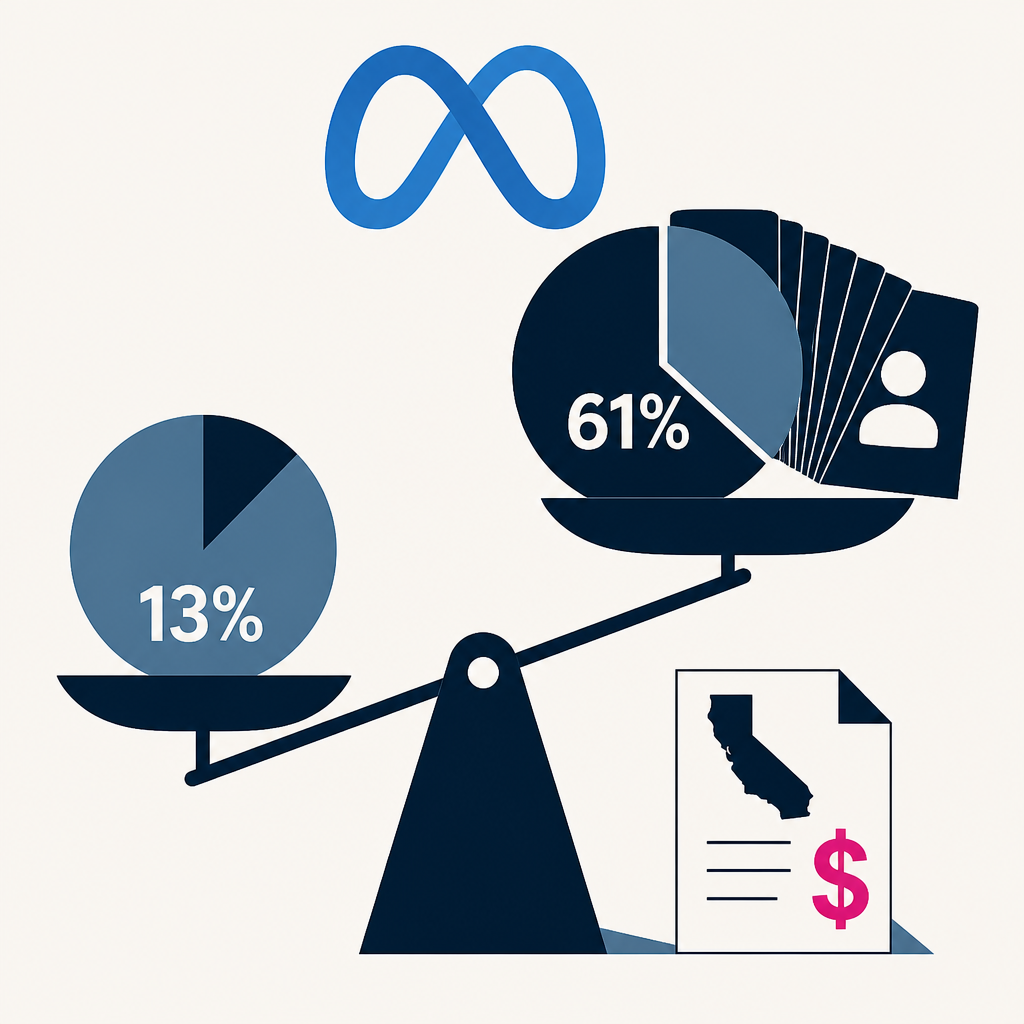
California may tax Zuckerberg on what he owns, not what he controls. That could force him to sell Meta stock and chip away at the voting power that keeps him in charge.
Based on reporting by Fortune, Catherina Gioino — read the original for the full story.
Summary, retelling and take written by AI under human oversight; images are AI-generated illustrations. How we work · Report an error
California voters will decide on Nov. 3 whether billionaires in the state should face a one-time 5% tax on their net worth. A bunch of them have already headed for the door, including Peter Thiel and Google cofounders Larry Page and Sergey Brin. Seven billionaires have publicly moved out so far, taking about $540 billion, or 30% of California’s billionaire wealth, with Jensen Huang among the holdouts.
Mark Zuckerberg looked like another likely stay-put case. Meta’s new SEC filing says the reason is less about loyalty than about control. He owns about 13% of Meta’s value, but because most of his holdings are Class B shares with 10 votes apiece, he controls about 61% of the company’s votes. That lets him elect the entire board and dominate shareholder votes.
A wealth tax would hit the ownership side, not the voting side. To pay it, Zuckerberg would have to sell stock, and those Class B shares turn into one-vote Class A shares when sold. So every sale trims the control he has spent years locking in. The filing says Meta’s independent directors worried he could face a “significant, multi-billion dollar tax payment” and that the tax mattered because it could force him to sell shares or borrow against them.
Zuckerberg, for his part, pushed back on the idea that economic ownership and voting power need to track each other. At an Aug. 26 meeting, he said other companies have allowed founders to keep voting control with relatively small economic stakes. But Meta’s board had a different problem in mind: it wanted him physically near the company, not running it from somewhere else. The filing says the committee was mindful of the difficulty of the COVID-19 period, when he was not close to the management team, and on Sept. 6 Zuckerberg said he would need to start taking steps by mid-September to establish residency outside California by mid-October.
Instead, Meta struck a deal that keeps him in California, or wherever Meta is headquartered, for eight years unless something unexpected happens. The company says the new stock structure is also about raising money for AI and other corporate needs, with forecasts showing a need to raise hundreds of billions of dollars beginning as early as fall 2026. And because Zuckerberg can approve the change on his own, Class A shareholders did not even get a vote.
My take — AI-written commentary, not fact-checked reporting
Meta didn’t just defend founder control; it built a fresh financing tool around it. That’s classic Silicon Valley: call it flexibility, then make sure the founder still gets to steer the ship while everyone else gets a new share class and a polite explanation. California’s tax fight is really a control fight wearing a property-tax costume.
Read more about this at: Fortune
Related stories
 Zuckerberg spent years building on Apple’s terms. His $100 billion-plus AI bet is about owning everything
Fortune ·
43
5 funding signals hidden in Zuckerberg’s ‘superintelligence for everyone’ manifesto
Tech Funding News · 2 months ago ·
33
Can you forget how you feel about Meta?
The Verge · 1 month ago ·
45