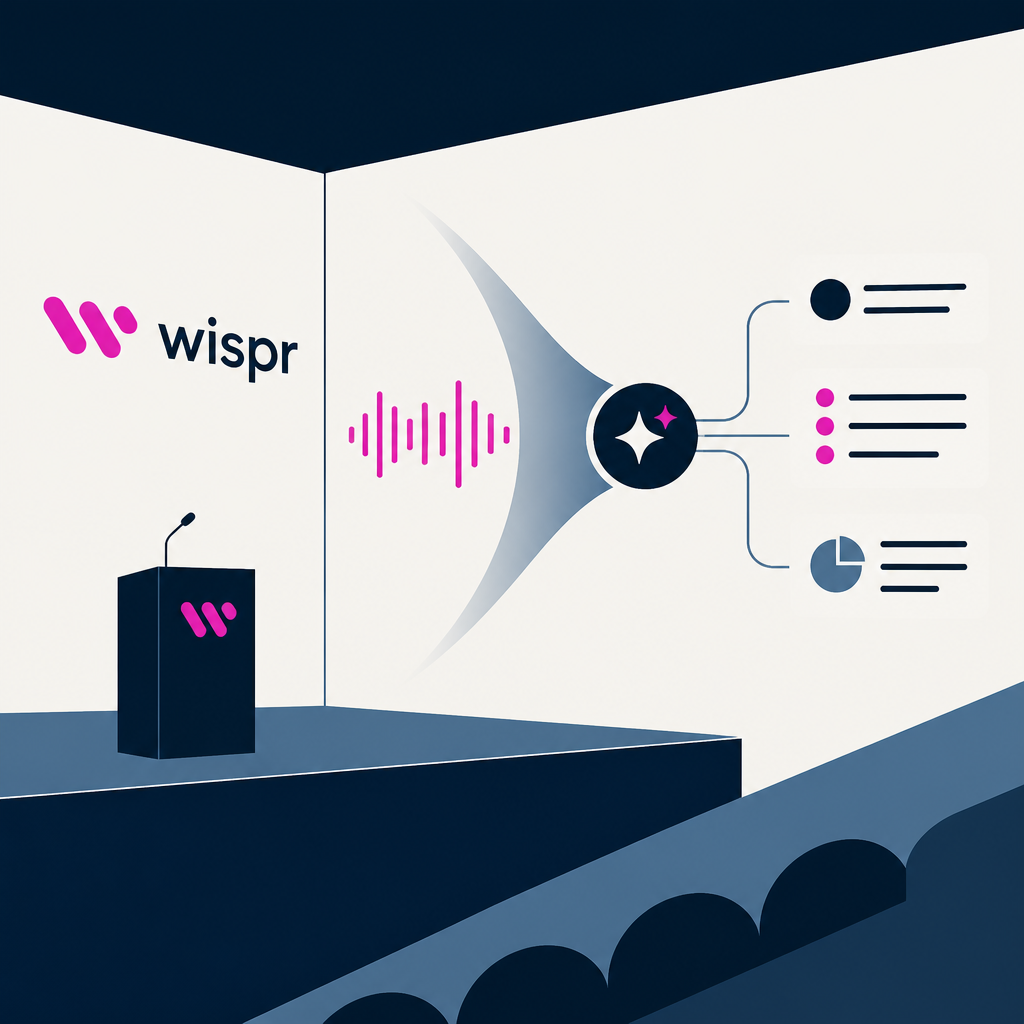
Wispr talks its way to a $2 billion valuation. The company says dictation’s only the beginning
Fortune Allie Garfinkle ● Covered by 4 sources
Wispr just hit a $2 billion valuation after doubling down on voice dictation. Its pitch is bigger than typing: it wants to be the way people talk to AI.
Based on reporting by Fortune, Allie Garfinkle — read the original for the full story.
Summary, retelling and take written by AI under human oversight; images are AI-generated illustrations. How we work · Report an error
Wispr started with a Marvel-sized idea. Back in 2008, founder Karan Kothari was thinking about JARVIS, the chatty assistant from Iron Man, and wondering if something like that could exist outside the movies. Years later, that itch turned into Wispr, which he co-founded in 2021 with Stanford classmate Sahaj Garg, someone he’d met on their first day in a freshman dorm.
The company did not arrive there in a straight line. Wispr spent time on wearables that never really took off and on “silent speech,” a system for controlling computers without speaking aloud. About two years ago, though, the startup found its lane with Wispr Flow, a dictation app that now says it’s used by millions of consumers and 100,000 businesses.
That product is moving fast. Wispr says revenue has jumped by more than 150% for four straight quarters, and investors have just gone back in, not out. The startup has raised a $280 million Series B at a $2 billion valuation, Fortune reported exclusively. Menlo Ventures led the round, with existing backers including Notable Capital, NEA, Neo Ventures, and 8VC, plus new investors such as Acrew, Forerunner, Goodwater, Plus Capital, and Peak XV. Athletes Joe Burrow, Shaun White, Klay Thompson, and Paul George also joined the cap table.
And yet the company insists dictation is only the doorway. Menlo partner Matt Kraning said the real market is not dictation itself, but the chance to avoid typing altogether, which eventually runs into workflow tools, meeting tools, and even the text box in front of AI models. That puts Wispr in a crowded field: Apple, Google, Microsoft, Anthropic, and OpenAI are all chasing voice in one form or another.
The use cases are already broader than a faster keyboard. Kothari says people have written novels with Wispr, and that it’s helpful for users with ADHD, dyslexia, quadriplegia, and blindness. He also described a blind friend’s father using it to send messages because Siri kept making mistakes. The bigger bet is simple and a little audacious: the next interface may not be visual at all. It may be something people trust enough to talk to all day.
My take — AI-written commentary, not fact-checked reporting
Wispr’s real advantage isn’t voice, it’s trust. Plenty of companies can bolt dictation onto an app; far fewer can convince people to hand over something this intimate without flinching. That’s the part AI hype keeps skipping: the best interface is useless if it feels like surveillance with better marketing.
Read more about this at: Fortune