
What a desert lizard teaches us about patents and the GLP-1 revolution
Fortune Dr. Bowman Heiden
Opinion — commentary, not a factual news event.
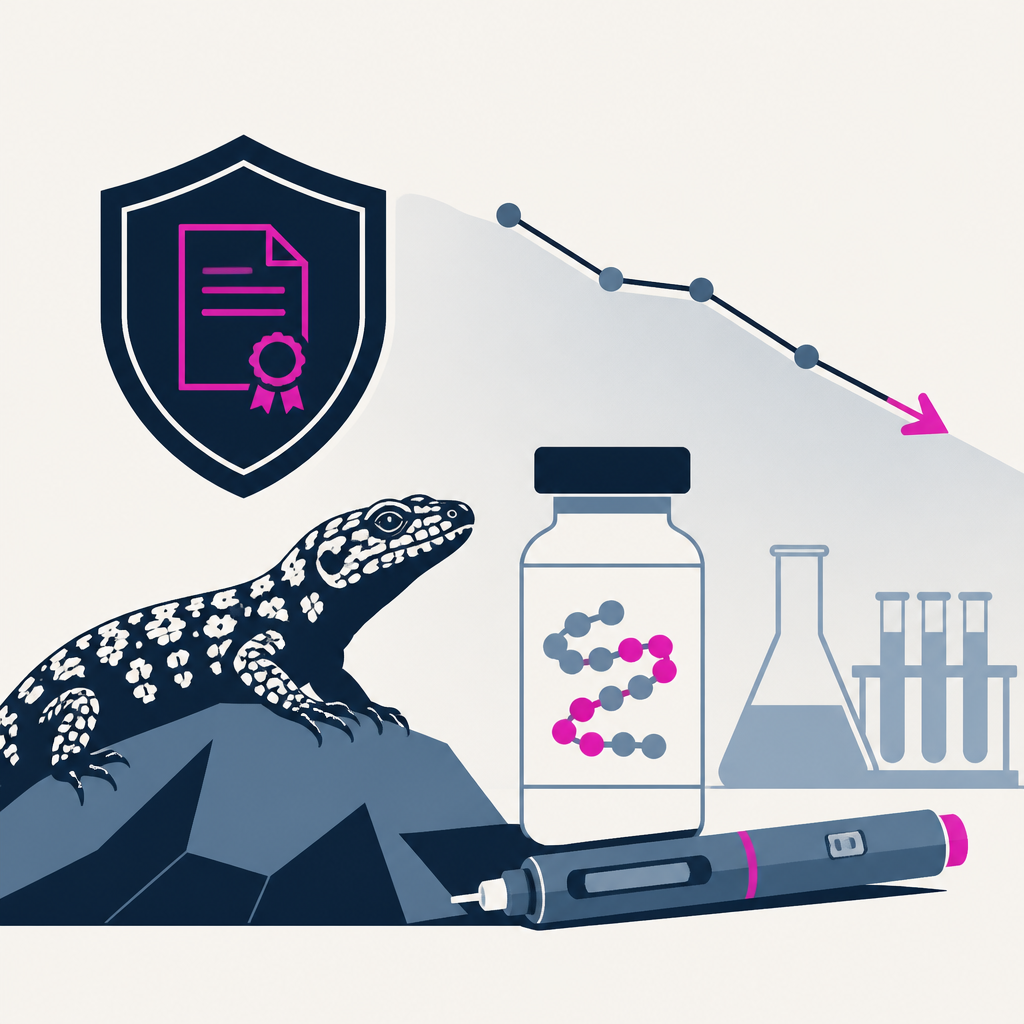
U.S. obesity rates are finally falling, helped by GLP-1 drugs like Wegovy and Zepbound. A lizard venom discovery and patent law made those meds possible, and now prices are dropping fast.
Based on reporting by Fortune, Dr. Bowman Heiden — read the original for the full story.
Summary, retelling and take written by AI under human oversight; images are AI-generated illustrations. How we work · Report an error
America’s long climb in obesity appears to be turning. Gallup says the rate peaked in 2022 at 39.9% of adults, then fell this year to 36.4%. One big reason: GLP-1 weight-loss drugs are no longer niche. About one in nine adults now takes Wegovy, Zepbound, or another GLP-1, roughly ten times as many as in 2022.
The price drop matters just as much as the popularity. These drugs cost more than $1,000 a month as recently as last year. Now some patients can get them for as little as $149 monthly, because the biggest makers have been cutting prices to protect their share of the market. That competition is doing what competition is supposed to do: making the drugs harder to ignore and easier to afford.
The origin story is stranger than the hype cycle. In 1990, John Eng, an endocrinologist at the Veterans Administration, isolated a peptide from Gila monster venom that acted like human GLP-1. The compound kept working for hours instead of vanishing in minutes. Eng patented it, Amylin Pharmaceuticals licensed it, and the result became the first GLP-1 drug. The FDA approved it in 2005 for type 2 diabetes. That 15-year path from lab bench to regulator would have been much harder without patent protection.
And the point of patents here isn’t monopoly for its own sake. It’s disclosure in exchange for a temporary shield, which gives companies a reason to spend money on something as risky as drug development. The source makes a simple case: rivals don’t just wait around to copy, they build better versions. Patients got from twice-a-day injections before meals to once-daily, then once-weekly drugs, then a pill, then a dual-receptor treatment that helps with even more weight loss.
The next wave is already forming. Drug companies are working on treatments that could cut side effects and preserve muscle better. Meanwhile, patent expiration eventually pushes prices down hard: in India, when Ozempic and Wegovy protections expired earlier this year, generics arrived at under $14 a month. In the U.S., one earlier GLP-1 is already generic, and the key patents on Wegovy are due to expire in the early 2030s.
My take — AI-written commentary, not fact-checked reporting
The patent system gets mocked as a legal swamp, but this is the boring miracle people keep missing. Give scientists a payoff for taking real risks, and you get better drugs, more competition, and eventually cheaper generics instead of endless copycat sludge. That’s not a bug; that’s the machine working.
Read more about this at: Fortune
Related stories
 'It was like a godsend' — GLP-1 drugs show promise against hormonal disorder that causes constant weight gain and forces women to shave facial hair
Fortune ·
38
After Pausing Its I.P.O., Oura Jumps on the GLP-1 Hype With Weight-Loss Tracking
Trending Topics · 4 days ago ·
3
'It was like a godsend' — GLP-1 drugs show promise against hormonal disorder that causes constant weight gain and forces women to shave facial hair
Fortune ·
38
After Pausing Its I.P.O., Oura Jumps on the GLP-1 Hype With Weight-Loss Tracking
Trending Topics · 4 days ago ·
3
 Launch HN: RonanRX (YC S26) – Personalized Peptides and GLP-1s
Hacker News · 1 month ago ·
34
Launch HN: RonanRX (YC S26) – Personalized Peptides and GLP-1s
Hacker News · 1 month ago ·
34