
TimesFM-3: A zero-shot foundation model for multivariate forecasting
Google Research ● Covered by 3 sources
Google’s new TimesFM-3 predicts several related time series at once, in one pass. That could make forecasts sharper when promotions, weather, and other signals move together.
Based on reporting by Google Research — read the original for the full story.
Summary, retelling and take written by AI under human oversight; images are AI-generated illustrations. How we work · Report an error
Google Research has a new time-series model called TimesFM-3, and the pitch is simple: it handles multivariate forecasting natively instead of treating each series like an island. The model is built for the messy cases where sales, foot traffic, weather, holidays, and other signals all matter at once. It’s also meant to do that without task-specific fine-tuning.
TimesFM-3 has 330 million parameters and was trained on more than 1 trillion time points from real-world and synthetic data. Google says it extends the zero-shot behavior of earlier TimesFM models, but with support for multiple targets, past covariates, and past-future covariates. That means it can forecast several related series together, use history-only signals, and also take known future events into account.
The architecture still uses a decoder-only transformer, but the details are tuned for time series. Data is grouped into patches of 32 time steps, then the model alternates between causal temporal attention and full variate attention. In plain English: it can look backward through time within each series, and sideways across other series at the same time step. That’s how it learns cross-series relationships without leaking future information.
The other big change is speed. Earlier versions generated forecasts patch by patch, which added latency and error along the way. TimesFM-3 uses contiguous patch masking to produce the whole forecast horizon in a single forward pass, while still outputting nine quantiles from the 10th to the 90th percentile for uncertainty estimates. For past-future covariates, known future signals stay visible during decoding.
Google tested the model on Gift-Eval, FEV-Bench, and Time, and says TimesFM-3 ranks first on all three among pre-trained foundation models for both point and probabilistic forecasting. The company also says the model beats or matches rivals even when run in univariate mode, then pulls ahead further in full multivariate mode. TimesFM-3 is available on GitHub and Hugging Face, with BigQuery support coming in the next few weeks.
My take — AI-written commentary, not fact-checked reporting
This is the part of AI forecasting that actually matters: not bigger spreadsheets, but models that can use the signals businesses already have. The open question isn’t whether the demos look nice; it’s whether teams will use the multivariate mode instead of falling back to the safe old univariate habit. Google is betting the boring stuff wins, and that’s usually where the real value hides.
Read more about this at: Google Research
Related stories
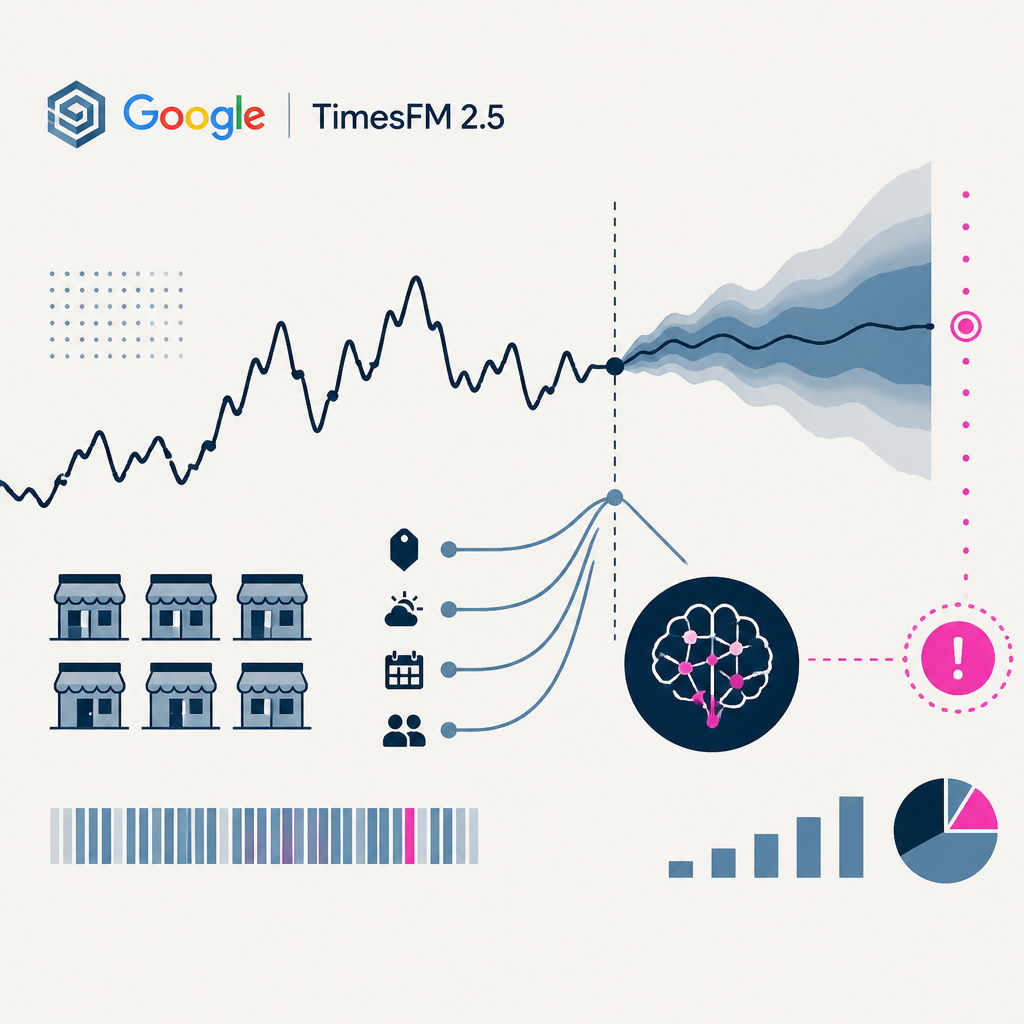 End-to-End Forecasting with TimesFM 2.5: Backtesting, Covariates, Anomaly Detection, and Scalable Colab Deployment
MarkTechPost · 2 months ago ·
34
Time series foundation models can be few-shot learners
Google Research · 1 year ago ·
50
End-to-End Forecasting with TimesFM 2.5: Backtesting, Covariates, Anomaly Detection, and Scalable Colab Deployment
MarkTechPost · 2 months ago ·
34
Time series foundation models can be few-shot learners
Google Research · 1 year ago ·
50
 Mistral AI Releases Timestral: A 209M Forecasting Model Family That Outperforms Google’s TimesFM-3
MarkTechPost · 16 hours ago ·
39
Mistral AI Releases Timestral: A 209M Forecasting Model Family That Outperforms Google’s TimesFM-3
MarkTechPost · 16 hours ago ·
39