
Thinking Machines Lab Releases Inkling: A 975B-Parameter Open-Weights Multimodal MoE With 41B Active Parameters And Controllable Thinking Effort
MarkTechPost Asif Razzaq ● Covered by 4 sources
Thinking Machines Lab just released Inkling, a huge open-weights AI model anyone can fine-tune. It also lets you dial its 'thinking effort' up or down to trade cost for accuracy.
Based on reporting by MarkTechPost, Asif Razzaq — read the original for the full story.
Summary, retelling and take written by AI under human oversight; images are AI-generated illustrations. How we work · Report an error
Thinking Machines Lab has shipped its first model built entirely in-house, and it's a big one: Inkling, a Mixture-of-Experts transformer with 975 billion total parameters and 41 billion active per token. The weights are open, the model is fine-tunable through the lab's Tinker platform, and the whole release is pitched less as a finished product than as a base people can bend into shape. A smaller sibling, Inkling-Small, at 276 billion total and 12 billion active parameters, got previewed alongside it — reportedly matching or beating the bigger model on several benchmarks — but its weights aren't out yet, pending more testing.
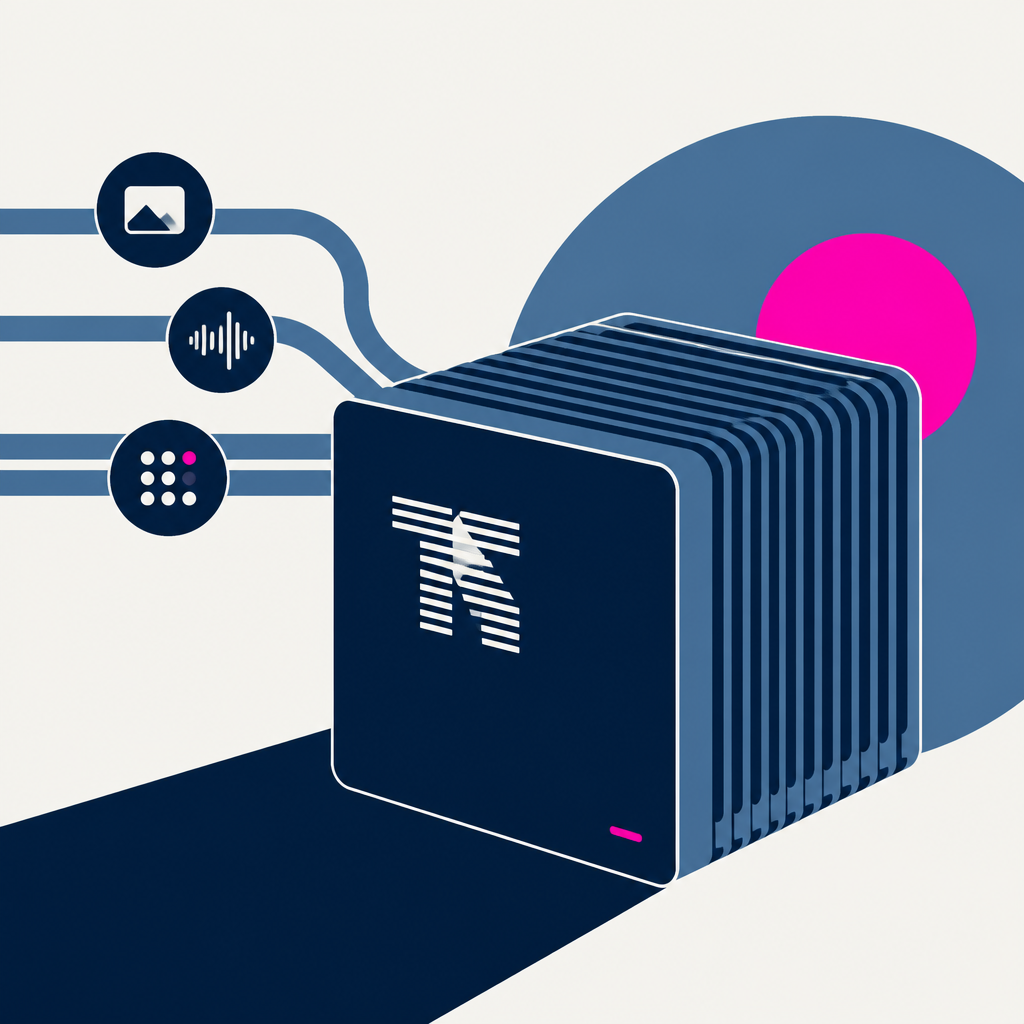
Under the hood, Inkling is a 66-layer decoder-only transformer with a sparse MoE backbone borrowing heavily from DeepSeek-V3's playbook: 256 routed experts plus 2 shared ones, six routed experts firing per token alongside both shared experts, and a sigmoid router with auxiliary-loss-free load balancing. The attention stack is where it gets unusual. Sliding-window and global layers interleave at a 5:1 ratio with 8 KV heads, positions are handled with relative embeddings instead of RoPE (the lab says this extrapolates better), and short convolutions get applied after key/value projections and on residual outputs. Multimodality skips a separate encoder entirely — audio comes in as dMel spectrograms, images get chopped into 40x40 patches through a four-layer hMLP, and everything gets projected into the same stream the decoder processes alongside text. Pretraining ran across 45 trillion tokens of text, images, audio, and video, and the context window stretches to 1 million tokens, though output is still UTF-8 text only.
Post-training started with SFT on synthetic data, some of it generated by Kimi K2.5, before most of the compute budget went into asynchronous reinforcement learning that scaled past 30 million rollouts and kept improving log-linearly the whole way. That RL run is also where the model's headline feature came from: by tweaking the system message and adjusting per-token cost during training, the team taught Inkling to spend wildly different token budgets depending on the task. The result ships as an adjustable effort dial, running from 0.2 to 0.99, exposed in code as a reasoning_effort argument with named levels. The payoff shows up in the efficiency numbers — Inkling reportedly matches Nemotron 3 Ultra's Terminal Bench 2.1 score while burning a third as many tokens, which turns cost and latency into something you tune per call instead of something baked into the model.
On raw benchmarks, run at effort=0.99, Inkling holds its own against open-weights peers like Nemotron 3 Ultra, Kimi K2.6, GLM 5.2, and DeepSeek V4 Pro, topping the group on FORTRESS Adversarial at 78.0%. It's not dominant everywhere, though — it trails GLM 5.2 by 18.9 points on Terminal Bench 2.1, and it reports 73.5% on MMMU Pro and 91.4% on VoiceBench alongside a 1257 score on Design Arena's blinded Agentic Web Dev leaderboard.
Actually running the thing takes real hardware. The BF16 checkpoint needs at least 2 terabytes of aggregated VRAM, meaning 8 NVIDIA B300s or 16 H200s, while the NVFP4 version cuts that to 600 gigabytes on 4 B300s or 8 H200s. Day-one support spans SGLang, vLLM, TokenSpeed, Unsloth, and Hugging Face transformers, with hosted access through TogetherAI, Fireworks, Modal, Databricks, and Baseten, and fine-tuning available on Tinker with 64K or 256K context options.
None of this comes free of caveats. Inkling still trails Kimi K2.6 and GLM 5.2 on HLE, Terminal Bench, and SWEBench Verified, and its SimpleQA Verified score of 43.9% sits well under DeepSeek V4 Pro's 57.0%. Inkling-Small's weights remain unreleased, there's no audio or image output, the Terminal Bench figures come from an internal harness rather than a shared one, and the lab itself flags role-play scenarios and indirect prompts as unresolved safety risks.
My take — AI-written commentary, not fact-checked reporting
The effort dial is the actual news here, not the benchmark table — a model that lets teams trade tokens for accuracy on demand is far more useful in production than another fractional point on GPQA. Teasing Inkling-Small's numbers while sitting on its weights is a classic open-weights move, and people should treat 'benchmarks now, weights later' with a bit of suspicion until those checkpoints actually land. Still, shipping day-one support across five hosted APIs and the usual open-source runtimes is the kind of follow-through that matters more than any single chart.”}}(hidden)}}(placeholder)}}
Read more about this at: MarkTechPost
Related stories
 Thinking Machines Lab Releases Inkling-Small: A 276B Total, 12B Active Open Weights Multimodal MoE Model
MarkTechPost · 2 months ago ·
21
Inkling: Our Open-Weights Model
Thinking Machines Lab · 3 months ago ·
25
Together AI brings Thinking Machines Lab’s new model Inkling on day 0
Together AI · 3 months ago ·
54
Thinking Machines Lab Releases Inkling-Small: A 276B Total, 12B Active Open Weights Multimodal MoE Model
MarkTechPost · 2 months ago ·
21
Inkling: Our Open-Weights Model
Thinking Machines Lab · 3 months ago ·
25
Together AI brings Thinking Machines Lab’s new model Inkling on day 0
Together AI · 3 months ago ·
54