ShinkaEvolve in Action: How a Human-AI Partnership Conquered a Coding Challenge
Sakana AI ● Covered by 5 sources
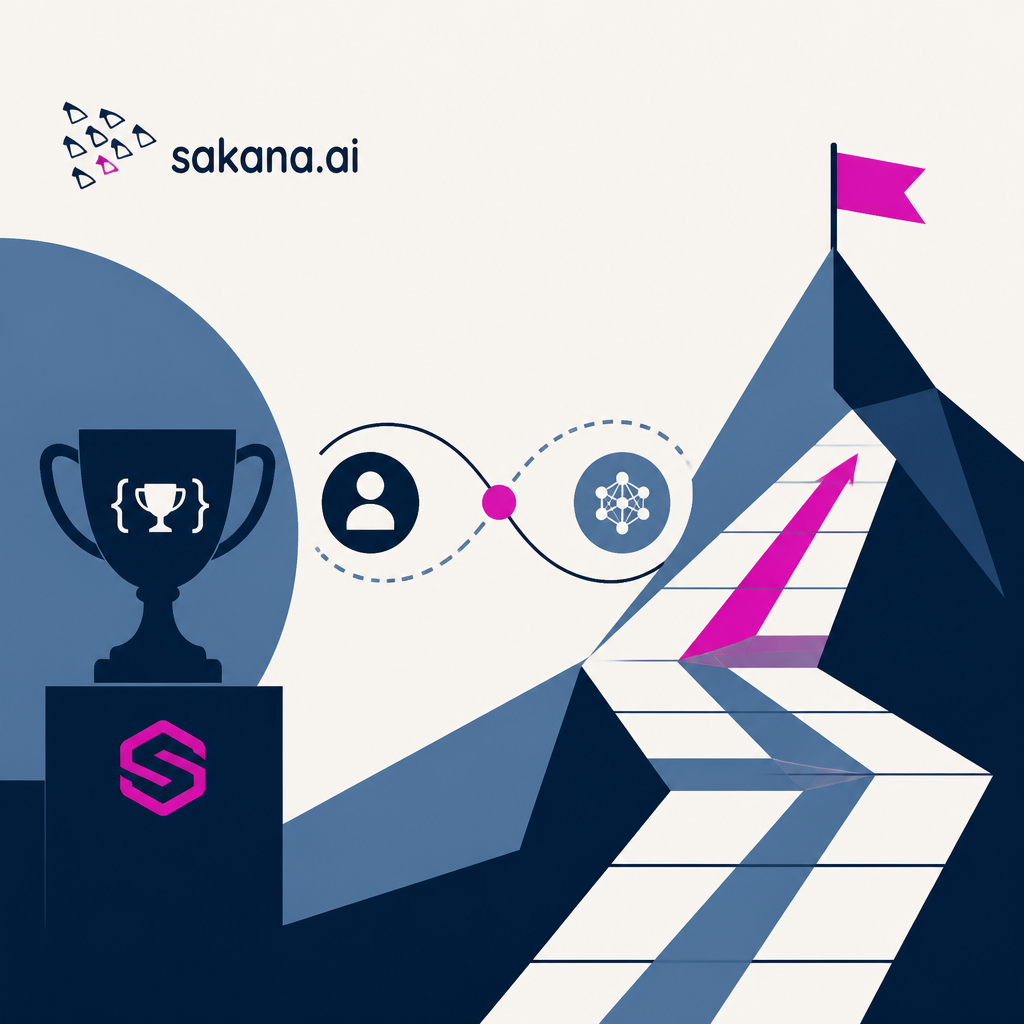
Sakana AI's ShinkaEvolve tool rewrote a team's solver code and sped it up to 10x. That boost helped Team Unagi win the 2025 ICFP programming contest.
Based on reporting by Sakana AI — read the original for the full story.
Summary, retelling and take written by AI under human oversight; images are AI-generated illustrations. How we work · Report an error
Takuya Akiba has spent years chasing competitive-programming glory with his friends in Team Unagi, long before he became a research scientist at Sakana AI. This year the hobby and the day job collided: Team Unagi took first place at the 2025 ICFP Programming Contest, and the winning edge came from a tool Akiba helps build, called ShinkaEvolve.
The contest task was a maze-mapping puzzle — figure out an unknown maze's full layout using as few ambiguous hints as possible. Team Unagi's plan was to encode every constraint and observation into a single Boolean satisfiability (SAT) formula and let a solver crunch it. The catch with SAT solvers is that they live or die by the quality of their encoding. A teammate built a strong initial version, but it choked on larger maze instances, turning into a hard bottleneck right when the team needed to scale up.
So they handed the Rust code for that encoding to ShinkaEvolve, Sakana AI's open-source framework for evolving code with the help of an ensemble of large language models, and told it to minimize solver execution time. Over 320 trials, costing around $60 in total, the system reworked the encoding and cut execution time dramatically — up to 10 times faster in places. That speedup wasn't just a nice benchmark number; it let the team actually solve 30-room maze instances in a realistic amount of time, something that had been out of reach before, and the improved code went straight into their contest submissions.
What makes this more than a routine optimization story is that ShinkaEvolve's fix was legible, not a black box. The original encoding tied doors directly together: door 1 of vertex A connects to door 2 of vertex B. ShinkaEvolve introduced an intermediate auxiliary variable instead, letting the solver first settle which vertices connect to which before worrying about which specific doors line up. That let the search operate at a higher level of abstraction first, and the gains followed. Team Unagi liked the idea enough to reapply it by hand later, when building a solver for an unrelated part of the contest.
Akiba frames the whole episode as a template: humans set the strategy and build a solid baseline, then AI runs a focused, computationally intensive search for improvements inside that structure, and humans take what they learn and carry it into the next problem. Nothing here replaced the team's own design work — the maze strategy, the heuristics, the testing infrastructure were all built by people. ShinkaEvolve just found something in the code that the humans hadn't, and it explained itself well enough that the humans could learn from it too.
My take — AI-written commentary, not fact-checked reporting
The interesting part isn't the 10x speedup, it's that the AI's fix was something a person could actually understand and reuse elsewhere — that's a much higher bar than just spitting out faster code nobody can read. Too much of the current AI-coding conversation is about replacing programmers outright; this is a cleaner story of a tool doing a narrow, expensive search job while humans keep the strategic reins and steal the good ideas back. More of these tools should be judged on whether they teach the team something, not just on the leaderboard score.”}
Read more about this at: Sakana AI