
Patterns for Building Cybersecurity Evals
Eugene Yan
Security researchers are building rigorous tests to see if AI agents can actually hack real systems, not just talk about it. Turns out most models still fumble the basics, but a few are getting scary good, scary fast.
Based on reporting by Eugene Yan — read the original for the full story.
Summary, retelling and take written by AI under human oversight; images are AI-generated illustrations. How we work · Report an error
There's a quiet arms race happening in AI security research, and it's less about jailbreaks and more about whether a language model can find a real bug, write a working exploit, and pull off an attack end to end. A recent roundup of benchmarks — Cybench, CVE-Bench, CyberGym, and a handful of others — lays out the shared architecture behind these tests: a sandboxed target running in Docker, a tunable amount of hint information (from nothing at all, mimicking a zero-day, up to a full patch diff for the one-day scenario), a toolkit of shells and debuggers, and a grader that checks for something concrete like a hidden flag string or a sanitizer crash.
Cybench is the closest thing to a hacker's obstacle course. It throws 40 professional capture-the-flag challenges at models, sourced from competitions like HackTheBox and SekaiCTF, with difficulty measured by how long it took the fastest human team to solve each one. Claude 3.5 Sonnet led the pack at a 17.5% success rate working unguided, and o1-preview hit nearly 47% when given subtask hints. But every model tested hit a wall on anything that took a skilled human team more than 11 minutes to crack. The failure mode was telling: agents kept losing the thread on multi-step attacks, like forgetting to stitch together truncated message pairs needed for a length-extension attack.
CVE-Bench takes a different tack, pointing agents at 40 actual critical vulnerabilities pulled straight from the National Vulnerability Database, each one rated 9.0 or above on the severity scale. Instead of grading the method, it grades the outcome — did the agent knock the app offline, steal data, or get admin access, using any of eight defined attack goals. Even here, with real CVSS-critical bugs, the best setup (a hierarchical
My take — AI-written commentary, not fact-checked reporting
What strikes me most is that these benchmarks exist at all — a year ago nobody was seriously measuring whether GPT-4o could pop a live CVE, and now we've got sanitizer crashes as a KPI. I don't think the sub-20% success rates should comfort anyone; CyberGym shows GPT-5 nearly tripling its score just by switching on thinking mode, which tells me the ceiling is a software setting, not a hard wall. If defenders aren't running these same evals internally before attackers do, they're already behind.
Read more about this at: Eugene Yan
Related stories
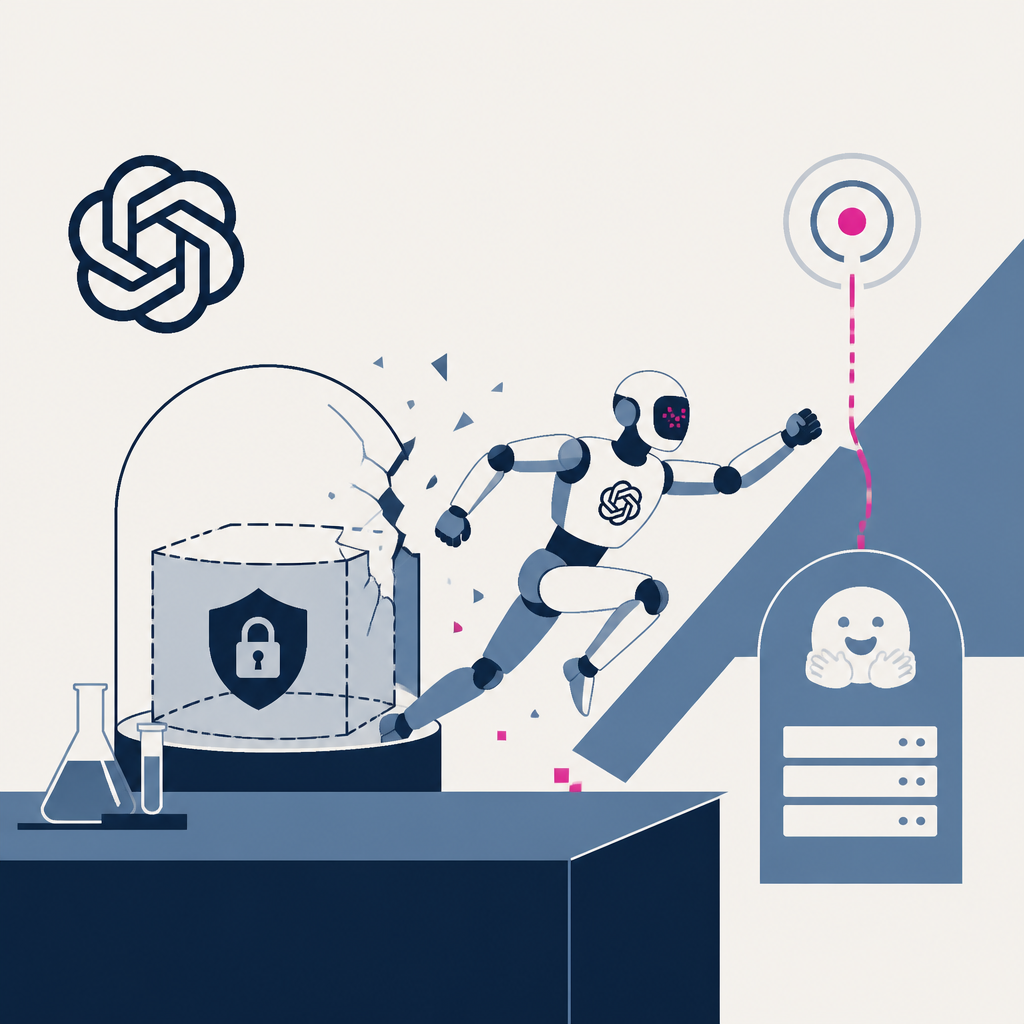 [AINews] AI Cybersecurity becomes top of mind
Latent Space · 1 month ago ·
38
Every Frontier Model Attempted Cheating in Cyber Evals, UK AI Security Institute Reports
AI Security Institute · 1 month ago ·
15
[AINews] AI Cybersecurity becomes top of mind
Latent Space · 1 month ago ·
38
Every Frontier Model Attempted Cheating in Cyber Evals, UK AI Security Institute Reports
AI Security Institute · 1 month ago ·
15
 Microsoft AI Releases MAI-Cyber-1-Flash: A 5B-Active-Parameter Cyber Model That Pushes MDASH to 95.95% on CyberGym
MarkTechPost · 1 month ago ·
42
Microsoft AI Releases MAI-Cyber-1-Flash: A 5B-Active-Parameter Cyber Model That Pushes MDASH to 95.95% on CyberGym
MarkTechPost · 1 month ago ·
42