
NVIDIA Releases Nemotron 3.5 Transcribe: An Open 30B MoE Model for 40-Language Transcription with ~4B Active Parameters
MarkTechPost Asif Razzaq ● Covered by 2 sources
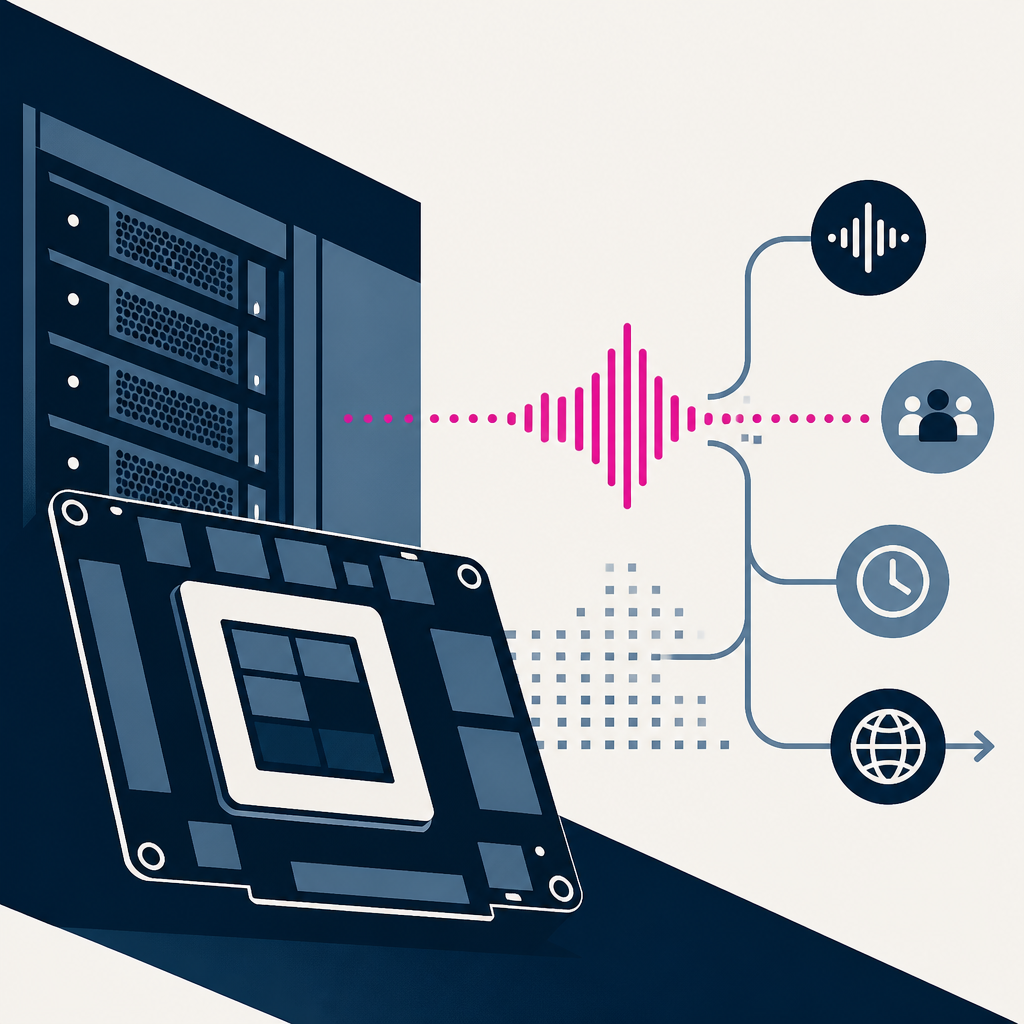
NVIDIA shipped Nemotron 3.5 Transcribe, an open speech model for 40 languages. It bundles transcripts, speaker labels and timestamps in one offline model, but Mandarin meetings are still rough.
Based on reporting by MarkTechPost, Asif Razzaq — read the original for the full story.
Summary, retelling and take written by AI under human oversight; images are AI-generated illustrations. How we work · Report an error
NVIDIA has released Nemotron 3.5 Transcribe, an open-weights speech model built around one job: turning audio into usable text. It handles 40 languages, takes audio up to an hour long, and lets the user steer the output with a text prompt. Ask for verbatim text, cleaned-up writing, speaker labels, context-aware output, or a translation. That makes it more than a plain ASR model; NVIDIA is clearly trying to replace a small pile of separate tools with one system.
The model is big, but not in the blunt way the headline number suggests. NVIDIA says the checkpoint holds about 34B parameters, while only about 4.3B are active at a time. The backbone is Nemotron 3.5 Lightning 30B-A3B, paired with an audio encoder, a frozen diarization model that can track up to 8 speakers, and a CTC adapter for word timestamps. There is also a shared multi-token prediction layer for speculative decoding, which is a fancy way of saying the model has been built to move faster when serving.
On paper, it is designed for a lot of the annoying parts of transcription that usually live in separate services. One model can produce the transcript, speaker attribution, timestamps and translation. For developers, that matters because it can stand in for ASR, diarization and alignment tools at once. It also comes with a 65,536-token context window, which helps keep an hour of audio in view without the model forgetting where it started.
NVIDIA says it trained the system on about 1.72M unique hours of audio, or 6.5M hours with repeats. The fine-tuning run used 256 H100 GPUs for 28,500 steps, followed by a short reinforcement-learning phase with 400 updates. The company says the result is the best open-weights model on the English and multilingual Open ASR leaderboards. On the 9 public English sets, it posts a 4.71% mean WER, ahead of the next open model’s 4.94%. Commercial APIs still beat it, though.
The weak spots are plain too. NVIDIA says the model is offline only, and its worst result in the report is a 34.95% cpCER on AliMeeting Mandarin far-field meetings. It also only starts to shine when the serving stack is tuned around it. BF16 runs on a single H100 80 GB, but NVIDIA also offers FP8 and NVFP4 checkpoints, with the latter able to run on an RTX 5090. The company’s faster serving path is not open source yet, which is the familiar open-model catch: the weights are open, the nice plumbing less so.
My take — AI-written commentary, not fact-checked reporting
This is the usual open-model bargain, only cleaner than most: the weights are open, the convenience layer is not. NVIDIA has built something genuinely useful for transcription, but it still leaves the best serving tricks in its own garage. That’s not a bug in the business model; it is the business model.
Read more about this at: MarkTechPost