
NVIDIA Kumo Relational Outperforms Supervised Machine Learning on Relational Data, No Training Required
Hugging Face ● Covered by 2 sources
NVIDIA says Kumo Relational predicts straight from enterprise databases, with no training or feature work. It tops supervised models on 41 tasks and can scale past 500B rows.
Based on reporting by Hugging Face — read the original for the full story.
Summary, retelling and take written by AI under human oversight; images are AI-generated illustrations. How we work · Report an error
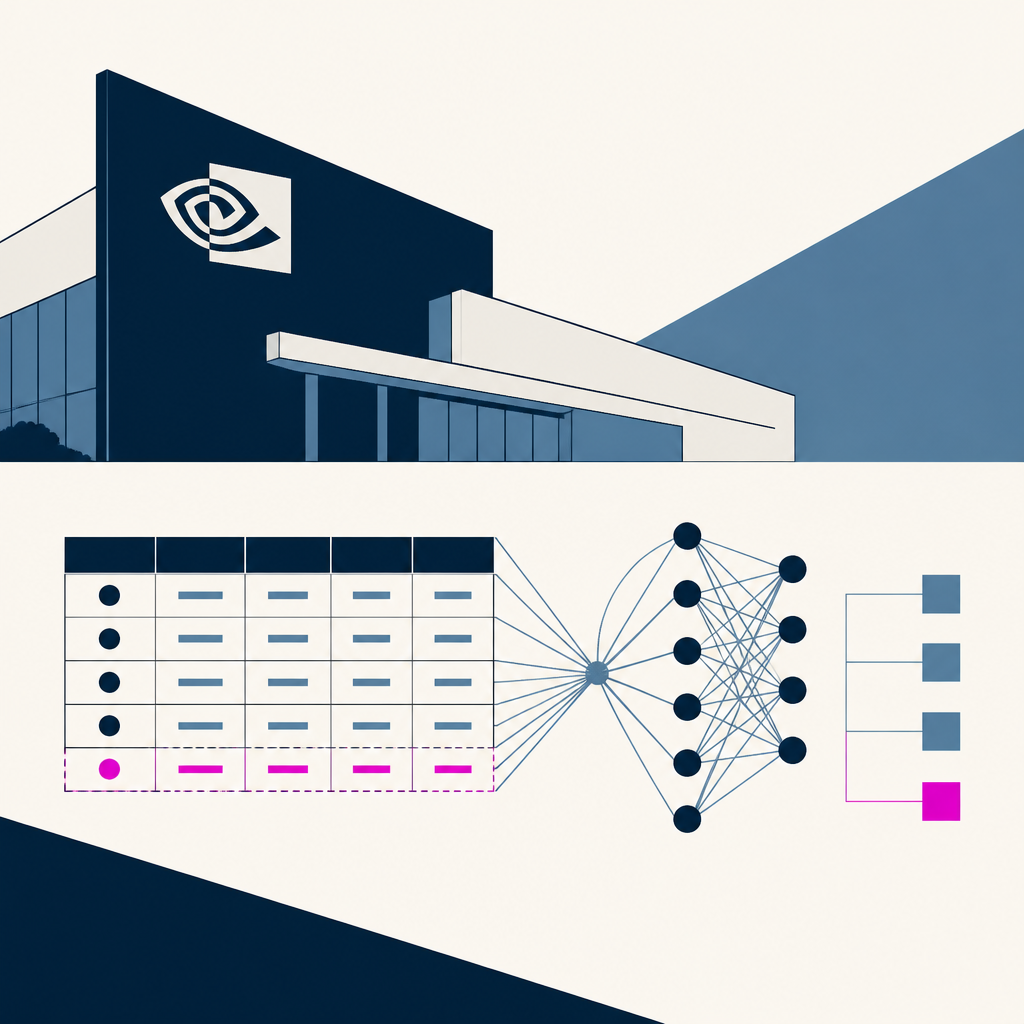
NVIDIA has a new relational foundation model, and it’s making a pretty direct pitch to ML teams: stop building a separate pipeline for every database task. Kumo Relational takes a predictive query, pulls in up to 10,000 historical examples as context, and produces outputs like churn, demand, or fraud in a single forward pass. No task-specific training. No feature engineering. No flattening tables into one giant spreadsheet-shaped compromise.
That matters because structured data has been stuck in a much older workflow than text or images. Enterprise prediction still often means weeks of feature work, custom training, and careful pipeline tuning. NVIDIA is arguing that Kumo Relational changes that by doing for relational data what foundation models did for language: one pretrained model that can be pointed at a new problem and used immediately.
The model is built to work directly on relational databases, respecting tables, foreign keys, and timestamps. It is pretrained on synthetic relational data, then adapted at inference time through in-context learning. For temporal tasks, it replays historical database states and only shows the model information from before the anchor timestamp, which is meant to avoid leakage. Under the hood, it first reasons within each table, then across tables, using graph attention and cross-sample attention to connect things like a user profile and transaction history.
NVIDIA says the results beat the usual suspects. Across 41 benchmarks on 15 databases, Kumo Relational outperforms supervised relational deep learning models and expert-engineered gradient-boosted tree pipelines. On the SAP SALT benchmark, it surpasses AutoGluon ensembles by 8% in mean reciprocal rank, and fine-tuning stretches that lead further. The company also says it stays usable when only 0.2% of training data is available as context, and that it can handle databases with 500B+ rows.
The model is available through NVIDIA’s open-source, GPU-native structured-data-models library or as an NVIDIA NIM. That’s the real tell: this isn’t being sold as a lab curiosity. It’s meant to slot into notebooks, connectors, and agents, with PQL as the front door and a lot less glue code in the middle.
My take — AI-written commentary, not fact-checked reporting
The annoying part is that this is exactly the kind of product the industry keeps promising and then quietly makes users assemble from six tools and a prayer. NVIDIA is pushing a cleaner story: relational data should be queried, not tortured into features. That’s a sensible bet, and the fact it lands on enterprise benchmarks instead of vibes is the part that should make people pay attention.
Read more about this at: Hugging Face
Related stories
 NVIDIA Releases Kumo Tabular: Open Tabular Foundation Models That Predict New Rows in a Single Forward Pass
MarkTechPost · 2 weeks ago ·
18
Nvidia bets open models can give enterprise AI agents the context they’re missing
The New Stack · 10 hours ago ·
48