
Microsoft Open-Sources Agensh: A Multi-Agent Harness for 1,024 Agents
MarkTechPost Asif Razzaq
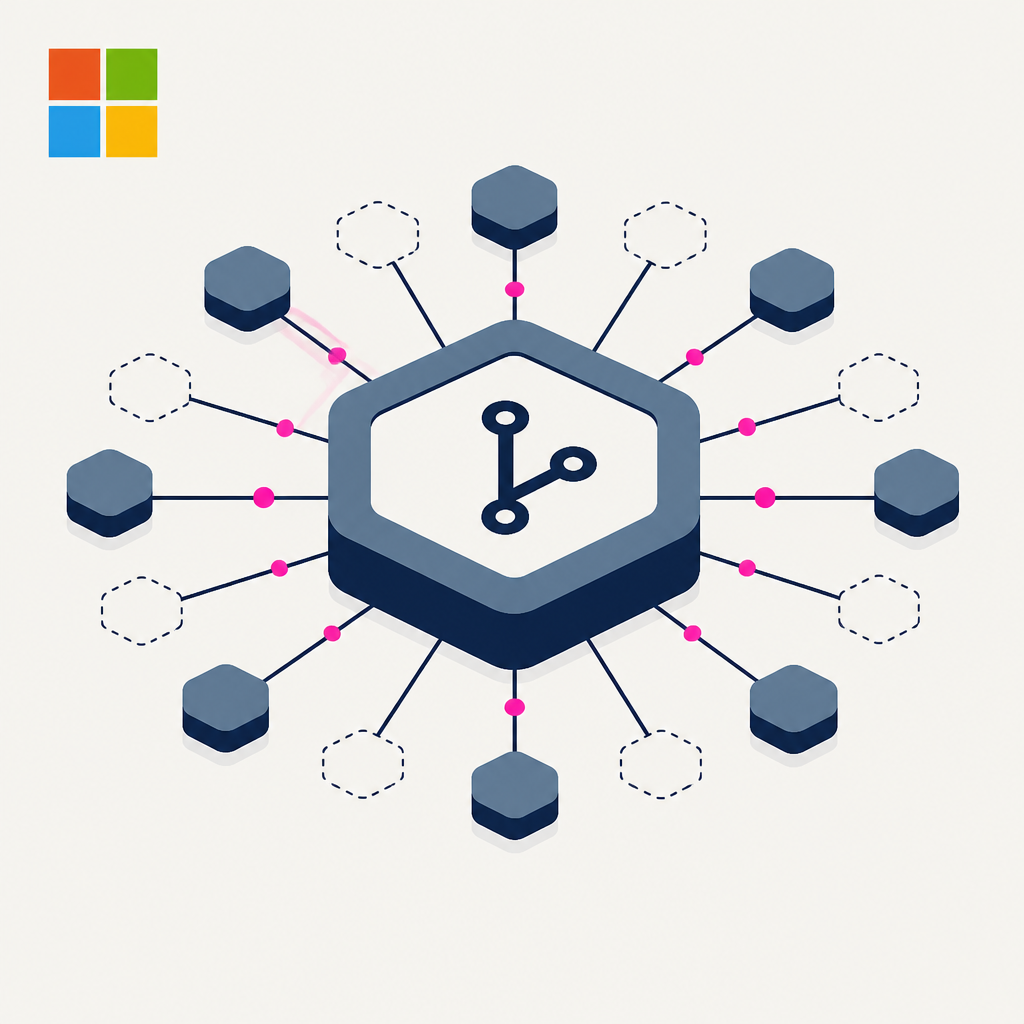
Microsoft open-sourced Agensh, a way to run up to 1,024 coding agents without a boss agent. It scaled across a shared repo and actually improved results on hard coding tasks.
Based on reporting by MarkTechPost, Asif Razzaq — read the original for the full story.
Summary, retelling and take written by AI under human oversight; images are AI-generated illustrations. How we work · Report an error
Microsoft Research has open-sourced Agensh, a decentralized harness built for very large teams of coding agents. The point is simple: take out the central orchestrator that most agent systems lean on, and let the workers coordinate for themselves. In this setup, each agent claims its own sub-task, shares what it learns, and merges code back into a common Git repository.
The team pushed that idea hard. On ProgramBench, Agensh was tested from a single agent all the way up to 1,024 agents. The 1,024-agent run used 16 nodes with 64 agents on each node, and every worker had a 272,000-token input limit, a 128,000-token output limit, and a 64 GiB memory ceiling. By default, the release runs on Linux with Docker Compose and starts with 8 workers.
What makes Agensh unusual is how little special machinery sits above the agents. The cooperation loop lives in the prompt, not in runtime code. Each worker follows the same five steps: gather context, claim a sub-task, take action, verify the result, and merge progress. Gitea handles the shared workspace, Mattermost handles team messages, and a shared context board stores notes such as OBSERVED, FACT, FAIL, CLAIM and PATCH_SUMMARY.
The scale-up did not just add noise. On the five hardest ProgramBench tasks — FFmpeg, gromacs, pandoc, PHP-src and ctags — more agents improved scores and got to those scores faster. With GPT-5.6-sol at high reasoning effort, the mean final test-pass rate rose from 19.31% with 1 agent to 28.78% with 128 agents. On pandoc, the 1,024-agent run reached 55.06%, and the README says GPT-6.1-sol with 32 agents hit 79.59% on the same task.
There were also signs that coordination itself was changing as the team grew. At 8 agents, peers handled overlap directly. At 32, they were reviewing shared work and even withdrawing approvals after finding counterexamples. At 128, they were reusing trusted reviewers and standardizing integration. By 1,024, several workers had started acting as integrators without being told to do so. That’s the sort of detail that makes this feel less like a benchmark stunt and more like a stress test of what happens when you stop pretending every agent team needs a boss.
My take — AI-written commentary, not fact-checked reporting
This is the kind of open-source release that matters: not another chatbot demo, but a system that exposes the messy reality of coordination at scale. The fun part is that the agents seem to invent management roles anyway, which is exactly what people do in real teams, minus the meetings that should’ve been an email.
Read more about this at: MarkTechPost
Related stories
 Prime Intellect Releases Prime Agent: An Open-Source RLM Harness Where Sub-Agents Are Function Calls Inside Persistent IPython Kernel
MarkTechPost · 2 months ago ·
23
Rebuilding Cognition's Agentic MapReduce
Matt Rickard · 3 months ago ·
22
Agent swarms and the new model economics
Cursor · 3 months ago ·
40