
Meta shakes up the frontiers, open and closed
Interconnects Nathan Lambert ● Covered by 27 sources
Meta’s new open model just jumped to the front of the U.S. pack. It matters because the gap with Chinese open models has shrunk fast, and the license may blunt the win.
Based on reporting by Interconnects, Nathan Lambert — read the original for the full story.
Summary, retelling and take written by AI under human oversight; images are AI-generated illustrations. How we work · Report an error
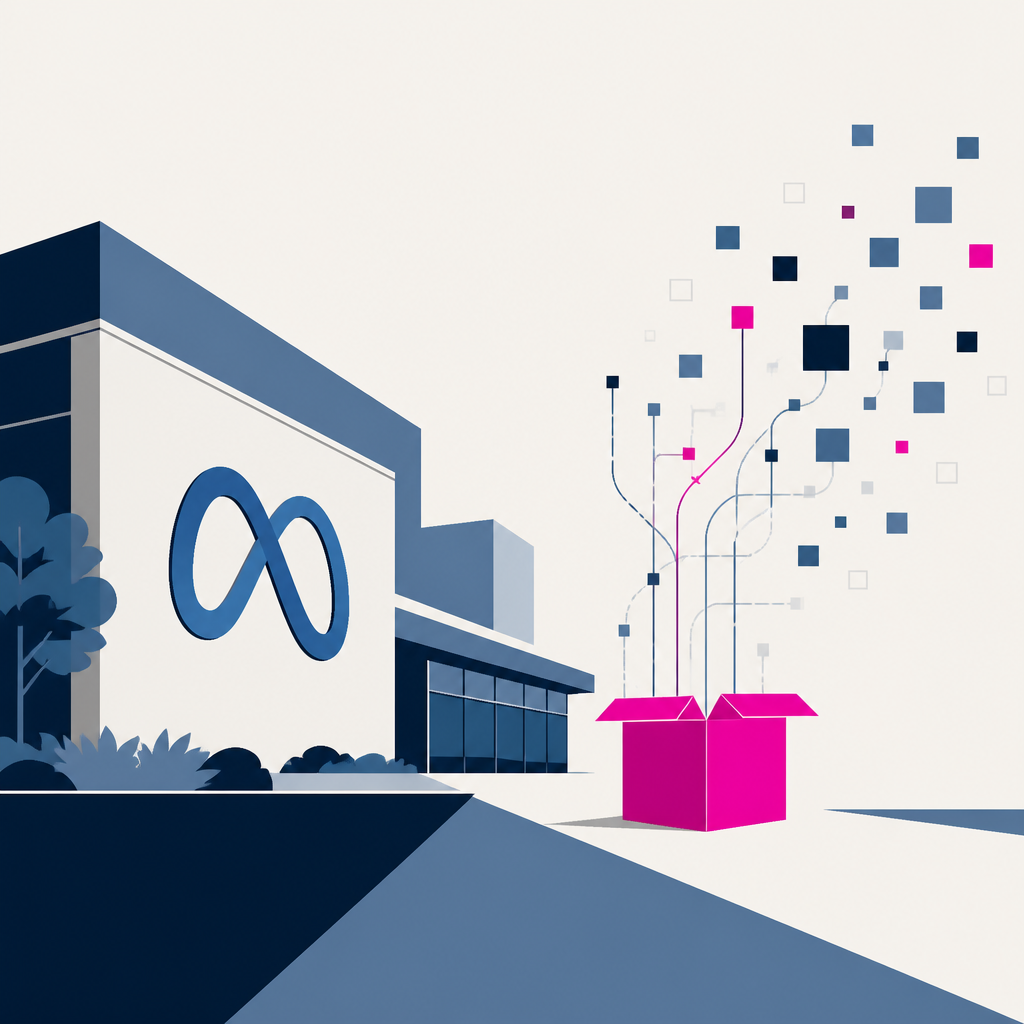
Meta has pulled off the clearest American comeback in open-weight AI this week. Its Muse Spark Open is now the strongest U.S.-made open model by a wide margin, and Reflection’s first model, Beam, adds to a sudden shift back toward the frontier. Without those two releases, the source says there would be 20-plus Chinese open-weight models ahead of the best Western ones.
The bigger point is that the gap has narrowed a lot. It is still there, but it is no longer the kind of gap that makes Western open models irrelevant. Muse Spark Open lands in a market where open-ended LLM agents are finally real, where demand for open systems is rising, and where enterprises want to control more of their own intelligence. On the performance readout in the piece, it sits above GLM 5.2, near DeepSeek V4.1 Flash, and behind GLM 5.3 and Kimi K3.
Meta says Muse Spark Open is an 816B total parameter model with 42B active parameters, a 1M-token context window, and native multimodal support. It is built for coding and agentic work, and Meta also added safety post-training before release. The article frames that safety work as likely a tune on an earlier version, not a broken model.
But the license may be the real drag. It asks product users to show “Built with Muse,” adds revenue gating above $20M per month across the business, requires an acceptable use policy, and applies those terms to outputs and derivatives too. The author thinks many people will ignore the fine print and build anyway, but also calls the setup an unnecessary strategic risk for any lab trying to win adoption.
The timing makes the release look even sharper. Meta had just shown off its closed frontier models, Muse Wonder and Muse Wonder Full, which the piece says sit just behind Anthropic’s Opus 5.5 and around OpenAI’s GPT-6-Astra or Google’s Gemini-4-Argon on traditional benchmarks. Add all that together, and Meta now looks like the rare American lab that can play both sides of the frontier at once.
My take — AI-written commentary, not fact-checked reporting
Meta’s move is smart, but the license smells like a tax on its own momentum. Open models win when people can actually use them without legal gymnastics, and the industry keeps pretending friction is a feature. It isn’t; it’s just paperwork wearing a hoodie.
Read more about this at: Interconnects
Related stories
 With new open models, Meta pitches another reboot of its struggling AI strategy
Ars Technica · 2 months ago ·
44
Meta Released Muse Spark 1.1 with Major Upgrades
The Neuron · 3 months ago ·
10
With new open models, Meta pitches another reboot of its struggling AI strategy
Ars Technica · 2 months ago ·
44
Meta Released Muse Spark 1.1 with Major Upgrades
The Neuron · 3 months ago ·
10
 [AINews] Muse Glimmer and Spark: Open Weights return Personal Superintelligence promise
Latent Space · 2 months ago ·
22
[AINews] Muse Glimmer and Spark: Open Weights return Personal Superintelligence promise
Latent Space · 2 months ago ·
22