HappyRobot lands $150M Series C to scale agentic AI for enterprise operations
Tech.eu Cate Lawrence ● Covered by 2 sources
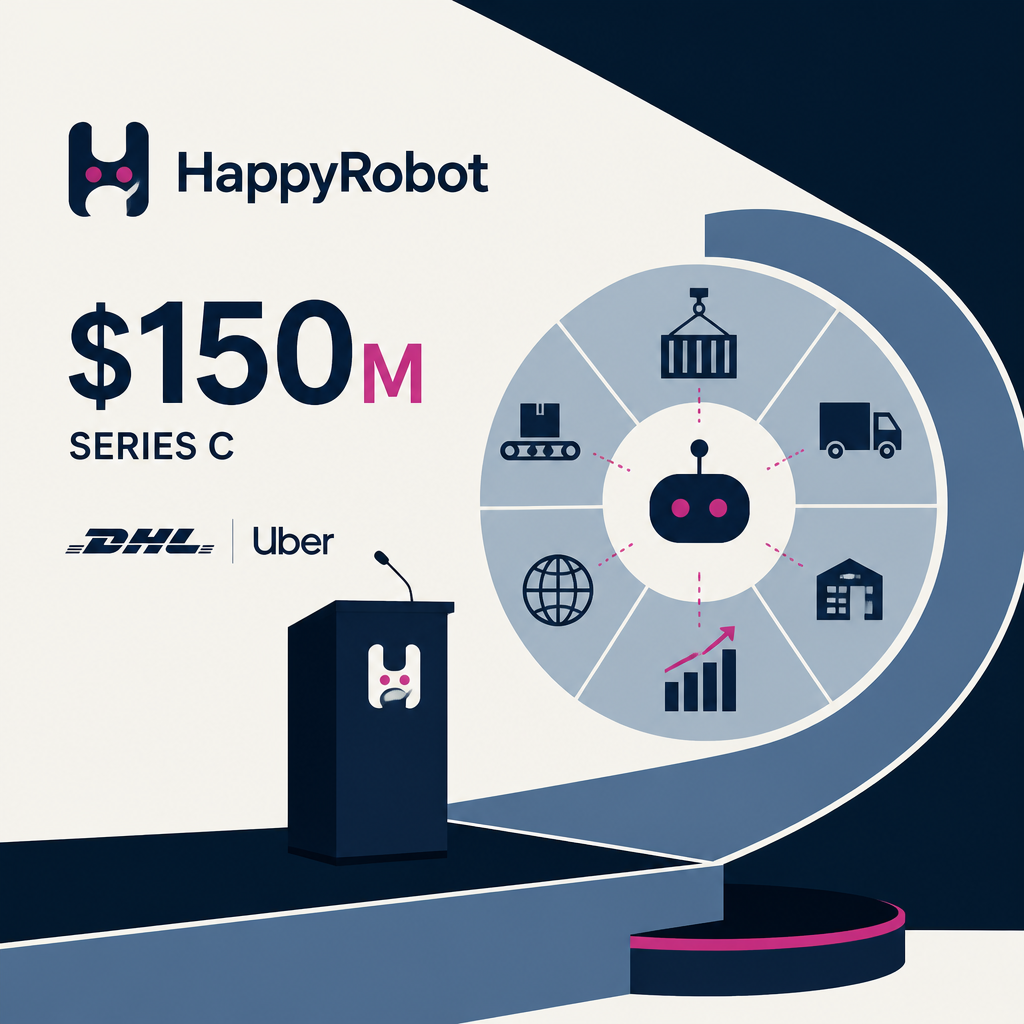
HappyRobot just raised $150M to put AI agents on the phones and emails that run supply chains. It's now worth $1.2 billion, and it's already handling 28,000 work-hours a month for one client.
Based on reporting by Tech.eu, Cate Lawrence — read the original for the full story.
Summary, retelling and take written by AI under human oversight; images are AI-generated illustrations. How we work · Report an error
Somewhere between the hype about AI writing essays and the reality of running a warehouse, there's a mountain of unglamorous work: phone calls to truckers, emails about shipment delays, paperwork nobody wants to touch. HappyRobot has built a $1.2 billion business betting that fixing that mess is worth more than another chatbot. The company just closed a $150 million Series C led by Prysm Capital and Eurazeo, pushing total funding to roughly $200 million, with a16z, Y Combinator, Base10, and a crowd of corporate investors including Deutsche Telekom's T.Capital and Orange piling back in.
What HappyRobot actually sells is agents that can pick up the phone, read a document, or fire off an email inside a company's existing systems, then learn from what happens next. It's not a one-off deployment. New agents typically go live in four to twelve weeks, and the company keeps iterating from there, tuning the ones already running and adding fresh ones as customers find more tasks to hand off. That cadence matters, because the pitch isn't automation as a project, it's automation as a relationship.
The numbers are the kind investors like to repeat in pitch decks. One customer is offloading 28,000 hours of work a month. Customer service agents are hitting 9.4 out of 10 satisfaction scores while resolving more than 70 percent of interactions without a human. Some operations teams have expanded capacity tenfold, and sales teams have pulled in five times more revenue from channels that used to sit idle. HappyRobot now counts more than 150 enterprise customers, among them DHL, Kuehne+Nagel, Uber, and Repsol, and says it has grown fivefold since its Series B closed less than a year ago.
Logistics was the proving ground, chosen because freight brokering is famously chaotic and phone-dependent. Now the company is pushing into insurance, energy, telecom, airlines and banking, industries that share the same DNA: fragmented systems held together by human coordination. CEO Pablo Palafox frames the ambition well beyond task automation, talking instead about what he calls enterprise superintelligence, where agents and employees compound each other's knowledge over time rather than just executing scripted actions.
The money will go toward broadening the platform's AI capabilities, deepening enterprise integrations, and building out the infrastructure to run agents at real scale, alongside hiring across engineering and go-to-market teams. HappyRobot has already gone from two offices to eight across North America, Europe, Latin America and Australia in the space of a year, which tells you the demand side of this bet isn't hypothetical.
My take — AI-written commentary, not fact-checked reporting
The interesting thing here isn't the valuation, it's that HappyRobot picked logistics, one of the least sexy, most operationally brutal industries around, and made that the proof point rather than a demo reel. Enterprise AI hype has mostly been about generating content faster; the companies actually making money are the ones automating the boring coordination work nobody wanted to do in the first place. Expect a wave of copycats chasing the same unglamorous phone-and-email plumbing across insurance and telecom, because $1.2 billion valuations tend to attract imitators fast.
Read more about this at: Tech.eu