
Every child will get AI. Not every child will get a teacher
Fortune Dmytro Korchevskyi
Opinion — commentary, not a factual news event.
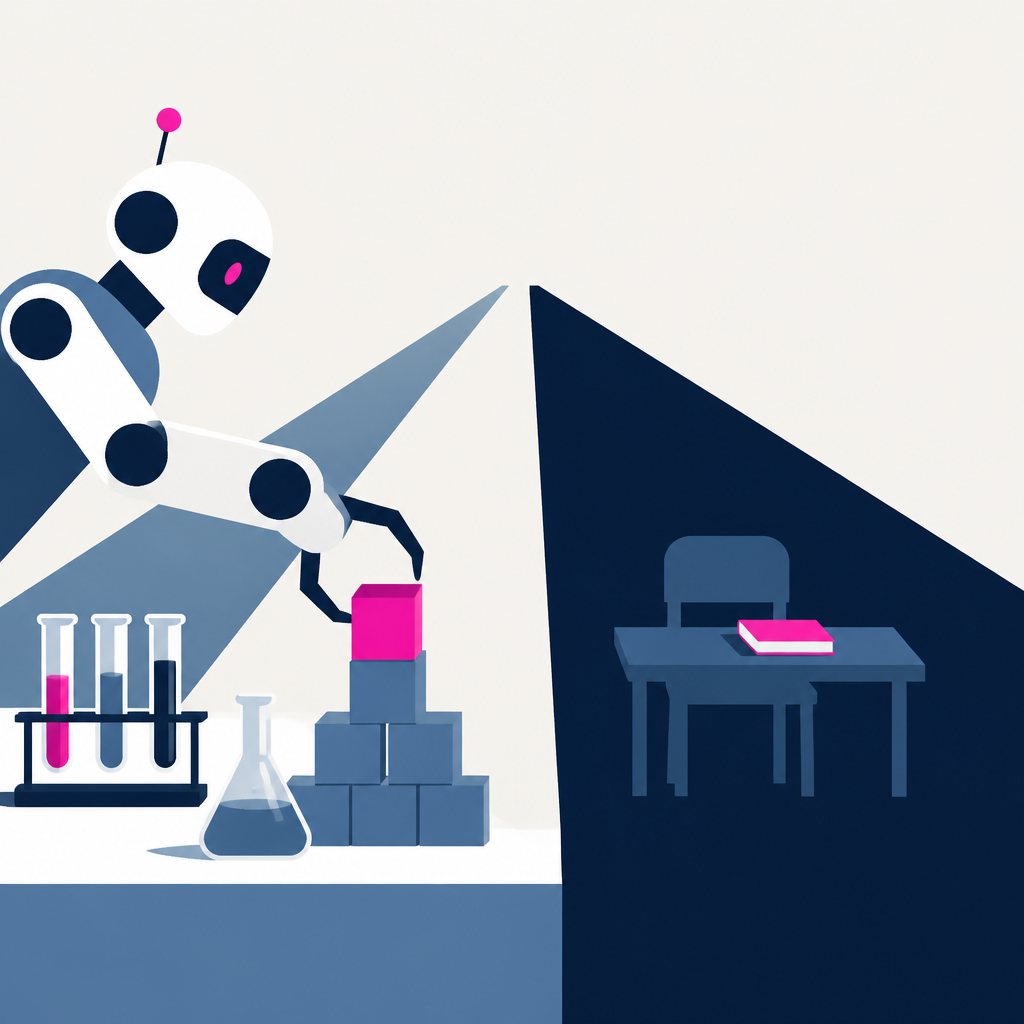
AI is already a homework crutch for poorer teens. The weird part: the real divide may become AI for all, human teachers for some.
Based on reporting by Fortune, Dmytro Korchevskyi — read the original for the full story.
Summary, retelling and take written by AI under human oversight; images are AI-generated illustrations. How we work · Report an error
The usual fear about AI in school is that only rich kids will get it. This piece flips that worry on its head: AI is already showing up more in low-income homes, and the bigger gap may soon be between children with a machine tutor and children with a real one.
Pew Research Center data cited here says one in five teenagers from families earning under $30,000 a year does all or almost all of their homework with chatbots. Among teens from families earning $75,000 or more, the figure is 7%. That doesn’t mean the lower-income students are winning. It means they’re leaning on the tool more, and that can cut both ways.
The author argues that access to knowledge is not the same as learning it. A story from an IT school illustrates the point: a young man who first looked like he had come in for warmth or money instead asked for a chance to study, paid his way, finished the course, and later taught there. He said he got through because teachers believed in him and kept him from dropping out. An AI tutor could have handed him information. It could not have done the believing.
That concern lines up with research and with practice. Sal Khan has said most students were not using the personal AI tutor he had promised for every student on the planet. And an experiment by the Wharton School found that about a thousand Turkish high school students who used regular ChatGPT during math practice improved at first, but then scored 17% worse than students who had no AI at all when they took the exam without the bots.
The policy pressure is moving the same way. This year, the U.S. Department of Education put AI development into its priorities for school grants, including AI tutors and help for students who are falling behind. It kept language about preserving the human side of learning, but the final text still stood. At the same time, UNESCO says the world will need 44 million more teachers by 2030, including 4.8 million in Europe and North America, and the U.S. already has 56,000 unfilled teaching jobs. AI is cheaper, faster, and very convenient. That is exactly why schools will be tempted to use it as a substitute, not just a tool.
My take — AI-written commentary, not fact-checked reporting
The bad policy move here is obvious: call it “support” while quietly using software to patch teacher shortages. That’s the kind of budget logic that sounds efficient right up until kids stop getting an adult who notices when they’re lost, bored, or about to quit. Silicon Valley loves a shortcut; education keeps paying for them later.
Read more about this at: Fortune
Related stories
 The Gates Foundation is spending $400 million on AI in schools. Teachers warn it could 'end up widening' the divide it's meant to close
Fortune ·
35
 Students are using AI in school and test scores are down, but the OECD finds that those who use it once or twice a week perform similarly to nonusers
Fortune ·
35
Students who use AI generally score worse at school
The Verge · 1 month ago ·
10