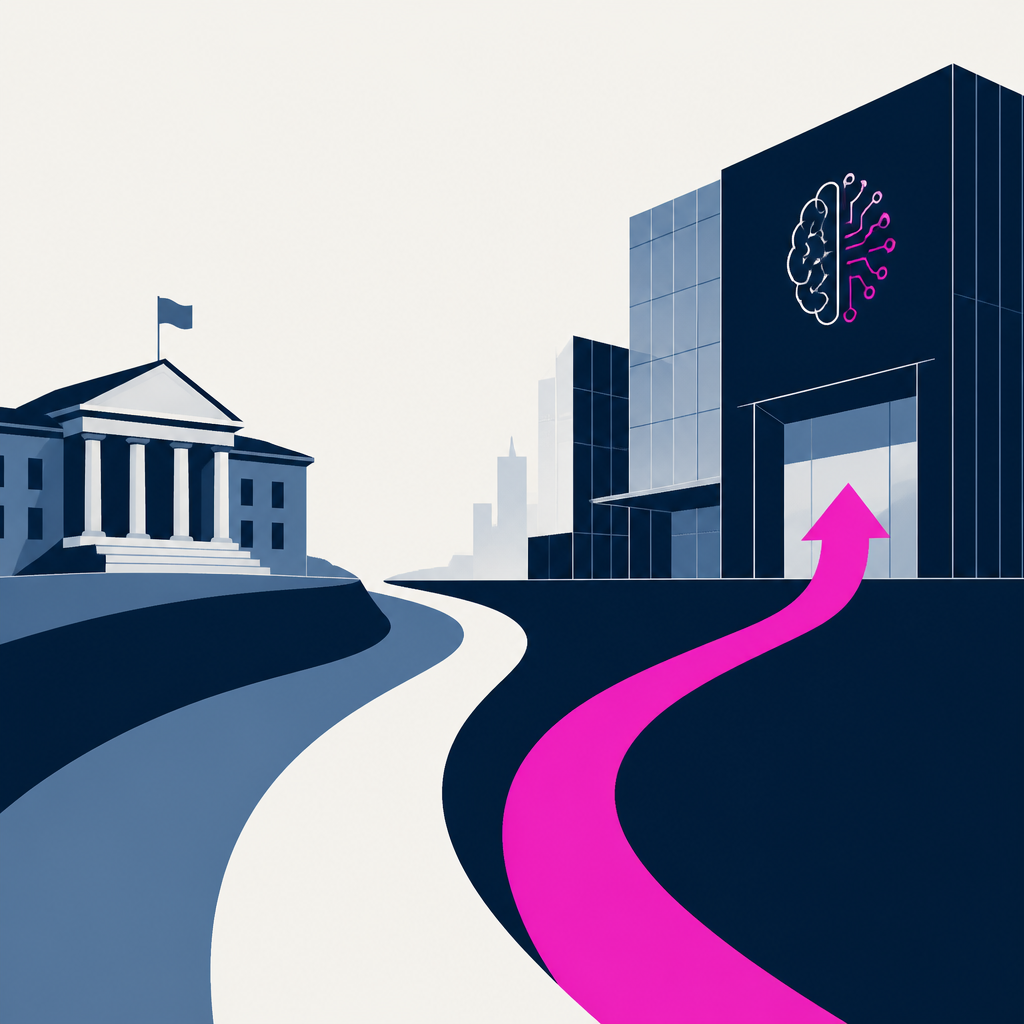
AI professors are negotiating the new realities of academic research
MIT Technology Review Grace Huckins ● Covered by 4 sources

AI professors are stuck on the sidelines of frontier models. So they’re chasing neglected problems, while companies keep the keys to the biggest tools.
Based on reporting by MIT Technology Review, Grace Huckins — read the original for the full story.
Summary, retelling and take written by AI under human oversight; images are AI-generated illustrations. How we work · Report an error
Last week, MIT Technology Review’s The Algorithm went to a Schmidt Sciences AI2050 gathering in Mountain View, where a room full of top AI academics was also a reminder of how much the field has shifted away from universities.
Over the past four years, AI research has swung hard toward large language models, and the center of gravity has moved into private companies. Universities usually can’t pay for the GPUs needed to train frontier systems, and outsiders can’t inspect the guts of Claude or ChatGPT anyway. That leaves professors in an odd position: they can study the outputs, but not the machinery that makes them.
Some AI2050 fellows do get funding they can use for GPUs, and several said that help matters. But the money problem hasn’t gone away, especially with federal scientific funding in the United States dropping. Even just probing commercial models again and again can get expensive, which pushes many academics toward questions the big labs are less likely to touch.
That can mean research that sits far from the hottest company work. Anjalie Field at Johns Hopkins said she tries to avoid problems she expects a tech company will solve anyway. One of her recent studies found that language models give weaker answers to prompts written in styles more often used by women than by men, the sort of result that is hard to imagine coming from Anthropic or OpenAI.
Not everyone in the room was chasing LLMs at all. Many of the academics build specialized systems that forecast, classify, or simulate specific physical processes. They face a different problem: too many people hear “AI” and picture only power-hungry chatbots. That makes it harder to argue for climate tools, scientific models, and other non-glamorous work that still matters.
The pressure is clearly reshaping academic careers. Some prominent researchers have taken leave to join frontier labs, and many AI2050 fellows split time between universities and industry. But there’s also a counterforce here: scarcity. When researchers can’t afford brute force, they get pushed toward smaller, cheaper, stranger ideas. That may be exactly where the next real breakthrough comes from.
My take — AI-written commentary, not fact-checked reporting
The real story is not that universities are losing. It’s that the industry has confused “AI” with “the few models it can afford to hoard,” which is a very expensive kind of tunnel vision. Academic labs have always been good at making do, and that usually beats having a bigger cloud bill and a louder blog post.
Read more about this at: MIT Technology Review