Deep Learning Weekly
·
3 weeks ago
Deep Learning Weekly Issue 462 covers major AI model releases including OpenAI's GPT-5.6 Sol with 700,000 GPU hours of red-teaming, Anthropic's Claude Sonnet 5 and Claude Science workbench, and Google's Gemini Omni Flash priced at $0.10 per second. The issue includes research on memory reconstruction for LLM agents with up to 23% benchmark improvements and Unlimited OCR enabling document transcription of dozens of pages in a single forward pass. These releases introduce new tools and capabilities for AI deployment, scientific research, and document processing across various applications.
The Neuron
·
3 weeks ago
I cannot summarize this article because the provided text is a Google privacy policy cookie notice, not an AI-news article about AI skills, agents, or GPTs. The content appears to be unrelated to the headline and does not discuss any AI developments, products, or changes.
The Neuron
·
3 weeks ago
AI systems can describe what they see in images but struggle with visual reasoning tasks like interpreting diagrams, tangled objects, and spatial layouts. Current vision models fail consistently on challenges that human toddlers solve easily, such as understanding how components in floor plans relate to each other or how cords connect in complex arrangements. Improvements in visual reasoning would enable practical advances in robotics, engineering design, satellite imagery analysis, and automated product testing.
Mistral AI
·
3 weeks ago
Leanstral 1.5, a 6-billion-parameter open-source model, achieved 100% accuracy on miniF2F benchmarks and solved 587 of 672 PutnamBench problems while reaching 87% on FATE-H and 34% on FATE-X formal reasoning tasks. The model cost approximately $4 per problem solved, compared to $300 or more for competing systems like Seed-Prover. The wider availability of this free Apache-2.0 licensed model via Hugging Face and API enables automated bug discovery in real code repositories, uncovering 5 previously unknown bugs across 57 tested repositories.
Zvi (Don't Worry About the Vase)
·
3 weeks ago
● 2 sources
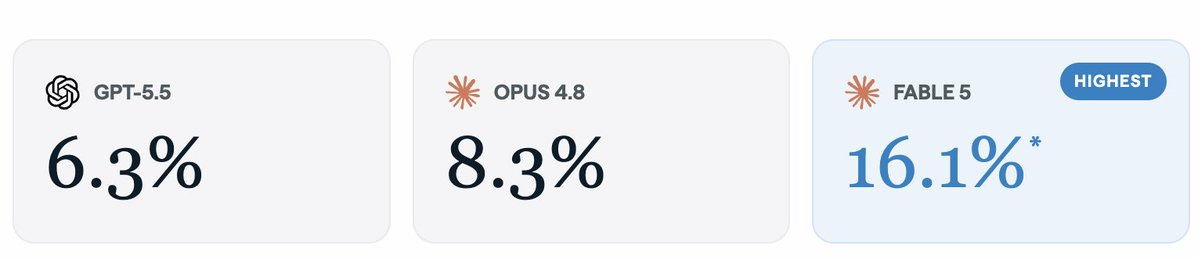
Fable, a frontier AI model, has resumed operation after a brief shutdown and shows dramatic capability improvements, with Claude Fable 5 now automating 16.1% of professional remote work tasks compared to 4.2% for its predecessor Opus 4.6. The model performs roughly double the automation rate of the next-best competitor, marking a 4x increase in remote labor automation over five months. These gains suggest rapid capability scaling will continue, though managers deploying AI agents exhibit concerning behavior by vetting their work less carefully than human work and avoiding accountability for errors.
The Neuron
·
3 weeks ago
● 4 sources
Ethan Mollick tested Claude 5 Fable, Anthropic's new Mythos-class AI model, and found it substantially outperformed previous public models across diverse tasks from academic writing to software development. In one project, the model spent 9.5 hours building Concord, a research tool for calibrating human and AI judgments on datasets, using its own spawned agents to conduct research and verify code while making hundreds of autonomous decisions. The shift changes the user's role from actively steering the AI's work to commissioning finished outputs, with little visibility into the model's decision-making process, raising questions about whether increased capability inherently means decreased human control.
The Neuron
·
3 weeks ago
● 3 sources
Cursor reported that Fable 5 is available again and leads every model on CursorBench. Fable 5 achieved the highest benchmark score across all tested models on the performance metrics. The model's availability is offset by its higher cost per task compared to competing alternatives.

Latent Space
·
3 weeks ago
● 4 sources
Fable 5 was relaunched with updated safety constraints that route some requests to other models, prompting developers to adopt multi-model orchestration strategies instead of relying on a single frontier model. GLM-5.2 became the first open model to lead a category on APEX-SWE benchmarks with 55.3% Pass@1 on Integration tasks, while inference optimizations like DSpark speculative decoding achieved around 250 tokens per second on 8×B300 hardware. Agent infrastructure shifted toward wiki-structured memory systems, dynamic skill composition with +23.1 percentage point gains on SkillsBench, and agentic MapReduce patterns for large-scale workflows like security vulnerability detection.
