One Useful Thing
·
3 weeks ago
● 4 sources
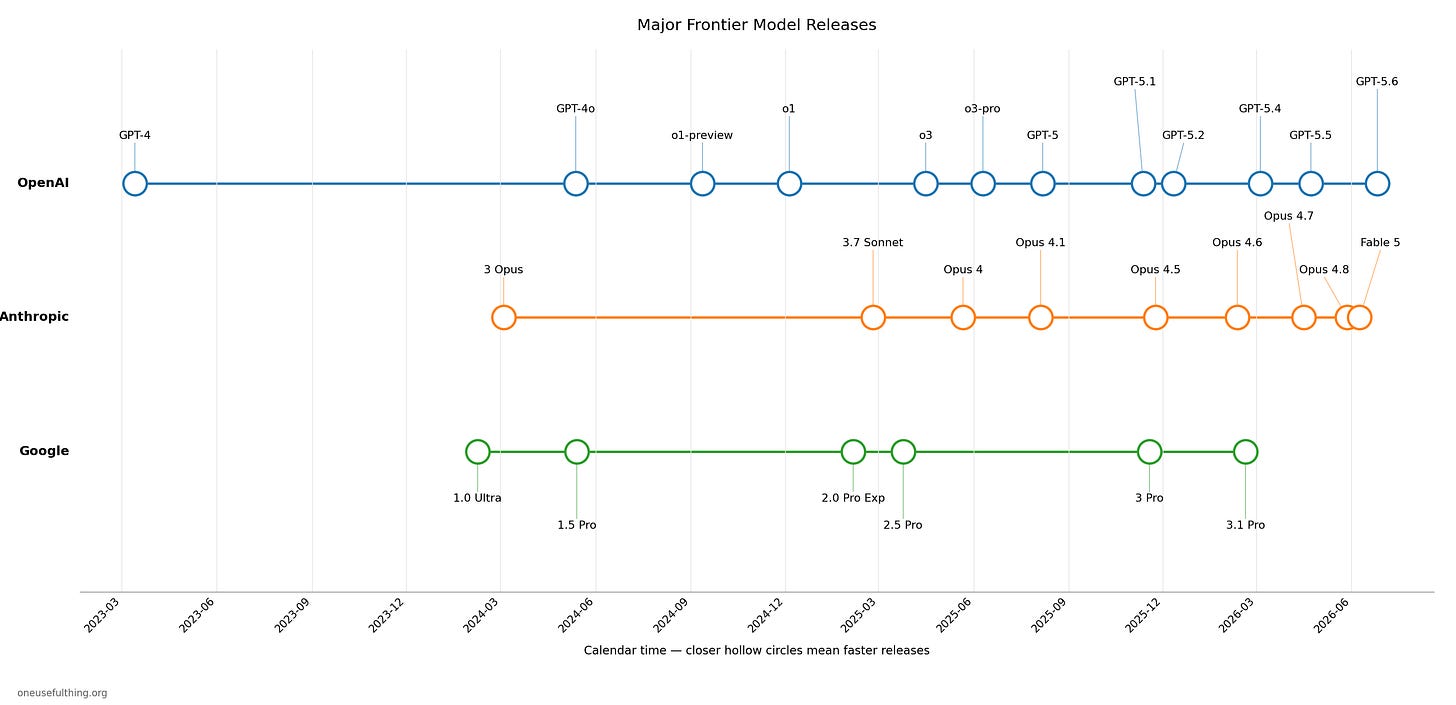
AI models from leading labs are improving at exponential rates in their ability to perform complex work autonomously, with systems like Opus 4.7 completing tasks in hours that would take humans weeks, while the usage pattern is shifting from interactive chatbots to autonomous agents managed by human operators. A recent OpenAI study found that a quarter of its workforce regularly manages at least four AI agents simultaneously, with agents adopted across technical and non-technical departments at similar rates, and success depends more on user domain expertise than professional background. As capability improvements compound exponentially, organizations face rapid disruption where AI plans written months ago are already obsolete, creating institutional turbulence as policy and markets struggle to track improvements that don't move at human speed.

Google Research
·
3 weeks ago
Google Research released building-level rooftop reflectivity data covering 50+ global cities through a new Heat Resilience Earth Engine App to help urban planners implement cool-roof solutions for mitigating extreme heat. The dataset achieves 30-centimeter spatial resolution by fusing Sentinel-2 satellite data with high-resolution commercial imagery using machine learning, validated against ground measurements with a root mean square error of 0.04. Cities can now prioritize individual buildings for cool-roof retrofits, with targeted interventions potentially reducing extreme urban heat by up to 0.5°C globally.

MIT Technology Review AI
·
3 weeks ago
AI systems can improve crop yield by 26%, reduce water use by 41%, and cut chemical usage by 33%, but agricultural operations lack the clean data foundations needed to make these systems reliable. Agriculture's data challenge is uniquely complex: modern farms use disparate IoT devices, autonomous machinery, and external feeds from weather and government sources, while requiring AI systems to understand specific geographic details like GPS coordinates and field-level soil variation. Organizations must first build unified data models, governance frameworks, and security controls before deploying AI, or risk generating misleading recommendations that waste resources or cause operational damage.
