
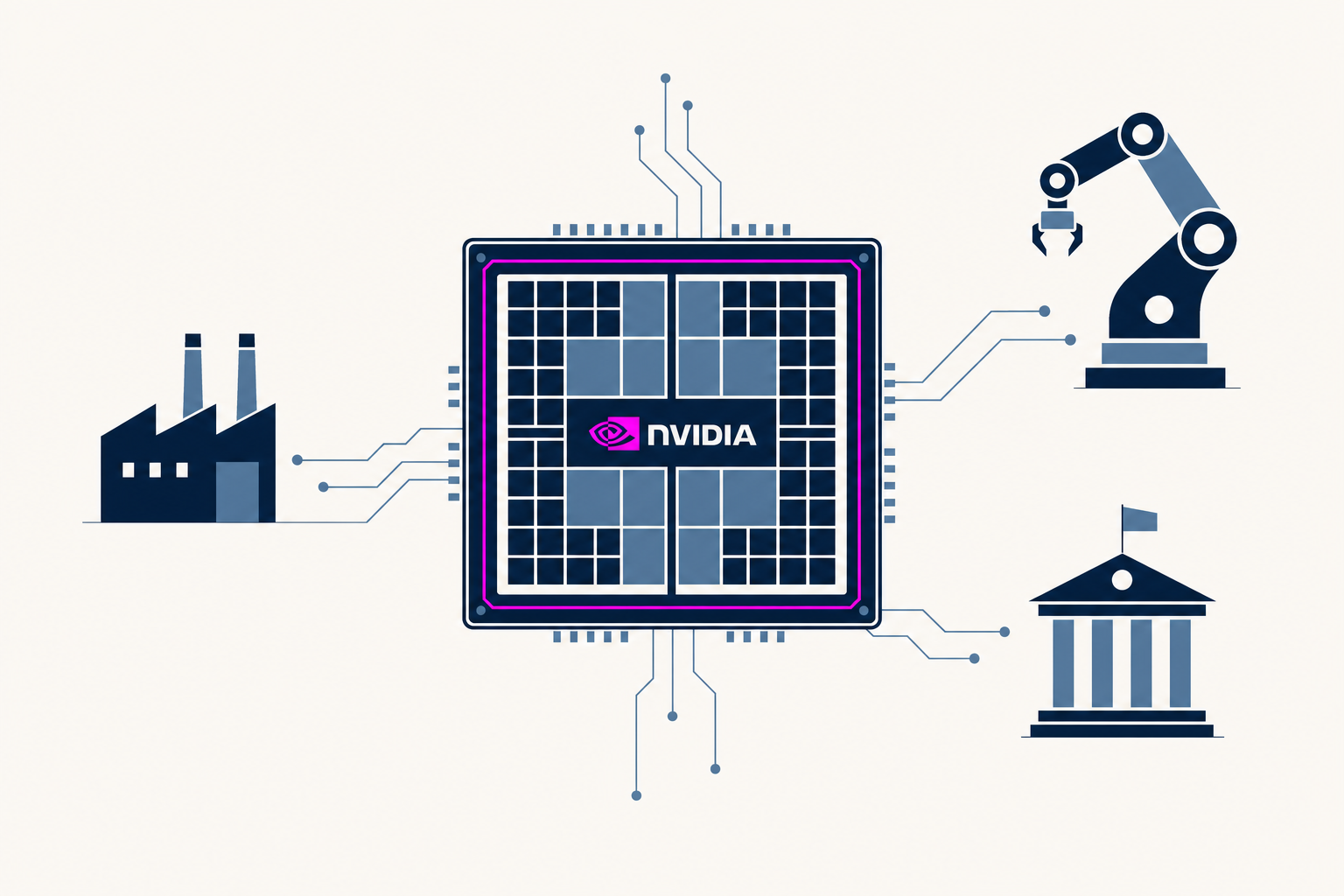
An Nvidia GPU chip, centrepiece of Japan's Noetra AI infrastructure project.
Analysis · 20 July 2026
Japan's $6.2B AI Bet and the Sovereignty Paradox
The phrase "sovereign AI" keeps appearing in government press releases, and it almost always conceals the same contradiction: a country declares it will control its own AI destiny, then immediately signs a hardware deal with Nvidia. Japan made this contradiction unusually visible this week, and the numbers are large enough to be worth examining seriously.
What Jensen Huang Actually Secured in Tokyo
Nvidia CEO Jensen Huang's two-day visit to Japan on July 15–16 produced a striking set of commitments. Japan is putting up to 1 trillion yen — roughly $6.2 billion — toward a domestically controlled AI infrastructure project called Noetra. The centrepiece is a data centre housing 13,750 Vera CPUs and 27,500 Rubin GPUs, scheduled to launch in 2028. Toyota, Fanuc, and Yaskawa pledged to adopt Nvidia's Cosmos models for factory and robotics applications. Japan has set a target of deploying 10 million AI-equipped robots across 18 sectors by 2040 and capturing 30% of the global AI robotics market by then.
These are not modest ambitions. But the architecture of the plan deserves scrutiny: Japan will own the data centre, employ the engineers, and set the policy. Nvidia will supply every meaningful chip inside it. "Sovereign" here means sovereign governance of an Nvidia-dependent stack — a useful distinction the press releases tend to skip.
This is not a criticism unique to Japan. The EU AI Factories programme, the UAE's Falcon initiative, and Saudi Arabia's HUMAIN project all share the same structure. The geopolitical logic is sound: owning data, compute contracts, and the talent is genuinely better than owning none of those things. But it creates a single point of dependency that Nvidia, whose Rubin GPU architecture will not face a credible alternative at scale until well after 2028, is quietly content to be.
The Model Layer Is Fragmenting While the Hardware Layer Consolidates
While the hardware tier concentrates around one vendor, the model tier is moving in the opposite direction — at speed. This week alone produced Alibaba's preview of Qwen3.8-Max, a 2.4 trillion-parameter multimodal model, announced at Shanghai's World AI Conference just two days after Moonshot AI released Kimi K3 at 2.8 trillion parameters. Both lack published active-parameter counts — the figure that actually determines inference cost — making honest benchmarking impossible for now. Developers are being asked to take performance claims on faith and subscribe at 10% of standard pricing to find out whether the models are genuinely capable.
This opacity matters for sovereign AI strategies specifically. Governments investing billions in compute infrastructure need to know whether the frontier models they plan to run will require 50 billion active parameters per token or 500 billion. The difference in inference cost at data-centre scale is enormous. The current practice of previewing trillion-parameter models without disclosure of their mixture-of-experts routing ratios is, charitably, a marketing decision.
At the application layer, more concrete progress is visible. Feyn AI's SQRL, a text-to-SQL model family that inspects a database schema before writing queries, scored 70.6% execution accuracy on the BIRD Dev benchmark — ahead of Claude Opus 4.6 at 68.77%. The 35B parameter version beats a frontier proprietary model on a specific, measurable task. That is the kind of narrow, verifiable benchmark result that enterprise buyers can actually use. Sovereign AI projects will run many workloads like this, not just general-purpose chat, and purpose-built models at manageable parameter counts are more practical for national data centres than whatever trillion-parameter system happens to be trending at the Shanghai World AI Conference.
What a Real Sovereign AI Stack Requires
Japan's Noetra project is more coherent than most national AI initiatives, precisely because it has a clear industrial rationale. Japanese manufacturing needs robotics intelligence. The country has the engineers, the factories, and the economic incentive. Nvidia's Cosmos models for robotic simulation fit that use case. The 2040 targets for robot deployment are ambitious but not arbitrary.
The harder problems are at the edges of the initiative. Nonprofit Current AI, which deployed $3.2 million in grants last month across organisations in Kenya, Lebanon, and Brazil, is pursuing the same sovereignty goal with a radically different philosophy: local data, local models, open-source infrastructure, community control. Its $400 million in committed government and foundation funding is a fraction of Japan's commitment, but its approach addresses the dependency problem directly rather than managing it.
Demis Hassabis proposed a Frontier AI Standards Body within the US government this week — voluntary pre-release reviews, 30 days before deployment. The proposal is modest by design and has already drawn criticism from safety researchers who note that internal model development would remain outside its scope. But it is relevant to sovereign AI for a different reason: if frontier models are eventually subject to pre-deployment review, governments building national AI infrastructure need to know which models they can legally and safely deploy. Right now, that question has no clear answer for any national programme.
The week's developments point toward an industry settling into a durable two-layer structure: hardware supply concentrated among very few vendors, model supply increasingly distributed and partially open-weight. Sovereign AI strategies that treat these as a single problem will keep finding that they have bought governance of a stack they do not actually control. The ones that treat them separately — owning the governance layer while managing hardware dependency as a supply-chain risk — will be in a more defensible position by 2030.