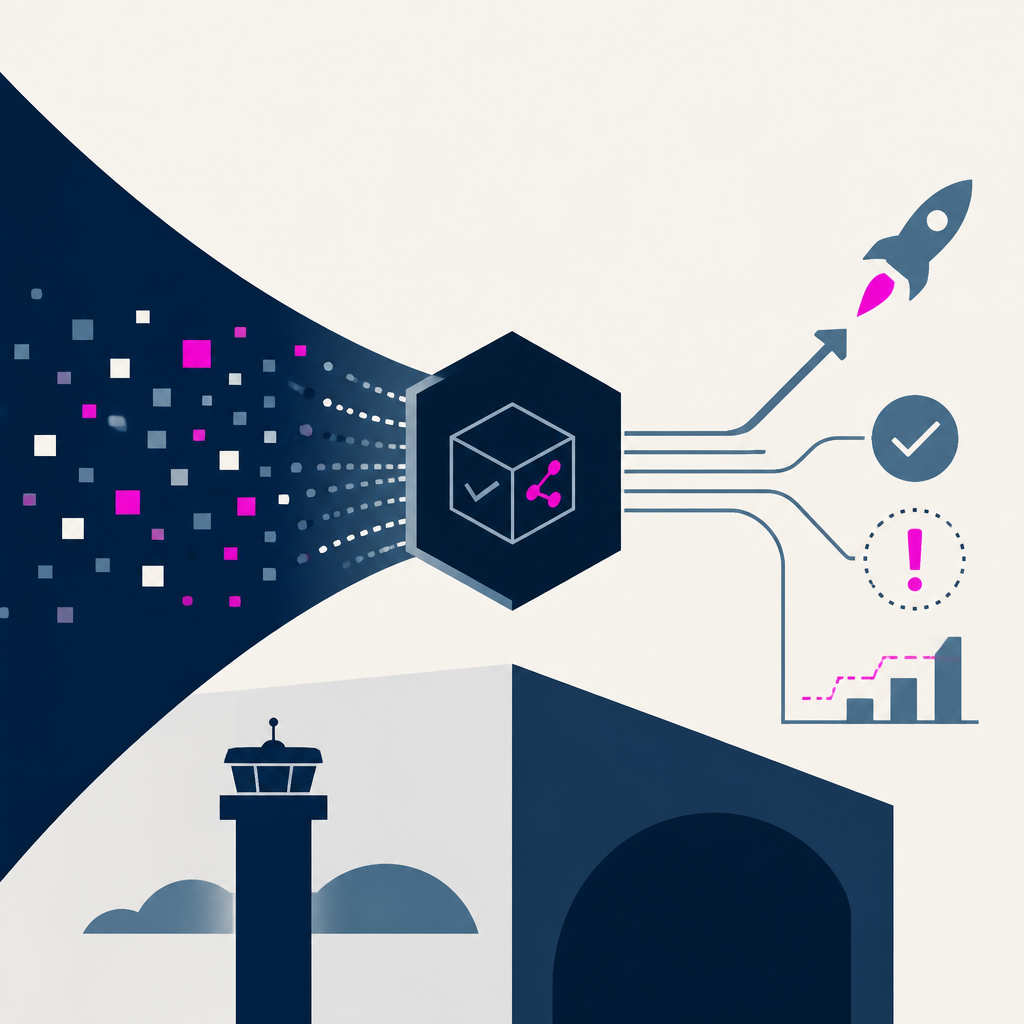
HarnessDev tested whether LLMs can write and iteratively improve the agent “harness” (the runnable code with tools and execution loop) rather than just produce answers. Only 34 out of 64 harness changes moved held-out scores in the same direction as feedback, with execution gains described as small and noisy. The work concludes harness quality is executor-specific and that much generated state/memory code often never runs, so generalization across executors and revisions is limited.
Checkly rewrote a Node.js JavaScript service in Go using Claude Code, with a black-box test harness that compared outputs against production data for a service handling 92 million daily messages. The rollout reported zero incidents and surfaced a production-vs-test queue mismatch due to incomplete dependency modeling. As a result, Checkly improved how dependencies are represented in testing to keep behavior aligned after the language switch.
OpenAI’s GPT-6 is presented as adding “Computer Use” as its next capability for AI agents. GPT-6 is tied to computer use that builds on an earlier shift during October 2025 to February 2026 when OpenAI “missed” a more unhobbling style of tools. As a result, the article argues agents can handle tasks that require using real computers, shrinking the need for gap-fillers and speeding workflows like software development and personal assistance that lack APIs.
Oracle argued during its Q1 FY 2027 earnings call that AI will enhance its packaged applications by automating and orchestrating implementation rather than replacing them with custom software. It said its next “agentic AI accelerator” would be released in October to compress SaaS deployments from years to months and months to weeks. Oracle also reported SaaS revenue up 10% and grew cloud revenue 60% year over year, while turning on 850 MW of new datacenter capacity as its AI infrastructure investment continues.
Extreme Networks launched Agent ONE Coworker to replace network troubleshooting dashboards with an AI agent that provides answers in Platform ONE. In the first eight days, it recorded about a 900% increase in interactions. The release uses a context layer, “nudge” notifications, and honesty guardrails to cut resolution time from hours to minutes while preparing the later, more autonomous Operator mode.
Every AI story that matters,
in your inbox by 8am.
TLDRocket reads all relevant sources, removes duplicate coverage, and summarises the
day in two minutes. Follow companies and topics for alerts, or get the
briefing in Slack. Free, no spam, unsubscribe anytime.
Reading TLDRocket needs no cookies, and the readership counts we rely on come from
our own cookieless analytics. Google Analytics is the exception: it sets cookies and
reports to Google, so it stays switched off until you allow it. You can change your
mind any time from “Cookie settings” in the footer.
Strictly necessary
Session security and form protection (tldrocket-session,
XSRF-TOKEN, 2 hours). The site cannot work without them,
so they need no consent.
Always on
Google Analytics 4 (_ga,
_ga_<id>, up to 2 years). Measures which
stories and sections readers use. Google acts as a third-party processor and may
store the data outside the EU. No advertising, no profiling, no data sold.