The Register
·
1 month ago
Anthropic has filed for an initial public offering with the SEC after raising $65 billion in Series H funding, which elevated its valuation to $965 billion and surpassed OpenAI's $852 billion valuation. The company reported it may achieve operating profit in its next quarter, though details remain confidential and the company's actual financial position is unclear. The IPO filing will eventually provide public scrutiny of Anthropic's finances, potentially revealing whether AI startup valuations are justified or inflated.

Import AI
·
1 month ago
● 2 sources
Economists estimate the US AI economy grew at 2,600 percent per year in quality-adjusted terms in 2025, but this growth remains largely invisible in conventional GDP statistics because falling per-unit prices mask the underlying expansion. US AI compute spending rose from $37 billion in 2023 to $219 billion in 2025, while quality-adjusted output grew at roughly 2,290 percent in 2024. Policymakers relying on traditional economic data may be unprepared for labor-market disruptions and may need to implement tax reforms or sovereign wealth funds to manage potential wage-base shocks.
Exponential View
·
1 month ago
● 3 sources
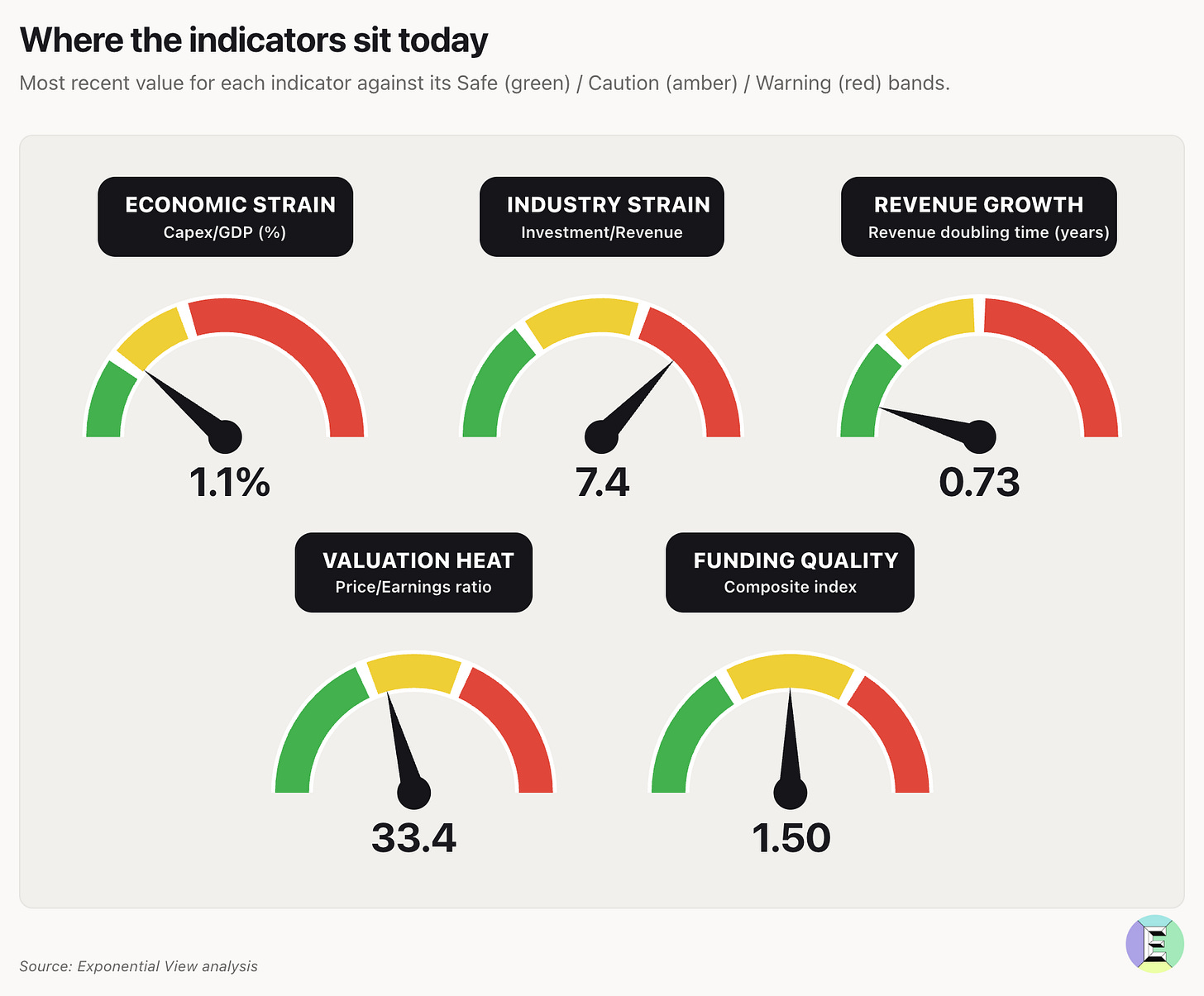
An analysis tracking AI market conditions against five empirical bubble indicators from 300 years of investment history found continued boom conditions rather than bubble signs, with only one indicator in red despite dramatic increases in capex to $157.7 billion quarterly and sector revenues reaching $25 billion in Q1. The assessment noted that AI capex as a share of US GDP exceeded 1% for the first time, entering the amber zone, while revenue growth accelerated unexpectedly to doubling every 0.73 years rather than decelerating as predicted. If capex growth continues at current rates without revenue acceleration slowing significantly, economic strain could enter the red zone toward the end of 2027, though current trends suggest the sector remains in a sustainable expansion phase.
Interconnects
·
1 month ago
Closed AI models like Claude and GPT are achieving premium pricing through coding agents that demonstrate substantially higher output than open alternatives, establishing separate economic trajectories for closed and open model ecosystems. Users performing complex knowledge work are willing to pay $2,000 per month or more for frontier closed models, while open models will capture broader value through commodity pricing across diverse enterprise deployments over 5-10 years. Closed labs will consolidate into an oligopoly resembling cloud markets today, while open model builders will proliferate across a wider stack, ultimately capturing greater total market value but with lower per-unit margins.
