Palantir CEO Alex Karp said a top executive told him to stop hyping Foundry because it sounded out of touch to employees. He pointed to Q2 U.S. commercial revenue growth of 149% year over year to $764 million. As a result, Foundry became central to Palantir’s fastest-growing business and Karp’s messaging shifted away from constant hype while AI-driven execution and competitive advantage remained a focus.
iwant launched a one-command system for hosting AI models (including DeepSeek and others) on GPUs it provisions by scanning GCP regions and setting up vLLM plus an OpenAI-compatible endpoint. It focuses on getting an endpoint, an API key, and SSH access included in the single launch flow. As a result, developers can deploy self-hosted model services quickly instead of manually finding GPUs, provisioning instances, downloading models, and configuring vLLM.
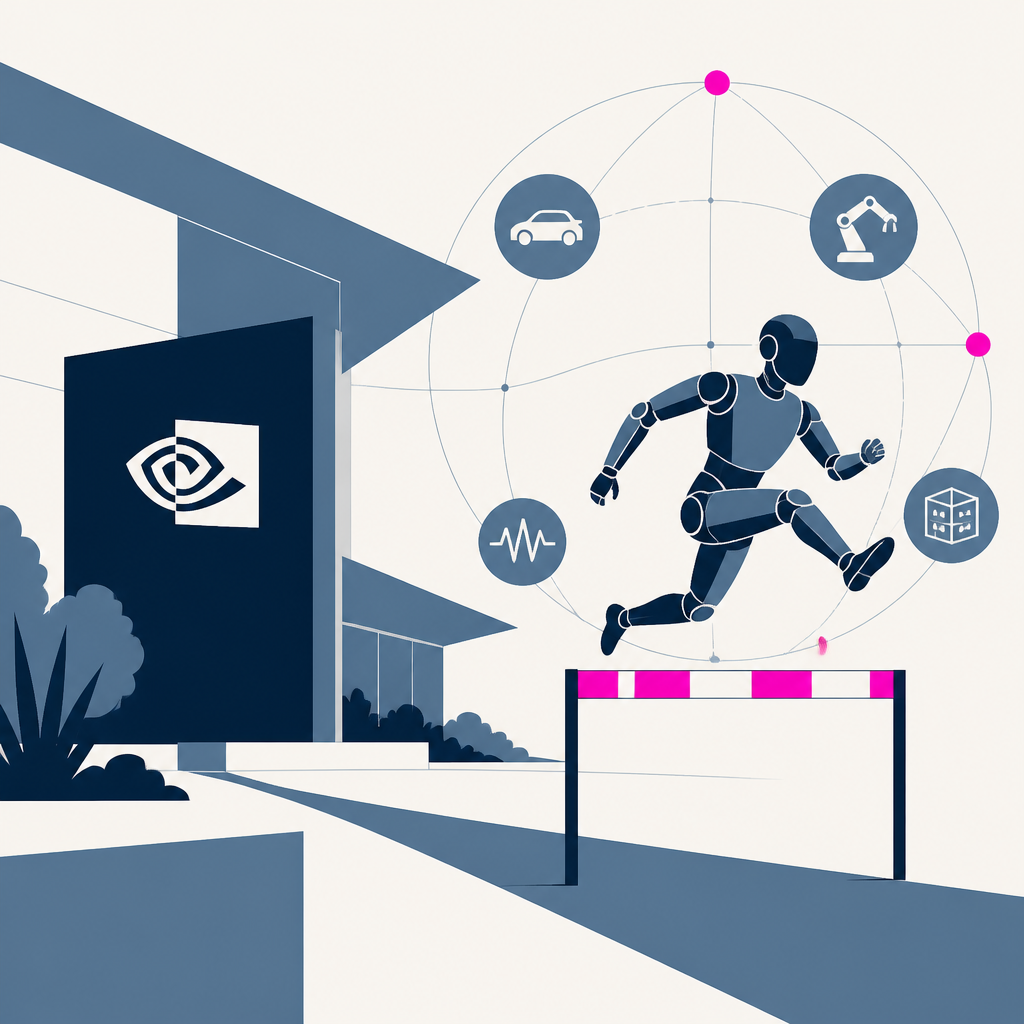
NVIDIA developers used frontier AI agents with NVIDIA Omniverse libraries to turn simulation concepts into interactive applications for robotics, autonomous driving, digital twins, and 3D/telemetry viewers. In one Robo Olympics experiment, the simulated Unitree G1 humanoid cleared a single hurdle in 64 of 100 simulation trials. The workflow shifts from manual scene setup to agent-directed asset connections, staged integration checks, and iterative simulation validation that improves designs based on measured results.
Manus, an AI agent developer, raised more than $500 million, led by Boyu Capital with support from Tencent and others. The round reportedly values the company at $4 billion, about double Meta’s prior offer in December 2023. Manus is also rolling out Manus 2.0, which adds a new harness that reduces token use by 23.2% on some tasks and speeds processing by more than 28%, alongside new tools such as Cloud Computer and Cue.
Anthropic launched the Anthropic Cyber Mission, offering tools, research, and engineering support to help defenders secure critical infrastructure systems and open-source software. It will provide open-source projects periodic security scans through OSS Scanner for free, with the company expecting a true-positive rate above 90%. As a result, defenders and maintainers gain faster vulnerability reports and better access to frontier Claude models, while Anthropic expands its cyber support beyond the earlier Project Glasswing work.
CoreWeave announced CoreWeave Forge to connect training, inference, and evaluation in an open, full-stack AI cloud. The platform is tied to its newly announced development platform and CoreWeave recently earned SemiAnalysis’ Platinum ClusterMAX rating for a third consecutive time. As a result, production learnings can feed back into improving models and agents, and customers can start with specific inference use cases on the same platform.
The U.S. Federal Reserve’s latest policy meeting minutes said the A.I. infrastructure buildout is contributing to stubborn inflation alongside tariffs and energy costs. Inflation was 3.8% in August on the Fed’s preferred PCE measure and core inflation was 3.4%, with an A.I.-related rise in technology consumer-goods prices cited. The Fed’s outlook supports another rate increase by year-end, potentially keeping inflation-fighting policy in place as A.I. investment continues to raise demand and prices.
Amazon Bedrock AgentCore added managed pay-per-inference payments so AI agents can pay BlockRun for model inference during runtime without manual approval. Incarna integrated the full AgentCore payments flow in 3 days and, during the beta, agents processed over 1,000 payments at $0.001 to $0.05 per call that settled individually on-chain. As a result, pay-per-inference runs in production with per-request spending controls enforced by infrastructure, and transaction settlement becomes auditable via verifiable on-chain records.
Anthropic launched OSS Scanner, a free opt-in service that runs periodic security vulnerability scans on open-source projects using its AI models. The service is offered at no cost. Its reports are fully model-generated without human review or triage, so scanning may happen faster but with a higher chance of incorrect or invalid results.
GitHub Copilot is adding automatic routing so coding tasks can run on local inference or be sent to cloud models. Microsoft says the rollout is expected by the end of October. Developers still won’t be able to confirm how much repository context or conversation history is sent to the cloud, and local inference won’t guarantee a fully offline session unless tool access is locked down.
Liquid AI builds personal AI systems intended to run on users’ devices using device-level context rather than elastic cloud capacity. Its Liquid Context is optimized for Snapdragon processors. The company adds agent software and observability loops so onboard agents can retain, compress, and continuously improve their context and models over time, including in Mercedes-Benz cars.
Developers preparing Postgres-based time-series systems for AI agent workloads are running into scaling limits, including slower queries, more frequent maintenance, and rising database activity. The webinar is scheduled for October 21 and will show a live demo of extending Postgres with TimescaleDB. The change is adding TimescaleDB to address Postgres pain points as data volume and velocity increase, instead of replacing Postgres.
Amazon SageMaker HyperPod is presented with a reference multi-tenant design so multiple internal teams can share one GPU cluster while keeping workload isolation, fair scheduling, and per-team cost visibility. The example architecture shows two teams sharing a single HyperPod EKS cluster using separate Kubernetes namespaces plus per-team identity and governance controls. This shifts operations from unmanaged, cross-team usage to a setup where access is tied to IAM Identity Center groups and namespaces, and spend can be attributed per team via namespace-level cost allocation.
Goodfire launched “inside-out” monitors that detect misuse by reading internal signals inside an AI model instead of having a separate model reread the agent’s output. In tests on Kimi K3, monitoring about 1,500 sessions cost roughly $51 versus $233 for a cheaper step-by-step checker and about $10,000 for a top-tier one. This lowers monitoring cost and overhead, enabling Baseten customers to choose which risks to watch and whether to log, escalate to human review, or refuse requests.
Willow Care Inc. chose CoreWeave for forward-deployed support to handle reinforcement-learning infrastructure for its AI dictation app Willow Voice. It will have “no keyboard” in about two years, by having users’ speech directly understood by their computer. As a result, Willow shifts its focus to eval alignment while scaling training and increasing inference work as dictation demand rises.
Ambrosia Energy CEO Ben Longmier and Bloom Energy SVP Bill Thayer discussed how AI scaling is constrained by physical infrastructure on the Smart Systems Stage at TechCrunch Disrupt 2026. The session is scheduled for October 13 at 8 a.m. PT. The talk shifts attention from AI models and chips to opportunities in power, grids, data centers, cooling, and related infrastructure markets.
AI development is forcing hyperscale data centers to redesign data lakes because AI training and inference require continuous, concurrent, high-throughput access rather than batch-style retrieval. The article points to recent demonstrations of 256TB NVMe drives built for AI workloads. As a result, storage architectures and cloud storage tiers shift toward higher-performance all-flash offerings and higher-capacity QLC NAND systems, with SSD designs focusing on reducing unnecessary data movement to manage endurance and efficiency.
SpaceXAI announced it is joining the Omacom Foundation as a Founding Corporate Patron and backing the Omarchy Linux distro. It donated $1.5 million in Grok tokens, which Hansson says will be used mainly to speed development, review code, and patch bugs. The Omarchy project gains new funding and compute support from SpaceXAI as a formal partner.
env zero says autonomous AI agents stall because they lack cross-domain cloud infrastructure context, leading to shadow infrastructure and failed operations. It claims an example failure mode where an agent completes 90 API queries, fails on the 91st, and restarts the sequence, compounding the “API tax.” The company’s fix is a shared context layer plus an “EZ Control” autonomous control loop that correlates declared intent with discovered state, remediates under policy, and verifies resolution, targeting general availability by the end of December 2026.
Google Cloud introduced Gemini agent, a unified assistant that can act autonomously across web, mobile, desktop, and tools like the command line, Workspace, Microsoft 365, and Slack. It adds persistent execution with memories shared across channels and can run on different models, including Gemini Flash and “Argon” for long-horizon work, with spend caps that pause agents when triggered. This shifts enterprise AI use toward always-on, multi-tool delegated work that persists and can enforce token-based cost limits per project.
The article shows that storing streamed AI output as tokens (or not storing anything) can make late joiners like refreshed browsers or agent handoffs see nothing, fragments, or restarted responses. Flushing every 20 tokens reduces writes by a factor of 20 but makes an agent console read up to 20 tokens (about 200ms at 100 tokens per second) behind what the customer sees. Message appends store the full response as one growing message so late joiners get the response so far and a live tail without per-token database writes, but using that requires message-append infrastructure rather than simple token streaming.
An article explains how a minimal OpenAI-compatible agent API can silently break context when scaled across replicas without moving conversation state out of the process. In a POC benchmark with 200 conversations of four turns each, deploying the monolithic endpoint on 3 machines produced a 75.0% loss rate. It recommends redesigning the API around stateless conversation storage and bulkheads, splitting chat and tool execution into separate services and using a shared database substrate to keep context consistent across replicas.
The Wall Street Journal·6 days ago·
36
● 3 sources
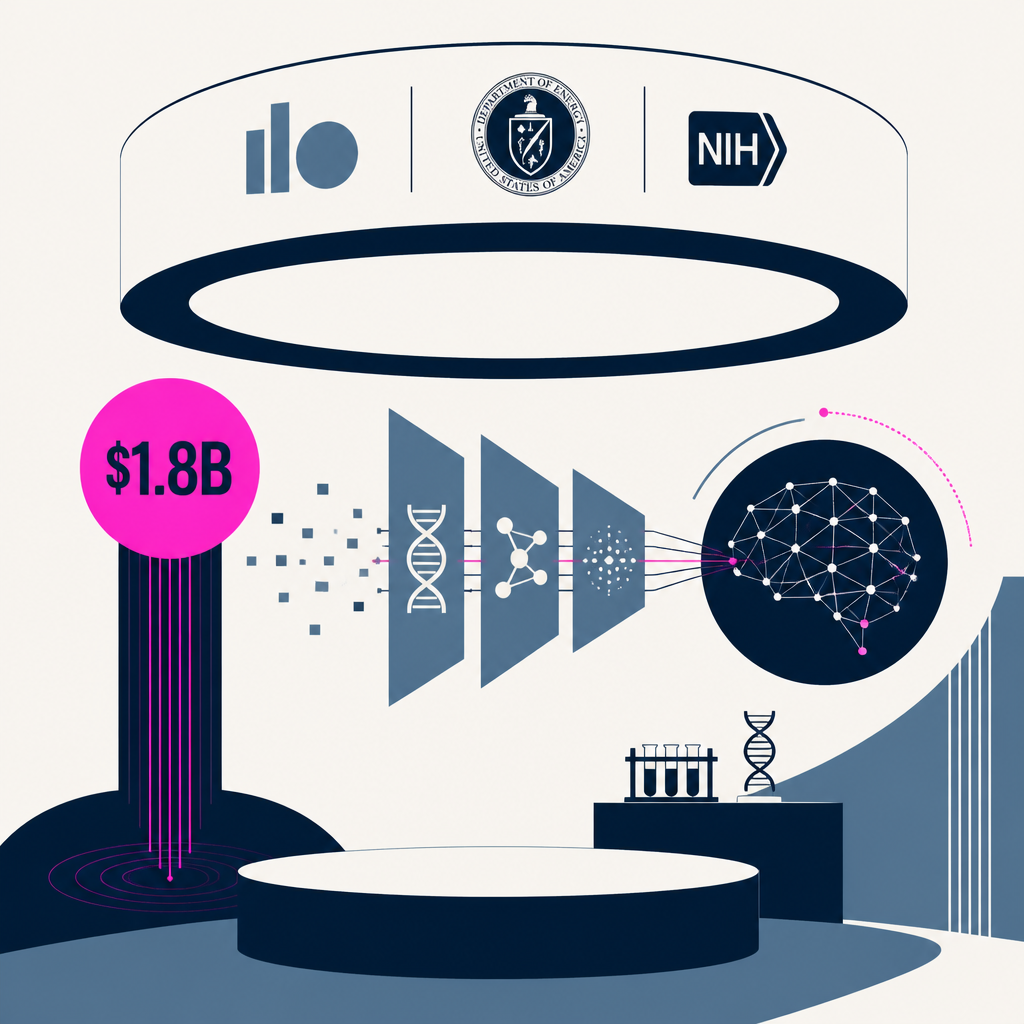
Biohub partnered with the US Department of Energy and the National Institutes of Health to invest in biological data intended for AI models. The effort involves $1.8 billion in funding. It will expand lab measurement, modeling, and computation alongside coordinated datasets and repositories to make the data usable for disease research.
Microsoft opened Surface Laptop Ultra preorders and confirmed the device will ship on October 16 at a starting price of $2,599. The entry-level model starts at $2,599. The listings specify availability and pricing for the 15-inch mini-LED laptop, including its breakaway USB-C port and the option for high-end configurations aimed at intensive AI developer workloads.
The UK and Germany launched an industrial tech corridor aimed at connecting companies and accelerating adoption of cutting-edge technologies, including AI, between the two countries. Germany-based MicroAGI will expand into London with plans to create 180 new, high-paid jobs. The corridor and related funding will drive more cross-border partnerships and research, including a €20 million quantum effort and additional local company expansions in the UK.
Architect Financial Technologies launched Liquid Inference, a router that runs a per-request live auction for LLM inference across providers bidding to serve a named model. The maximum price is locked before the first token is generated. Buyers can swap to an OpenAI/Anthropic-compatible base URL to use marketplace-style pricing with rule-based controls, while providers bid quotes and get payouts through Stripe for metered usage.
Unsloth Studio adds automated, load-time security rechecks for local AI model repositories because a Hugging Face repo that copied OpenAI’s Privacy Filter model card included malicious code that ran on Windows. One highlighted example says the repo reached #1 trending with about 244,000 downloads, figures HiddenLayer says were likely inflated. As a result, Studio blocks or re-prompts when code fingerprints change, separately gates unsafe serialized weight files, enforces package-content scanning, and verifies OS sandbox isolation before executing remote model tools.
Microsoft used its first live event in two years to announce the Surface Laptop Ultra, plus a set of Windows 11 changes focused on local AI and agentic workflows for developers and home users. The Surface Laptop Ultra starts at $2,599, shipping on October 16 with up to 128GB of LPDDR5x unified memory and either a 5,120-core or 6,144-core Blackwell GPU. Users will get new Surface AI-friendly hardware and Windows 11 updates intended to better support running and deploying local AI and agent-style tasks on-device.
Every AI story that matters,
in your inbox by 8am.
TLDRocket reads all relevant sources, removes duplicate coverage, and summarises the
day in two minutes. Follow companies and topics for alerts, or get the
briefing in Slack. Free, no spam, unsubscribe anytime.
Reading TLDRocket needs no cookies, and the readership counts we rely on come from
our own cookieless analytics. Google Analytics is the exception: it sets cookies and
reports to Google, so it stays switched off until you allow it. You can change your
mind any time from “Cookie settings” in the footer.
Strictly necessary
Session security and form protection (tldrocket-session,
XSRF-TOKEN, 2 hours). The site cannot work without them,
so they need no consent.
Always on
Google Analytics 4 (_ga,
_ga_<id>, up to 2 years). Measures which
stories and sections readers use. Google acts as a third-party processor and may
store the data outside the EU. No advertising, no profiling, no data sold.