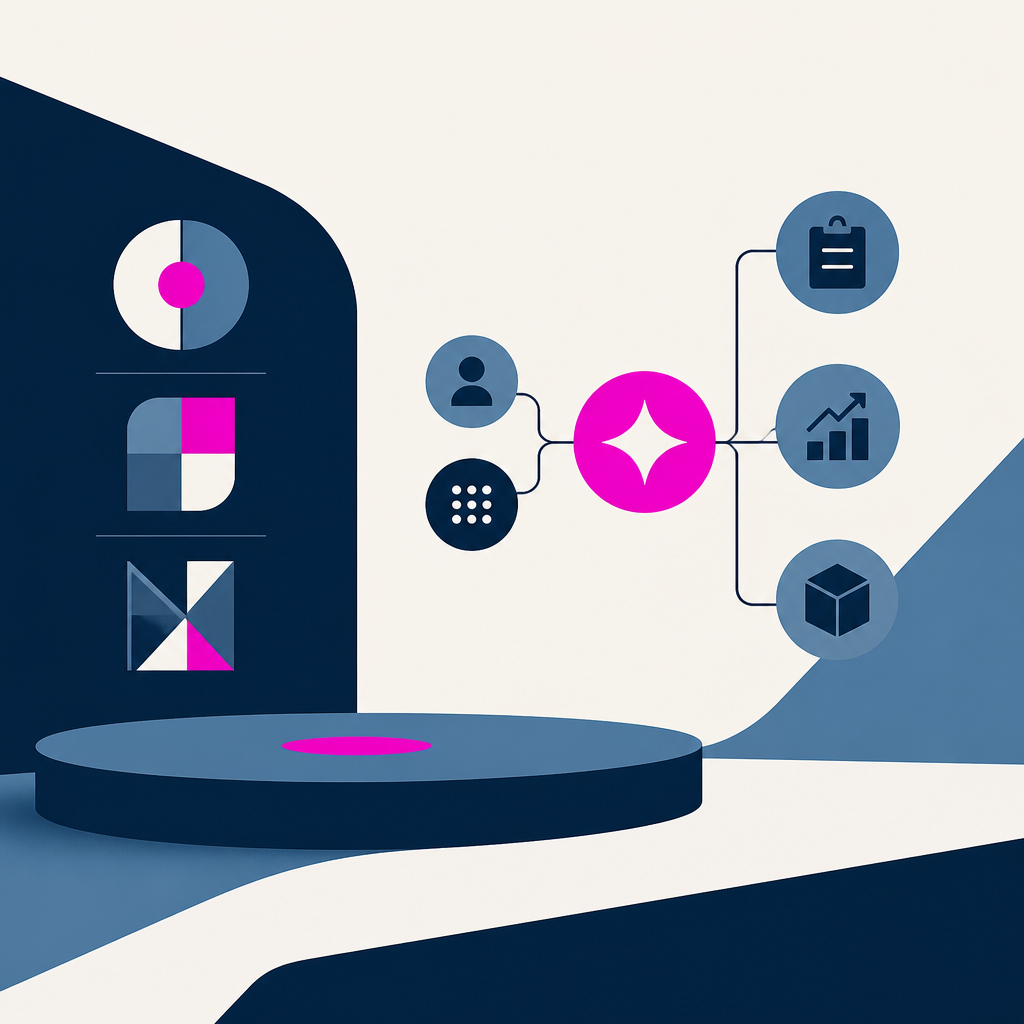
Doop launched today as an infinite multiplayer canvas where AI agents design alongside you. It is available today. It shifts collaboration to a live AI-streamed shared board where you can bring your own AI subscriptions, with no platform tokens or markup, and the project is open source.
Perplexity launched Hybrid Compute, letting its AI agents shift parts of a single task between cloud models and smaller models running on a user's Mac for privacy-aware processing. The local requirement is at least 32GB of unified memory on Apple silicon with macOS 15. Local execution means users can keep selected sensitive steps on-device and avoid token charges for locally generated output, while retaining overall task continuity without restarting.
Basis, Clay, and Exa Labs use AI agents to improve onboarding, account management, and developer integrations. The piece profiles three companies: Basis, Clay, and Exa Labs. It changes what enterprise leaders focus on by turning workflow improvements into operating capability patterns to copy.
AIR, an AI security startup, has come out of stealth and raised funding to monitor and control the skills, plugins, and add-ons AI agents use inside companies. It raised $50 million across two seed rounds, including $10 million in the first and $40 million in the second. The product will discover agents running in enterprise environments, continuously vet their components, block risky tool interactions, and expand its customer and hiring plans.
Boomi introduced Boomi Scribe, an AI agent on AWS that automatically generates and keeps up-to-date documentation for Boomi integration workflow processes as they change. It uses Amazon Bedrock with Claude Haiku 4.5 and can compare DAG versions to highlight component differences, with one example workflow shown at Version 3. As a result, developers get live documentation plus change insights stored in Amazon S3, reducing manual documentation work and helping maintain audit-ready coverage.
Fambot introduced an AI chief of staff aimed at helping families manage children’s activities and school-related logistics across email, calendar, and WhatsApp groups. The service is free in beta testing on iOS, Android, and the web and reached over 1,000 families during testing. It will deliver a daily checklist and calendar look-ahead, using multiple AI models without training on users’ data, and is planned to expand by integrating with more child-communication apps.
Relaticle launched an open-source, approval-gated AI CRM that lets an MCP client use OAuth to access first-party tools and have workspace custom fields mapped into each agent’s schema. It offers 37 first-party tools. Writes happen as record-by-record proposals that must be approved, with everything available for self-hosting under AGPL (including local inference with Ollama) and free self-hosting plus flat per-workspace cloud pricing.
Kimi (Moonshot AI) built an agent-driven app that not only provisions a full stack and deploys it quickly, but also persists to maintain it over time.
Kimi provisions a database in about 1 second using a warm pool of pre-initialized resources.
The main change is that agent-scale products must redesign infrastructure around separating durable state from ephemeral compute to avoid “idle cost trap” losses in both tenant databases and the agent’s own workspace state.
CBTS Technology Solutions launched Forge Agents, a platform that converts plain-language job descriptions into working AI agents with enterprise security controls. The platform is built from a library of 187 prebuilt artifacts and 34 cross-industry blueprints to get agents into production in days. It targets midmarket buyers by offering usage-based pricing and options to run agents on clients’ existing cloud or on-prem systems with governance and audit trails included.
A group of 100 firms, including Google, Microsoft, Anthropic, and OpenAI, signed an open letter urging governments and organisations to strengthen cyber defences before AI systems become more capable. The letter warns that current cybersecurity measures are no longer sufficient as AI threats accelerate, citing incidents including a successful Hugging Face cyber-attack carried out by OpenAI AI agents during testing. The call-to-action adds pressure for more investment and coordinated work to provide defensive AI tools, testing, funding, and specialist support for under-resourced groups.
Endorsed said it found North Korean fraud patterns showing up in remote IT job applications as its AI identity-checking system flags impostor-like submissions for human review. The share of flagged applications for remote IT roles rose from 11% in Q3 2024 to 44% a year later, with Endorsed estimating 47% in the most recent quarter. As a result, screening is shifting from relying on single biographical details to combining device, network, document, and behavior signals, while venture funding for cybersecurity security startups has slowed.
Humalike launched its 3rd offering for Humalike x GTA RP, a roleplay experience with AI NPCs. It is launching today and lets NPCs recognize players and maintain memory, personality, and voice. The experience adds the ability to build AI societies with ongoing relationships that react to what happens around them.
49agents IDE launched, presenting a 2D canvas that places each agent, terminal, repo, and machine on a single map. It launched today. It changes tab navigation by using a citybuilder-style layout meant to reduce tab-switching fatigue and keep processes easy to revisit later.
Porte launched as an open-source phone remote control for Grok Build. It is described as pairing a phone with your machine to read live transcripts and send prompts and files. As a result, users can run command-line slash commands, stop turns, and handle permission requests from their phone while using Grok Build.
Reflexio launched today to help AI agents improve from user feedback and outcomes by turning corrections and successes into reusable behavior. It says it can reduce task failure rate by more than 30% and save tokens by more than 60%. As a result, agents can learn continuously with lessons made visible, testable, and reversible instead of staying buried in logs.
Empirik emerged from stealth to build an Autonomous Infrastructure Engineer that uses change context instead of symptom-only observability. It raised $21M in funding. The product shifts enterprise infrastructure from reactive troubleshooting to proactive planning and risk checks for changes before they are deployed.
Every AI story that matters,
in your inbox by 8am.
TLDRocket reads all relevant sources, removes duplicate coverage, and summarises the
day in two minutes. Follow companies and topics for alerts, or get the
briefing in Slack. Free, no spam, unsubscribe anytime.
Reading TLDRocket needs no cookies, and the readership counts we rely on come from
our own cookieless analytics. Google Analytics is the exception: it sets cookies and
reports to Google, so it stays switched off until you allow it. You can change your
mind any time from “Cookie settings” in the footer.
Strictly necessary
Session security and form protection (tldrocket-session,
XSRF-TOKEN, 2 hours). The site cannot work without them,
so they need no consent.
Always on
Google Analytics 4 (_ga,
_ga_<id>, up to 2 years). Measures which
stories and sections readers use. Google acts as a third-party processor and may
store the data outside the EU. No advertising, no profiling, no data sold.