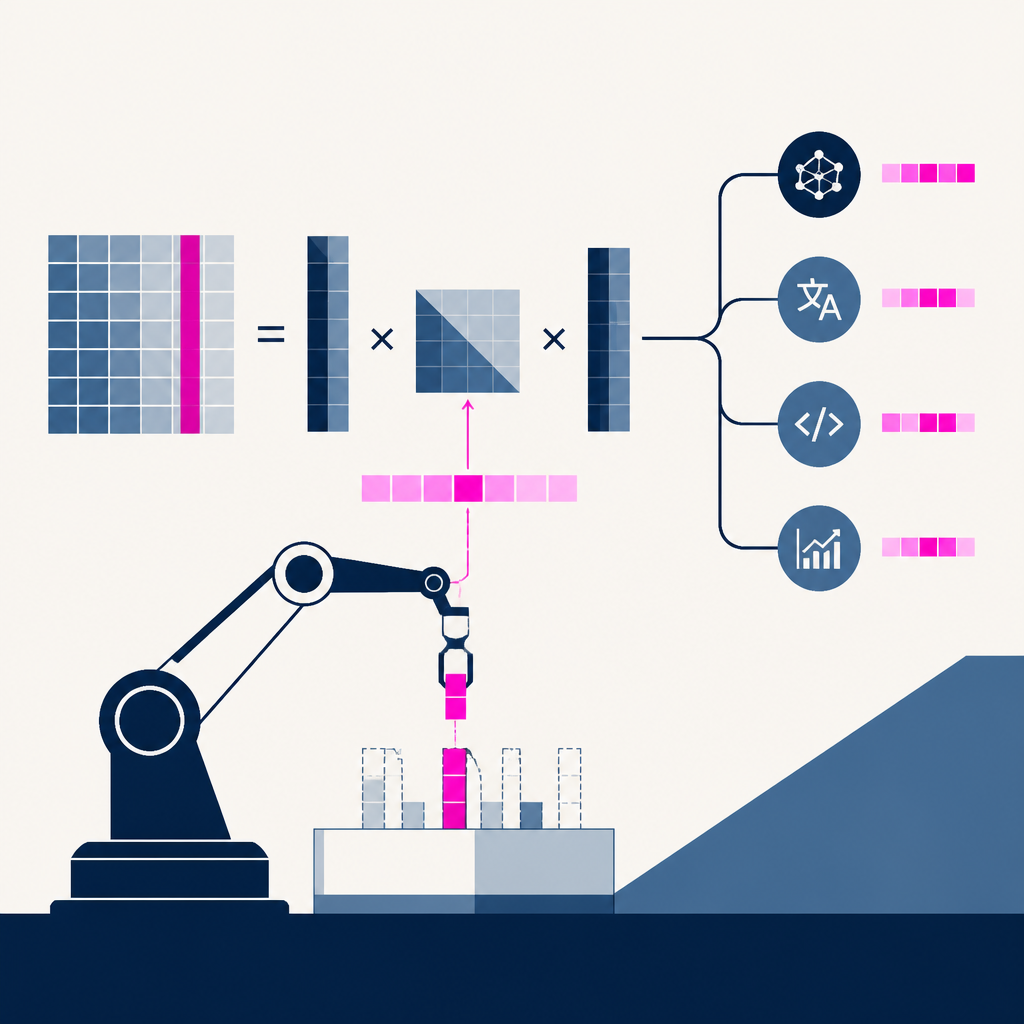
Researchers introduced Transformer², a machine learning system that dynamically adjusts its weights for different tasks using Singular Value Decomposition and reinforcement learning. The method learns task-specific z-vectors that modulate weight matrix components, requiring far fewer parameters than LoRA while achieving comparable or better performance on math, coding, reasoning, and visual tasks. This approach enables LLMs to adapt to new tasks at inference time without retraining, and z-vectors learned on one model can partially transfer to another model.
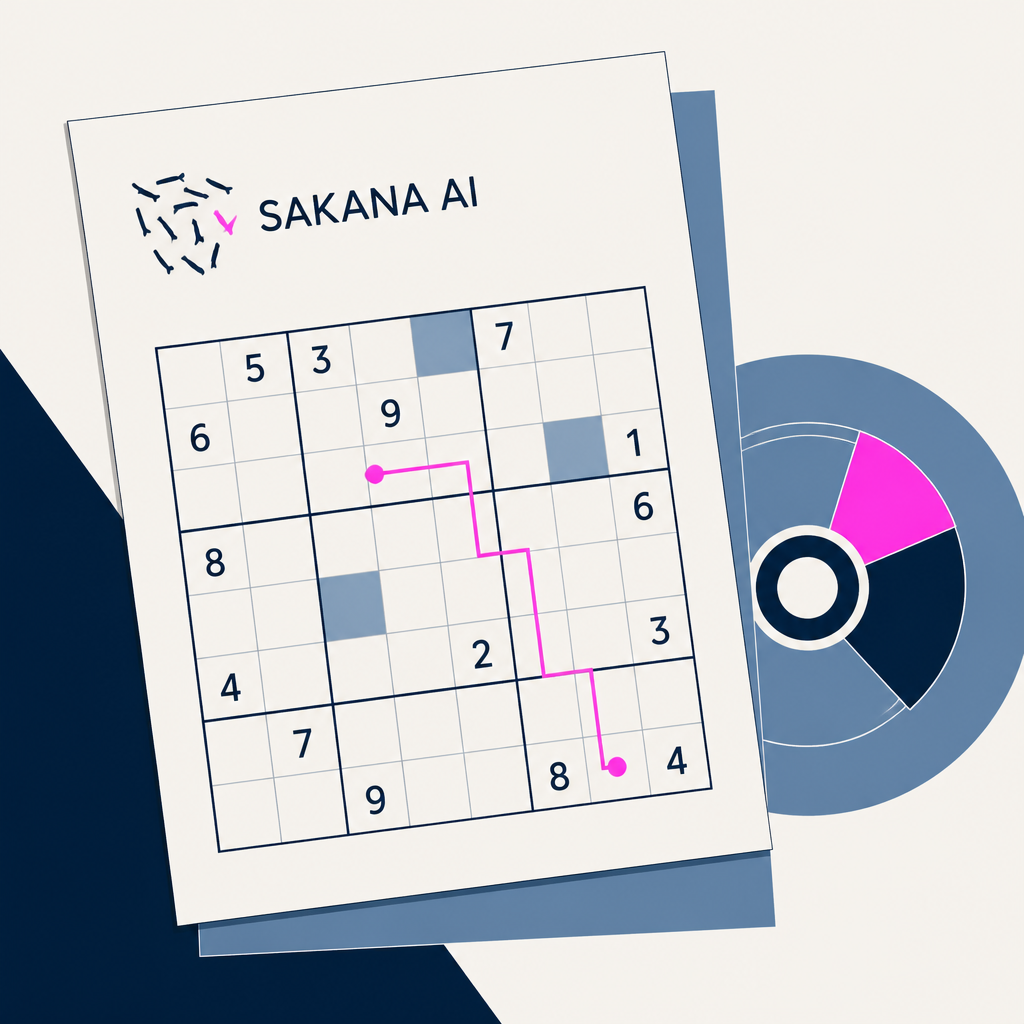
Sakana AI released a reasoning benchmark based on Sudoku puzzles to test and improve AI models' logical reasoning capabilities. The benchmark includes thousands of curated traditional and modern Sudoku puzzles, with data extracted from thousands of hours of reasoning explanations from YouTube channel Cracking The Cryptic, where world-championship-level solvers narrate their step-by-step solving process. Current state-of-the-art models struggle significantly, with only OpenAI's o3 achieving a 5% success rate on the easiest puzzles, highlighting the gap between human-like reasoning and contemporary AI approaches.
Kimi K3, a Chinese AI model, delivers comparable code quality to Claude at three-to-five times lower API costs and more generous subscription tiers, while also operating without US restrictions that hobble Anthropic's offerings. K3's API pricing is $3 per million input tokens and $15 per million output, compared to Claude's $10 and $50, with Kimi's $39 monthly tier significantly outperforming Claude's metered plans. The price and capability gap suggests US regulatory policy has backfired by constraining American customers while leaving unrestricted Chinese alternatives accessible, potentially reshaping which AI models dominate the market.
Researchers introduced Length Value Model (LenVM), a framework that predicts remaining generation length at each token step during decoding by treating it as a value estimation problem. On LIFEBench exact length matching, LenVM improved a 7B model's length score from 30.9 to 64.8, and maintained 63 percent accuracy on GSM8K with a 200-token budget compared to 6 percent for baseline methods. This enables better control over generation length-performance tradeoffs and provides interpretable signals about how individual tokens influence reasoning depth.
Researchers introduced RayRoPE, a positional encoding method for multi-view transformers that represents patch positions using predicted 3D points along camera rays rather than ray directions. The method achieves 15% relative improvement on LPIPS metrics in the CO3D dataset for novel-view synthesis compared to alternative position encoding schemes. RayRoPE enables geometry-aware attention that maintains SE(3) invariance and can incorporate RGB-D inputs, improving performance on multi-view 3D reconstruction tasks.
Every AI story that matters,
in your inbox by 8am.
TLDRocket reads all relevant sources, removes duplicate coverage, and summarises the
day in two minutes. Follow companies and topics for alerts, or get the
briefing in Slack. Free, no spam, unsubscribe anytime.
Reading TLDRocket needs no cookies, and the readership counts we rely on come from
our own cookieless analytics. Google Analytics is the exception: it sets cookies and
reports to Google, so it stays switched off until you allow it. You can change your
mind any time from “Cookie settings” in the footer.
Strictly necessary
Session security and form protection (tldrocket-session,
XSRF-TOKEN, 2 hours). The site cannot work without them,
so they need no consent.
Always on
Google Analytics 4 (_ga,
_ga_<id>, up to 2 years). Measures which
stories and sections readers use. Google acts as a third-party processor and may
store the data outside the EU. No advertising, no profiling, no data sold.