
Yuxiang Zhou hired food delivery riders to sell AI to factories. Now he’s chasing China’s industrial AI breakthrough
Fortune Nicholas Gordon
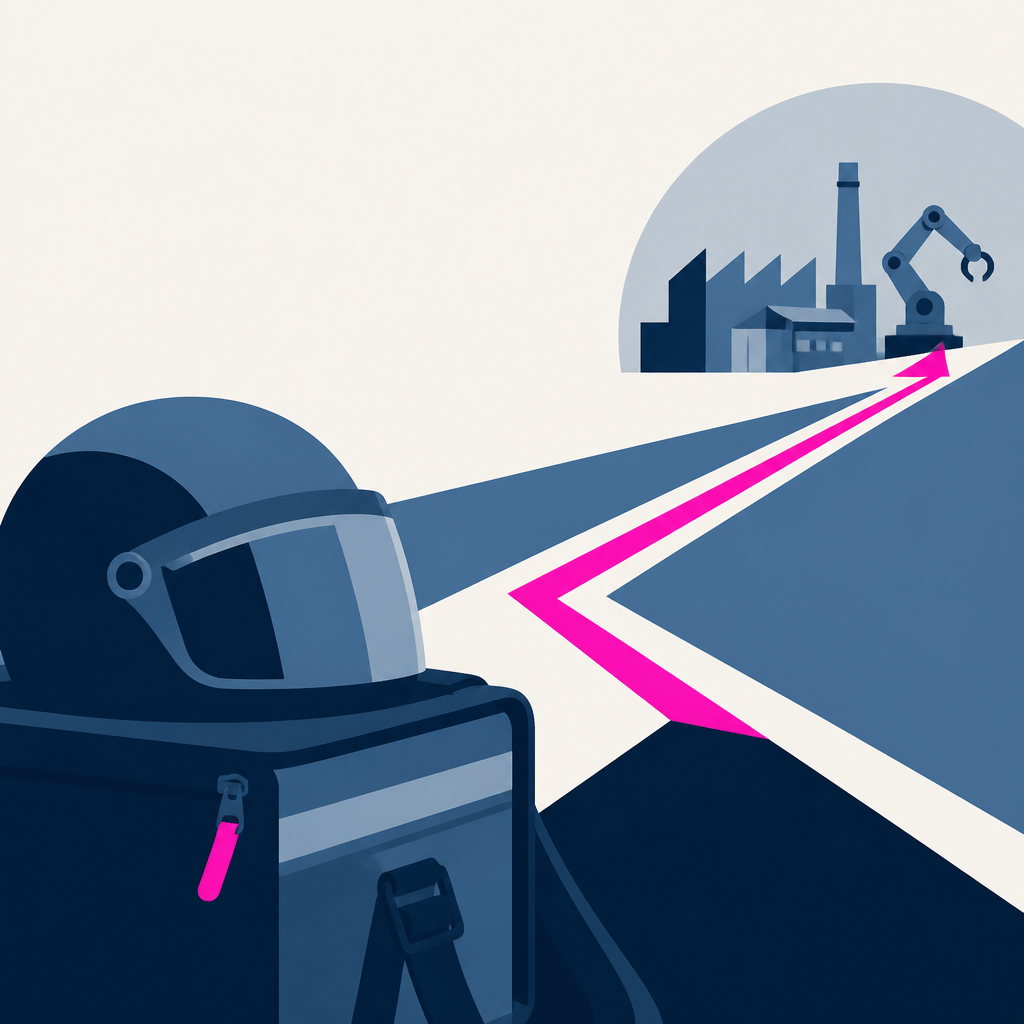
A Shanghai AI startup hired food delivery riders to sell software to factories. Its founder says AI won’t matter until it reshapes manufacturing, not just speeds it up.
Based on reporting by Fortune, Nicholas Gordon — read the original for the full story.
Summary, retelling and take written by AI under human oversight; images are AI-generated illustrations. How we work · Report an error
Yuxiang Zhou started Black Lake Technologies with what looked like a normal sales playbook: hire people from big Western software names and send them out. That worked poorly once the company moved beyond enterprise customers and into China’s smaller factories, a market Zhou says runs to about four million. The polished reps couldn’t get past guards, dogs, or the front gate. Couriers from Meituan and Ele.me could.
So Zhou changed the hiring model. Black Lake now recruits food delivery riders for sales, then puts them through a five-day “devil boot camp” with 14-hour training days, daily tests, and a phone sale by the end. Only about half make it through. It sounds improvised because it is, but it also fits the market Zhou is chasing: messy, fragmented, and still heavily run on relationships, back entrances, and practical know-how.
Black Lake’s core product is factory-management software that tracks orders, schedules, materials, and output. More recently, it has added AI agents that can read an incoming order, generate a quote, and schedule production on their own. Zhou says the company has been profitable since 2025 and that revenue has grown more than 60% a year. He thinks the real prize is not the smartphone or the office, but the shop floor.
That bet is being made in China, which may be the world’s second-most important source of AI innovation after the U.S. Open-weight models from Alibaba, DeepSeek, Z.ai, and Moonshot AI are now near the frontier at lower cost, and the country installed 354,000 industrial robots in 2025, or 59% of the world total, according to the International Federation of Robotics. But Zhou isn’t selling a hype story. He keeps coming back to the same point: AI has mostly replaced tasks so far, not rebuilt industries.
He learned that lesson the hard way. Black Lake was his second startup; the first, MadaData, was supposed to be a “Palantir for China” but failed because most factories the team visited had no data at all. That problem still matters. Zhou says China can’t simply skip the long, boring digitization phase and jump straight to AI. His newer bet, PopZao, tries to bridge the gap by turning ideas into designs, 3D simulations, and factory-ready data, then handing the work to manufacturers. A Buddhist temple used it to make a 500-unit batch of stone-lion merchandise that sold out in a week. Useful. But not yet the big industrial shift Zhou is waiting for.
My take — AI-written commentary, not fact-checked reporting
This is the part the AI crowd keeps trying to dodge: the future runs on boring factory data, not vibes. Hiring delivery riders to sell software is a neat reminder that distribution beats pedigree, and that China’s industrial AI story is still more grind than magic. The real breakthrough won’t be a model demo; it’ll be when the paperwork disappears and the factory stops needing a human to babysit every handoff.
Read more about this at: Fortune
Related stories
 Black Lake founder Yuxiang Zhou pitted an AI agent against his top sales coach. His most experienced salespeople chose the AI
Fortune ·
25
A dumpling shop becomes a poster child of AI adoption in China
Rest of World · 1 month ago ·
7
China’s AI boom is creating a different kind of entrepreneur
Rest of World · 2 months ago ·
25
Black Lake founder Yuxiang Zhou pitted an AI agent against his top sales coach. His most experienced salespeople chose the AI
Fortune ·
25
A dumpling shop becomes a poster child of AI adoption in China
Rest of World · 1 month ago ·
7
China’s AI boom is creating a different kind of entrepreneur
Rest of World · 2 months ago ·
25