
Why Scaling AI Compute Performance Requires a New Power Architecture
NVIDIA Harry Petty
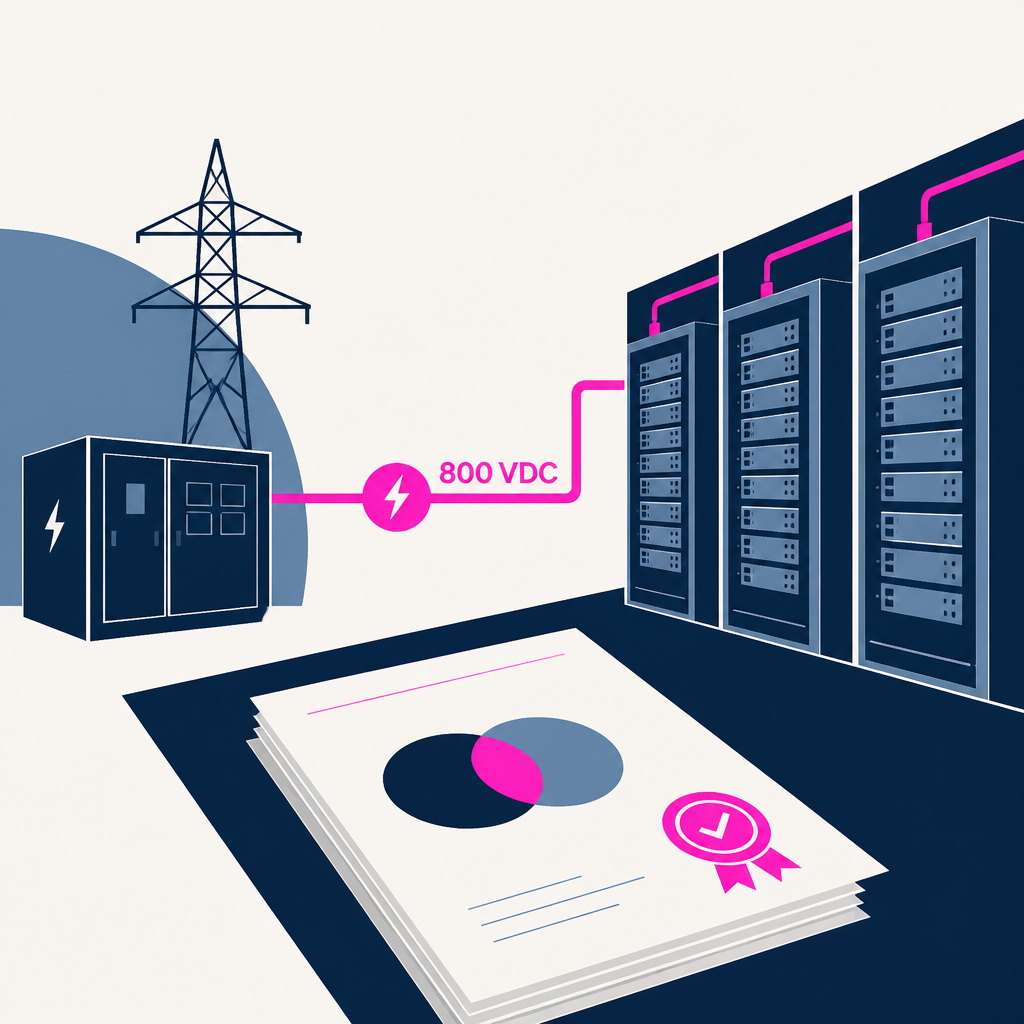
AI data centers are moving to 800 VDC power. It cuts conversion steps, and NVIDIA says existing sites can adopt it without rebuilding the building.
Based on reporting by NVIDIA, Harry Petty — read the original for the full story.
Summary, retelling and take written by AI under human oversight; images are AI-generated illustrations. How we work · Report an error
NVIDIA is pushing a new answer to a very old problem: moving power into AI hardware without wasting too much of it along the way. As racks get denser and compute demand climbs, the issue is no longer just how much electricity a site can get. It’s how much of that power actually reaches the GPUs instead of disappearing into repeated conversions and extra infrastructure.
The company’s pitch is 800 VDC, a direct-current architecture meant to simplify the path from the grid to the accelerator. Fewer conversion stages mean less overhead, and that starts to matter fast when the power levels keep rising. NVIDIA says its DSX reference designs are meant to help operators move from today’s AC setups to hybrid systems and, eventually, to native 800 VDC facilities.
This isn’t being framed as a solo move. NVIDIA, Google and Microsoft have been developing the architecture through the Open Compute Project, and they published a joint white paper in March 2026 plus the LVDC Solid-State Transformer Specification v0.3 in July 2026. More than 80 equipment manufacturers and infrastructure companies are already building products to that spec, which is the kind of detail that separates an actual platform from a slide deck.
For existing sites, the near-term piece is the NVIDIA MGX-compatible 800 VDC power rack, expected in the second half of 2026. It’s designed to fit into current AC infrastructure and deliver 800 VDC to compute racks within the row, without changes to the building’s electrical system. NVIDIA says that keeps the land, power rights and buildings already in play from being stranded while operators add more compute density.
The longer-term roadmap has two other steps. There’s a row power center for full rack rows, using an overhead 800 VDC busway and supporting up to 2 megawatts per row, with availability expected in 2027. And then there’s the DC power block, which converts grid power directly to 800 VDC in one step for new facilities being planned for the next decade. Wood Mackenzie’s projected $9 trillion in global AI and data infrastructure investment through 2040 gives the whole thing a simple logic: if the power architecture is wrong, the money won’t matter much.
My take — AI-written commentary, not fact-checked reporting
This is the rare AI infrastructure story that sounds boring and still matters a lot. Power, not hype, is what decides whether these giant builds scale or stall. Open standards help here because nobody wants a data center held together by one vendor’s wishful thinking and a pile of adapters.
Read more about this at: NVIDIA