What happens when you put AI to work deciphering lost languages?
Ars Technica Jane Adkins, The Conversation
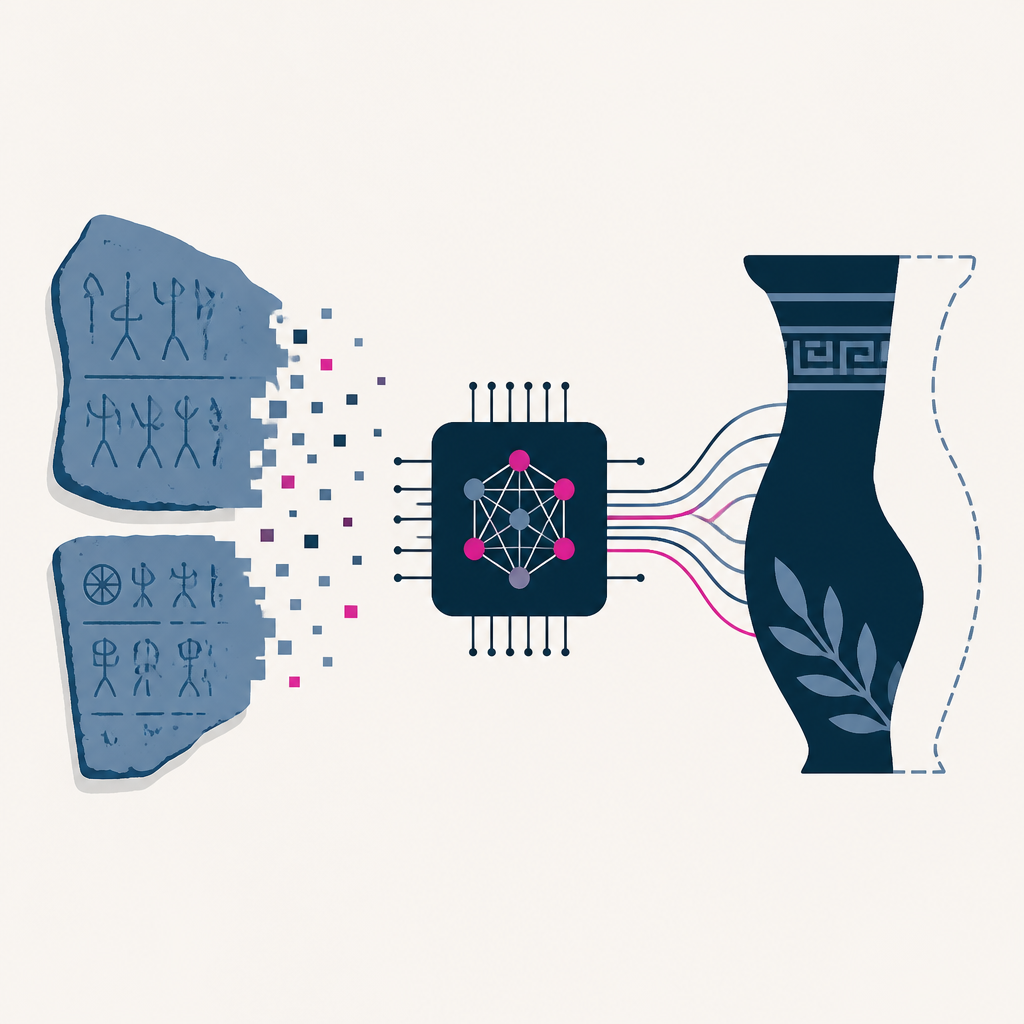
AI can spot patterns in dead languages like Linear A, but it still can't tell you what the words mean. Turns out fluency and translation aren't the same trick.
Based on reporting by Ars Technica, Jane Adkins, The Conversation — read the original for the full story.
Summary, retelling and take written by AI under human oversight; images are AI-generated illustrations. How we work · Report an error
There's a specific kind of AI hype that shows up whenever someone points a language model at an ancient script, and the reality is messier than the headlines suggest. A model trained on a lost language like Linear A or Etruscan can absolutely learn which signs tend to follow which, and which words cluster together. What it can't do is know what any of those signs actually refer to, because meaning isn't something you can infer from statistical adjacency alone.
That gap matters enormously when it comes to checking the work. For known languages, you verify a translation against native speakers, related texts, or decades of scholarly consensus. None of that exists for a language nobody has understood in millennia. There's no informant to ask, no fallback corpus to cross-check against, and short of inventing time travel, no way to confirm a guess is right rather than merely plausible.
The data problem makes it worse. Linear A's entire surviving corpus runs to roughly 7,500 characters, small enough to fit on one screen. With that little material to work from, almost any hypothesis can dig up a few matches that seem to support it. That's precisely why serious claims in this field rest on independent expert scrutiny and peer review rather than a model spitting out a confidence score. Finding a pattern and finding the correct meaning are two very different achievements, and it's easy for that distinction to get blurred in a press release.
None of this makes AI useless here — quite the opposite. As an accelerant, it can compress years of manual cross-referencing into minutes, and it opens the door to far more people attempting these puzzles than institutions with limited resources ever could. But it doesn't eliminate the two things decipherment has always needed: a genuine comparative anchor to ground the guesswork, and rigorous human review to separate a real breakthrough from an appealing coincidence.
Jane Adkins, a PhD candidate at Dublin City University's School of Computing, frames it plainly: until that anchor or that scrutiny shows up for Linear A or Etruscan, AI's role stays exactly what it is now. A very fast assistant to a very old, very human puzzle.
My take — AI-written commentary, not fact-checked reporting
Every few months someone announces an AI has 'cracked' an ancient script, and every few months it turns out the model just found a pattern, not an answer. People should treat these claims the way they'd treat a metal detector find in a field with no historical records — interesting, worth digging into, and absolutely not proof of anything until actual experts pick it apart. The tech is a genuine time-saver, not a shortcut around the hard part.
Read more about this at: Ars Technica